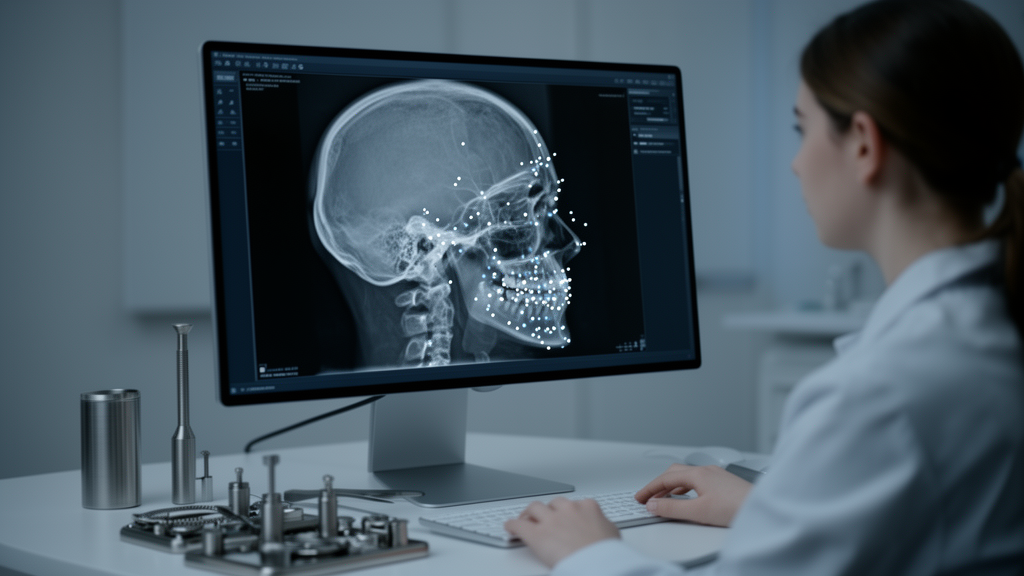
A study published in BMC Medical Imaging reports that the YOLO11-Pose algorithm achieved the lowest mean pixel error for detecting specific cephalometric landmarks in lateral radiographs of children. The research team evaluated this pose estimation approach against several conventional deep learning models to determine its utility in assessing adenoid hypertrophy. The primary finding indicates that YOLO11-Pose localized four key anatomical landmarks more accurately than direct coordinate regression methods, with a mean pixel error of 2.71 pixels. This performance was statistically significant compared to six regression-based models, which exhibited pixel errors ranging from 3.91 to 5.72 pixels.
The study focused on the accurate detection of anatomical landmarks required for calculating the adenoid-nasopharyngeal ratio, a standard metric in evaluating adenoid hypertrophy in pediatric patients. The authors noted that traditional convolutional neural network-based regression approaches treat landmark detection as a direct coordinate regression problem. Consequently, the researchers aimed to evaluate YOLO11-Pose, a state-of-the-art pose estimation algorithm, for its ability to automatically detect these cephalometric landmarks and to analyze its algorithmic advantages over existing deep learning approaches.
The methodology involved collecting 900 lateral cephalometric radiographs that were annotated with four specific landmarks: the posterior nasal spine (PNS), the adenoid point (A1), the basion (Ba), and the artion (Ar). The YOLO11-Pose model was compared against six regression-based models, including a custom CNN, ResNet18, ResNet50, DenseNet121, GoogLeNet, and VGG16. Additionally, the team included one heatmap baseline model, HRNet-W32, to provide a high-resolution comparison point. The YOLO11 architecture utilized a CSPDarknet backbone, multi-scale feature fusion through PANet, and a decoupled detection head with integrated pose estimation capabilities.
In terms of results, YOLO11-Pose demonstrated superior accuracy with a mean pixel error of 2.71 ± 1.81 pixels and a PCK@0.05 score of 99.86%. The difference in performance was statistically significant, with adjusted p-values less than 0.001 for each comparison against the regression-based models. At the strictest threshold, PCK@0.01, YOLO11-Pose reached a score of 55.56%, whereas the other models ranged from 18.06% to 31.81%. The most pronounced difference was observed at the posterior nasal spine, where the error for YOLO11-Pose was 46.4% lower than that of ResNet18, measuring 2.29 pixels compared to 4.27 pixels.
The study concluded that in this single-centre validation set, YOLO11-Pose localized the four cephalometric landmarks more accurately than direct coordinate regression. It also matched the performance of the high-resolution heatmap baseline at a small fraction of the computational cost. The accuracy of the model was found to be comparable to the inter-observer variability of the reference annotations, which ranged from 2.7 to 3.7 pixels.
However, the authors emphasized that the individual components of the YOLO11-Pose architecture were not ablated in this study. Therefore, the observed advantage is reported as an empirical property of the detection-and-pose formulation rather than as the proven effect of a single specific architectural element.
The researchers highlighted that external validation and prospective evaluation are still required before the method can be considered for routine clinical adenoid assessment.
Subject of Research: Deep learning–based cephalometric diagnosis of adenoid hypertrophy in children
Article Title: Deep learning–based cephalometric diagnosis of adenoid hypertrophy in children
Article References: Xia, M., Chen, Y., Wang, Y., Yang, Y., Zhang, Y., Chen, J., & Su, K. (2026). Deep learning–based cephalometric diagnosis of adenoid hypertrophy in children. BMC Medical Imaging. https://doi.org/10.1186/s12880-026-03005-8
Image Credits: AI Generated
DOI: 10.1186/s12880-026-03005-8
Keywords: Deep, learning, based, cephalometric, diagnosis, adenoid, hypertrophy, children
News Source: Ophelia Keating. (November 12, 2026). YOLO11-Pose Outperforms Regression Models in Pediatric Cephalometric Landmark Detection. Scienmag.