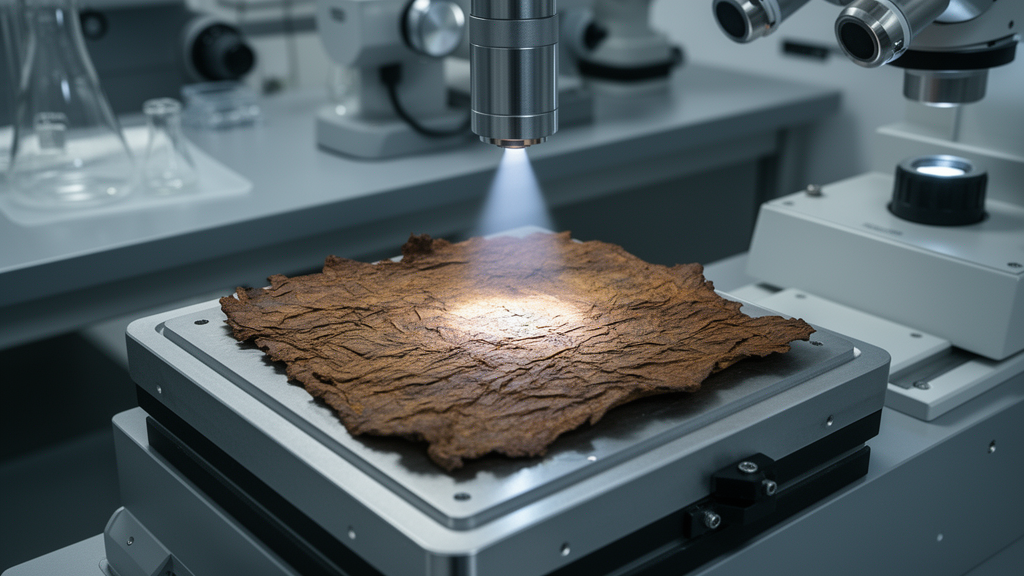
Researchers have developed a rapid, non-destructive method for identifying vegetable tanned ancient leathers using synchrotron small-angle X-ray scattering, or SAXS. Published in the journal Collagen and Leather, this study addresses a significant challenge in the conservation of cultural heritage: the difficulty of determining which tanning agents were used in the manufacture of leather artifacts. Leather is a valuable medium for investigating material culture and reconstructing human civilization, but as an organic material, it undergoes physical and chemical changes during deterioration. Accurate identification of tanning agents is essential for understanding deterioration mechanisms, assessing conservation conditions, and designing targeted preservation strategies. The new approach offers a way to analyze these delicate items without the need for destructive sampling, which is often required by traditional chemical methods.
The study, led by Yue Yu and colleagues, presents a pioneering approach based on the structural effects of tanning agents on collagen fibrils. Collagen, the primary protein in leather, possesses a periodic light-dark banded structure known as the D-period. This structure produces characteristic diffraction patterns in SAXS measurements. The research team hypothesized that different tanning agents alter these patterns in distinct ways. By analyzing the alterations in the diffraction patterns, it is possible to distinguish the structural effects of various tanning agents. This provides a basis for identifying the original tanning method used in ancient leather artifacts, which is crucial for their long-term preservation and historical interpretation.
To validate the method, the researchers prepared six simulated ancient leather samples using different tanning techniques: vegetable, oil, smoke, aluminum, iron, and mirabilite-flour. These samples were produced following restored ancient tanning processes. The composition of the tanning agents in each simulated sample was confirmed using a combination of analytical techniques, including attenuated total reflectance Fourier transform infrared spectroscopy, X-ray fluorescence, and pyrolysis–gas chromatography-mass spectrometry. This multi-technique approach ensured that the simulated leathers accurately represented the intended tanning methods, providing a reliable baseline for comparing SAXS results. The use of simulated samples allows for controlled experimentation where the ground truth of the tanning agent is known.
SAXS analysis revealed distinctive diffraction patterns for the different types of leather. Vegetable tanned leathers exhibited minimal or absent peaks due to the masking of the collagen fibril D-periodic structure by vegetable tannins. In contrast, non-vegetable tanned leathers displayed clear periodic diffraction peaks. The absence of detectable diffraction peaks was identified as a strong indicator of vegetable tanning. This phenomenon is attributed to vegetable tannins forming hydrogen bonds with collagen fibrils and creating inter-fibril crosslinks. The high relative molecular weight of tannins limits their deep penetration into the fibrillar structure, leading to a dense coating that obscures the underlying periodicity. This structural change is what makes vegetable tanned leather identifiable through SAXS.
The team applied this SAXS-based protocol to seven cultural relic samples to detect the presence of vegetable tannins. The morphological examination of these samples provided initial insights. One sample, labeled 1#, was determined not to be leather based on the absence of characteristic collagen bands in its ATR-FTIR spectra and the lack of fibrous structure. The other six samples displayed distinct fibrous structures. Among these, two samples, labeled 2# and 3#, exhibited blackened grain surfaces and heavily obscured fibrillary structures. These features suggested they might be vegetable-tanned ancient leathers, as the black coloration is likely due to the oxidation of vegetable tannins or the formation of vegetable tannin-iron complexes.
SAXS analysis of the cultural relic samples confirmed the initial morphological observations. Samples 2# and 3# exhibited no discernible periodic peaks, consistent with the masked collagen fibrillary structures observed in the scanning electron microscopy images. These results strongly suggested that they were vegetable-tanned ancient leathers. By contrast, samples 4# through 7# displayed clear periodic diffraction peaks, consistent with non-vegetable tanned ancient leathers. The SAXS results provided a rapid, non-destructive means of identifying the tanning type. However, the researchers noted that the absence of periodic peaks could also result from natural degradation of collagen fibrils or low concentrations of vegetable tannins, which imposes limitations on the standalone use of SAXS.
To verify the SAXS identifications, the researchers used complementary micro-destructive analytical techniques. Pyrolysis–gas chromatography-mass spectrometry, a high-sensitivity technique, was used to analyze the six leather relics. Characteristic phenol peaks were detected in the decomposition products of samples 2# and 3#, with guaiacol also present in sample 3#. These findings confirmed the presence of vegetable tannins, corroborating the SAXS results. For the other samples, the analysis revealed different tanning agents. Samples 4# and 5# lacked metal-tanning agents and were inferred to be untanned skin, while sample 6# showed elevated aluminum, sulfur, and potassium, indicating aluminum tawing. Sample 7# contained decomposition products of unsaturated fatty acids, consistent with oil tanning.
The study highlights the utility of SAXS as a rapid and non-destructive tool for the characterization of vegetable tanned ancient leather. Compared to leathers treated with other tanning agents, those tanned with vegetable tannins generally exhibit minimal or absent SAXS diffraction peaks. This distinct signature allows for the differentiation of vegetable tanned leather from other types. The method was validated through the analysis of both simulated ancient leathers and leather cultural relics. The results were further supported by Py-GC-MS and additional complementary analytical techniques, thereby confirming SAXS as a reliable and effective tool. This approach supports the conservation of leather cultural relics by reducing the need for destructive sampling, which is a critical consideration for valuable historical artifacts.
The findings have significant implications for the field of cultural heritage conservation. Traditional methods for identifying tanning agents often require small sample amounts and involve complex, time-consuming procedures. Chemical colorimetric techniques, for instance, are limited by low accuracy and the need for large sample quantities, making them unsuitable for non-destructive examination of valuable relics. Infrared spectroscopy, while non-destructive, often faces challenges due to the overlapping absorption bands of vegetable tannins and collagen. More precise analytical approaches, such as chromatography and mass spectrometry, can provide accurate identification but still require sample preparation. The SAXS-based strategy offers a rapid alternative that can be applied directly to the surface of the relic without causing damage.
The research also underscores the importance of combining multiple analytical techniques for a comprehensive understanding of leather artifacts. While SAXS provides a rapid, non-destructive screening method, complementary techniques like Py-GC-MS offer high sensitivity for detecting low concentrations of organic tanning agents. The integration of these methods allows for a more robust identification process. The study demonstrates that the structural information preserved in the collagen fibrils can be used to infer the original tanning process. This is particularly valuable for understanding the deterioration mechanisms of leather artifacts, as different tanning agents influence the material’s stability and durability in distinct ways.
Limitations of the SAXS method include the potential for natural degradation of collagen fibrils to mimic the absence of periodic peaks. The researchers acknowledged that low concentrations of vegetable tannins could also lead to obscured diffraction patterns. Therefore, while SAXS is a powerful tool for rapid identification, it is most effective when used in conjunction with other analytical methods. The study provides a framework for the non-destructive analysis of leather cultural relics, contributing to the development of targeted preservation strategies. By identifying the tanning agents used in ancient leather, conservators can better understand the material’s history and predict its future degradation, ensuring the preservation of these valuable cultural artifacts for future generations.
This work represents a significant advancement in the analytical techniques available for the study of leather cultural heritage. The ability to identify vegetable tanned leather non-destructively opens new avenues for research into ancient tanning practices and material culture. The study’s use of simulated ancient leathers provides a controlled environment for validating the method, while the application to real cultural relics demonstrates its practical utility. The findings are supported by a robust combination of structural, chemical, and elemental analyses. This comprehensive approach ensures the reliability of the identifications and highlights the potential of synchrotron-based techniques in the field of cultural heritage science.
Subject of Research: Non-destructive identification of vegetable tanned ancient leather using synchrotron small-angle X-ray scattering
Article Title: Synchrotron small-angle X-ray scattering: a non-destructive technique for identifying vegetable tanned leather cultural relics
Article References: Yu, Y., Li, H., Li, Q., Wang, H., & Wang, Y.-N. (2026). Synchrotron small-angle X-ray scattering: a non-destructive technique for identifying vegetable tanned leather cultural relics. Collagen and Leather, 8(1), Article 6. https://doi.org/10.1186/s42825-025-00228-3
Image Credits: AI Generated
DOI: 10.1186/s42825-025-00228-3
Keywords: synchrotron, small-angle X-ray scattering, ancient leather, vegetable tanning, cultural heritage, collagen, non-destructive analysis, conservation science, material culture, archaeology, small-angle, X-ray
News Source: Courtney Benton. (November 11, 2026). X-ray Scattering Reveals Vegetable Tanned Ancient Leather. Scienmag.