• HOME
  • NEWS
  • EXPLORE
    • CAREER
      • Companies
      • Jobs
    • EVENTS
    • iGEM
      • News
      • Team
    • PHOTOS
    • VIDEO
    • WIKI
  • BLOG
  • COMMUNITY
    • FACEBOOK
    • INSTAGRAM
    • TWITTER
Saturday, February 7, 2026
BIOENGINEER.ORG
No Result
View All Result
  • Login
  • HOME
  • NEWS
  • EXPLORE
    • CAREER
      • Companies
      • Jobs
        • Lecturer
        • PhD Studentship
        • Postdoc
        • Research Assistant
    • EVENTS
    • iGEM
      • News
      • Team
    • PHOTOS
    • VIDEO
    • WIKI
  • BLOG
  • COMMUNITY
    • FACEBOOK
    • INSTAGRAM
    • TWITTER
  • HOME
  • NEWS
  • EXPLORE
    • CAREER
      • Companies
      • Jobs
        • Lecturer
        • PhD Studentship
        • Postdoc
        • Research Assistant
    • EVENTS
    • iGEM
      • News
      • Team
    • PHOTOS
    • VIDEO
    • WIKI
  • BLOG
  • COMMUNITY
    • FACEBOOK
    • INSTAGRAM
    • TWITTER
No Result
View All Result
Bioengineer.org
No Result
View All Result
Home NEWS Science News Chemistry

X-ray imaging of atomic nuclei

Bioengineer by Bioengineer
May 13, 2020
in Chemistry
Reading Time: 2 mins read
0
IMAGE
Share on FacebookShare on TwitterShare on LinkedinShare on RedditShare on Telegram

IMAGE

Credit: ©Science China Press

As is well known, atomic nuclei not only are the cores of substances but also directly participate in bremsstrahlung (namely deceleration radiation), nuclear magnetic resonance (NMR), nuclear scattering, and spontaneous and induced nuclear reactions including nuclear fission, fusion, spallation and decay, all of which are significant for scientific research and practical applications, such as nuclear power, nuclear medicine and NMR imaging. Therefore, extensive efforts have been devoted to studying atomic nuclei for over 100 years by many scientists. However, to date, no methods of optical imaging can observe atomic nuclei, because it is extremely challenging to image such tiny entities surrounded by electrons.

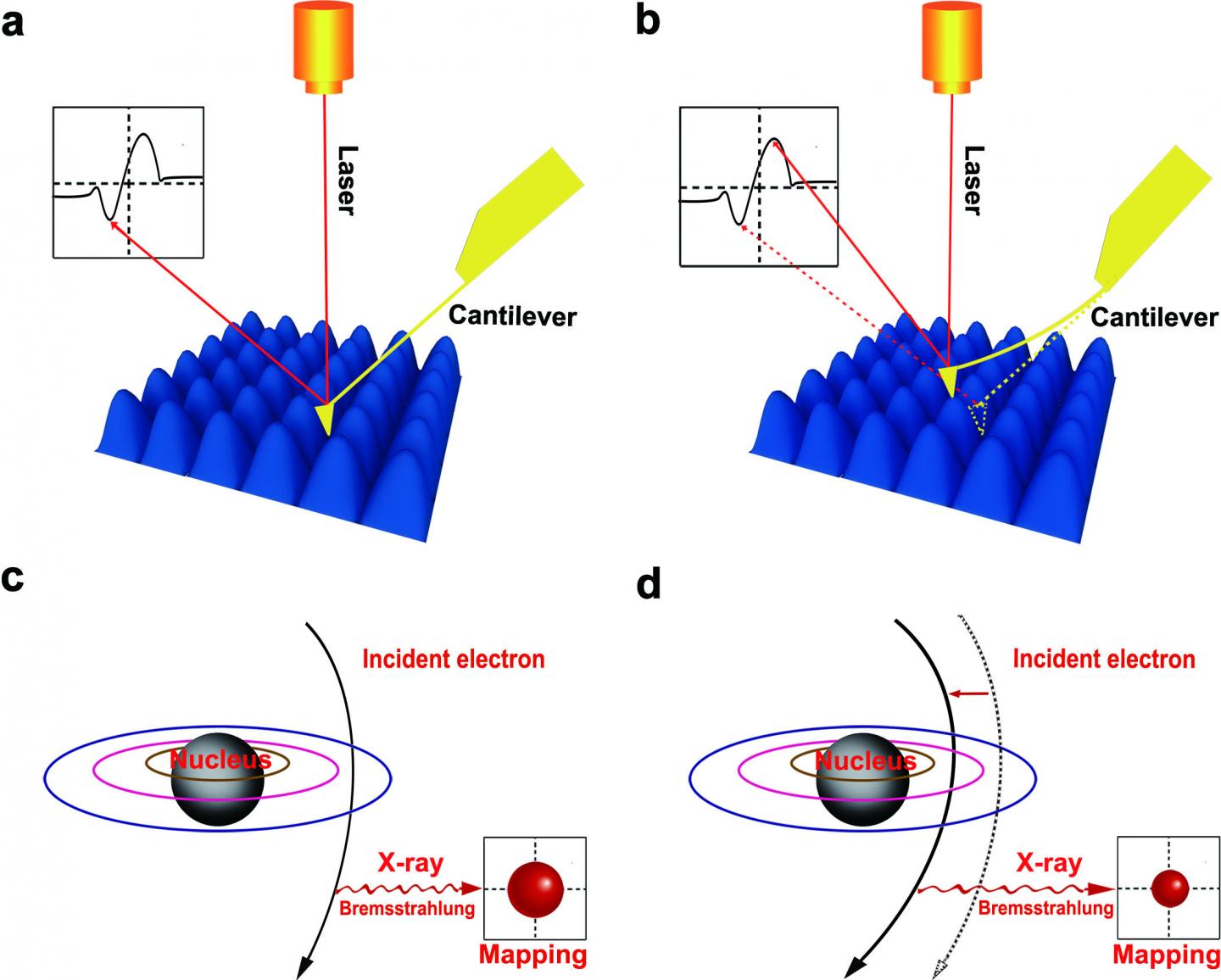
Fortunately, aberration-corrected scanning transmission electron microscopy (STEM) can provide an opportunity. Its electron beam is capable of positioning sample sites with the picometer (pm)-scale precision, and the interactions of the electron beam with the atomic nucleus and the electrons of an atom can emit bremsstrahlung X-ray photons and characteristic ones, respectively. Moreover, the bremsstrahlung and the characteristic X-ray photons can be received and distinguished by the detectors of energy-dispersive X-ray spectroscopy (EDS) in aberration-corrected STEM. The above functions can be performed simultaneously by modern instruments of aberration-corrected STEM.

Herein, Prof. Jun Luo and the co-authors propose and realize a new microscopy type of optical imaging for realizing the X-ray imaging of atomic nuclei (ANXRI) by integrating aberration-corrected STEM, the bremsstrahlung generation of X-ray photons, and the EDS receiving and mapping of the photons. ANXRI successfully images atomic nuclei in three different types of materials, including nanoporous gold (NPG) coated with Pd and Pt, NPG without Pd or Pt, and SrTiO3. “Our idea about the ANXRI method was originally inspired by the working mechanism of atomic force microscopy (AFM),” said Prof. Luo.

The accuracy of ANXRI can reach 1 pm, and the individual imaged sizes of atomic nuclei in ANXRI are adjustable by altering the X-ray energies. More importantly, ANXRI is capable of distinguishing atomic nuclei of different elements. This function is very useful, because in most of nuclear scattering and reactions, not the electrons in a material but only its atomic nuclei change and evolve, which cannot be imaged and monitored by characteristic EDS peaks. This work provides a new opportunity for imaging and studying atomic nuclei and their evolutions in materials science, chemistry and physics, such as nuclear fission, fusion, spallation and decay.

###

This research was financially supported by National Key R&D Program of China (2017YFA0700104), National Science Fund for Distinguished Young Scholars (51825102), National Natural Science Foundation of China (51971157, 51671145 and 51761165012), and Tianjin Science Fund for Distinguished Young Scholars (19JCJQJC61800).

See the article: Xu Jie, He Jia, Ding Yi, Luo Jun*. “X-ray imaging of atomic nuclei”, Sci. China Mater. (2020), doi: 10.1007/s40843-020-1320-1.
http://engine.scichina.com/publisher/scp/journal/SCMs/doi/10.1007/s40843-020-1320-1?slug=abstract

Media Contact
Luo Jun
[email protected]

Related Journal Article

http://dx.doi.org/10.1007/s40843-020-1320-1

Tags: Chemistry/Physics/Materials Sciences
Share12Tweet8Share2ShareShareShare2

Related Posts

blank

Breakthrough in Environmental Cleanup: Scientists Develop Solar-Activated Biochar for Faster Remediation

February 7, 2026
blank

Cutting Costs: Making Hydrogen Fuel Cells More Affordable

February 6, 2026

Scientists Develop Hand-Held “Levitating” Time Crystals

February 6, 2026

Observing a Key Green-Energy Catalyst Dissolve Atom by Atom

February 6, 2026
Please login to join discussion

POPULAR NEWS

  • Robotic Ureteral Reconstruction: A Novel Approach

    Robotic Ureteral Reconstruction: A Novel Approach

    82 shares
    Share 33 Tweet 21
  • Digital Privacy: Health Data Control in Incarceration

    63 shares
    Share 25 Tweet 16
  • Study Reveals Lipid Accumulation in ME/CFS Cells

    57 shares
    Share 23 Tweet 14
  • Breakthrough in RNA Research Accelerates Medical Innovations Timeline

    53 shares
    Share 21 Tweet 13

About

We bring you the latest biotechnology news from best research centers and universities around the world. Check our website.

Follow us

Recent News

Decoding Prostate Cancer Origins via snFLARE-seq, mxFRIZNGRND

Digital Health Perspectives from Baltic Sea Experts

Florida Cane Toad: Complex Spread and Selective Evolution

Subscribe to Blog via Email

Enter your email address to subscribe to this blog and receive notifications of new posts by email.

Join 73 other subscribers
  • Contact Us

Bioengineer.org © Copyright 2023 All Rights Reserved.

Welcome Back!

Login to your account below

Forgotten Password?

Retrieve your password

Please enter your username or email address to reset your password.

Log In
No Result
View All Result
  • Homepages
    • Home Page 1
    • Home Page 2
  • News
  • National
  • Business
  • Health
  • Lifestyle
  • Science

Bioengineer.org © Copyright 2023 All Rights Reserved.