• HOME
  • NEWS
  • EXPLORE
    • CAREER
      • Companies
      • Jobs
    • EVENTS
    • iGEM
      • News
      • Team
    • PHOTOS
    • VIDEO
    • WIKI
  • BLOG
  • COMMUNITY
    • FACEBOOK
    • INSTAGRAM
    • TWITTER
Monday, April 13, 2026
BIOENGINEER.ORG
No Result
View All Result
  • Login
  • HOME
  • NEWS
  • EXPLORE
    • CAREER
      • Companies
      • Jobs
        • Lecturer
        • PhD Studentship
        • Postdoc
        • Research Assistant
    • EVENTS
    • iGEM
      • News
      • Team
    • PHOTOS
    • VIDEO
    • WIKI
  • BLOG
  • COMMUNITY
    • FACEBOOK
    • INSTAGRAM
    • TWITTER
  • HOME
  • NEWS
  • EXPLORE
    • CAREER
      • Companies
      • Jobs
        • Lecturer
        • PhD Studentship
        • Postdoc
        • Research Assistant
    • EVENTS
    • iGEM
      • News
      • Team
    • PHOTOS
    • VIDEO
    • WIKI
  • BLOG
  • COMMUNITY
    • FACEBOOK
    • INSTAGRAM
    • TWITTER
No Result
View All Result
Bioengineer.org
No Result
View All Result
Home NEWS Science News Health

WSU researchers develop sugar-powered sensor to detect, prevent disease

Bioengineer by Bioengineer
September 27, 2018
in Health
Reading Time: 2 mins read
0
Share on FacebookShare on TwitterShare on LinkedinShare on RedditShare on Telegram
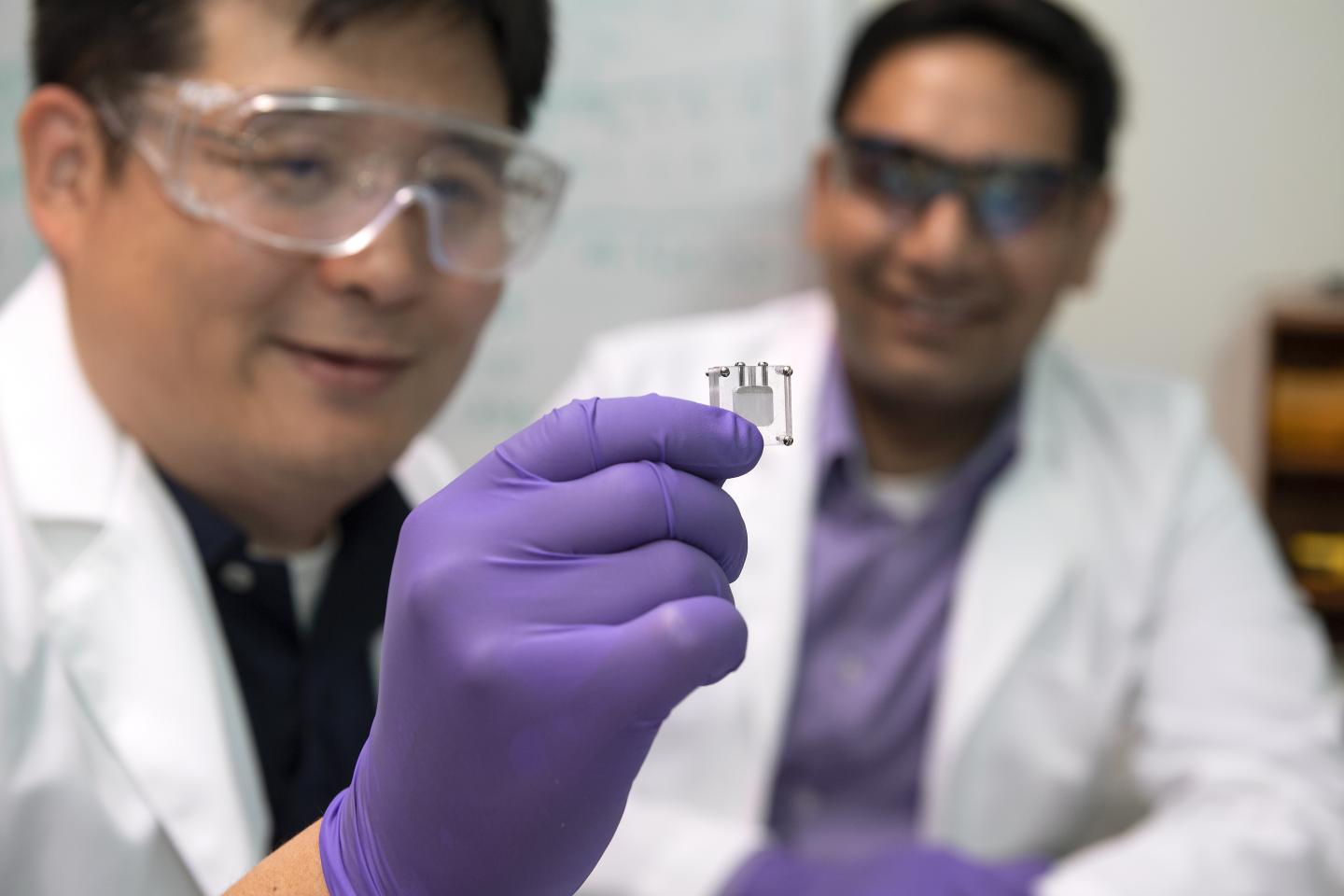
IMAGE

Credit: Washington State University

PULLMAN, Wash. – Researchers at Washington State University have developed an implantable, biofuel-powered sensor that runs on sugar and can monitor a body's biological signals to detect, prevent and diagnose diseases.

A cross-disciplinary research team led by Subhanshu Gupta, assistant professor in WSU's School of Electrical Engineering and Computer Science, developed the unique sensor, which, enabled by the biofuel cell, harvests glucose from body fluids to run.

The research team has demonstrated a unique integration of the biofuel cell with electronics to process physiological and biochemical signals with high sensitivity.

Their work recently was published in the IEEE Transactions of Circuits and Systems journal.

Professors Su Ha and Alla Kostyukova from the Gene and Linda School of Chemical Engineering and Bioengineering, led design of the biofuel cell.

Many popular sensors for disease detection are either watches, which need to be recharged, or patches that are worn on the skin, which are superficial and can't be embedded. The sensor developed by the WSU team could also remove the need to prick a finger for testing of certain diseases, such as diabetes.

"The human body carries a lot of fuel in its bodily fluids through blood glucose or lactate around the skin and mouth," said Gupta. "Using a biofuel cell opens the door to using the body as potential fuel."

The electronics in the sensor use state-of-the-art design and fabrication to consume only a few microwatts of power while being highly sensitive. Coupling these electronics with the biofuel cell makes it more efficient than traditional battery-powered devices, said Gupta. Since it relies on body glucose, the sensor's electronics can be powered indefinitely. So, for instance, the sensor could run on sugar produced just under the skin.

Unlike commonly used lithium-ion batteries, the biofuel cell is also completely non-toxic, making it more promising as an implant for people, he said. It is also more stable and sensitive than conventional biofuel cells.

The researchers say their sensor could be manufactured cheaply through mass production, by leveraging economies of scale.

While the sensors have been tested in the lab, the researchers are hoping to test and demonstrate them in blood capillaries, which will require regulatory approval. The researchers are also working on further improving and increasing the power output of their biofuel cell.

"This brings together the technology for making a biofuel cell with our sophisticated electronics," said Gupta. "It's a very good marriage that could work for many future applications."

###

The research team also included Yuehe Lin and Annie Du from the School of Mechanical and Materials Engineering and Martin Schiavenato, formerly with WSU's College of Nursing and now with Walden University. The project to develop the sensor was funded by a WSU Grand Challenges seed grant.

Media Contact

Subhanshu Gupta
[email protected]
509-335-5045
@WSUNews

Washington State University

Original Source

https://news.wsu.edu/2018/09/27/researchers-develop-sugar-powered-sensor-detect-prevent-disease/ http://dx.doi.org/10.1109/TCSI.2018.2869343
Share12Tweet7Share2ShareShareShare1

Related Posts

Distinct Heart, Metabolic, and Inflammatory Risk Profiles Found in Men and Women with Obesity

April 12, 2026

Machine Learning Identifies Fall Risk in Parkinson’s

April 12, 2026

SGLT2 Inhibitors Safe, Effective for Diabetes in Elderly

April 12, 2026

PPARs’ Impact on Diabetic Kidney Disease Development

April 12, 2026
Please login to join discussion

POPULAR NEWS

  • Scientists Investigate Possible Connection Between COVID-19 and Increased Lung Cancer Risk

    58 shares
    Share 23 Tweet 15
  • Boosting Breast Cancer Risk Prediction with Genetics

    47 shares
    Share 19 Tweet 12
  • Popular Anti-Aging Compound Linked to Damage in Corpus Callosum, Study Finds

    45 shares
    Share 18 Tweet 11
  • Imagine a Social Media Feed That Challenges Your Views Instead of Reinforcing Them

    1012 shares
    Share 400 Tweet 250

About

We bring you the latest biotechnology news from best research centers and universities around the world. Check our website.

Follow us

Recent News

Distinct Heart, Metabolic, and Inflammatory Risk Profiles Found in Men and Women with Obesity

Bio-Based Sulfonated Cyclodextrin Catalyzes 5-HMF Synthesis

Eco-Friendly Geopolymer Bricks Boost Thermal Comfort

Subscribe to Blog via Email

Success! An email was just sent to confirm your subscription. Please find the email now and click 'Confirm' to start subscribing.

Join 79 other subscribers
  • Contact Us

Bioengineer.org © Copyright 2023 All Rights Reserved.

Welcome Back!

Login to your account below

Forgotten Password?

Retrieve your password

Please enter your username or email address to reset your password.

Log In
No Result
View All Result
  • Homepages
    • Home Page 1
    • Home Page 2
  • News
  • National
  • Business
  • Health
  • Lifestyle
  • Science

Bioengineer.org © Copyright 2023 All Rights Reserved.