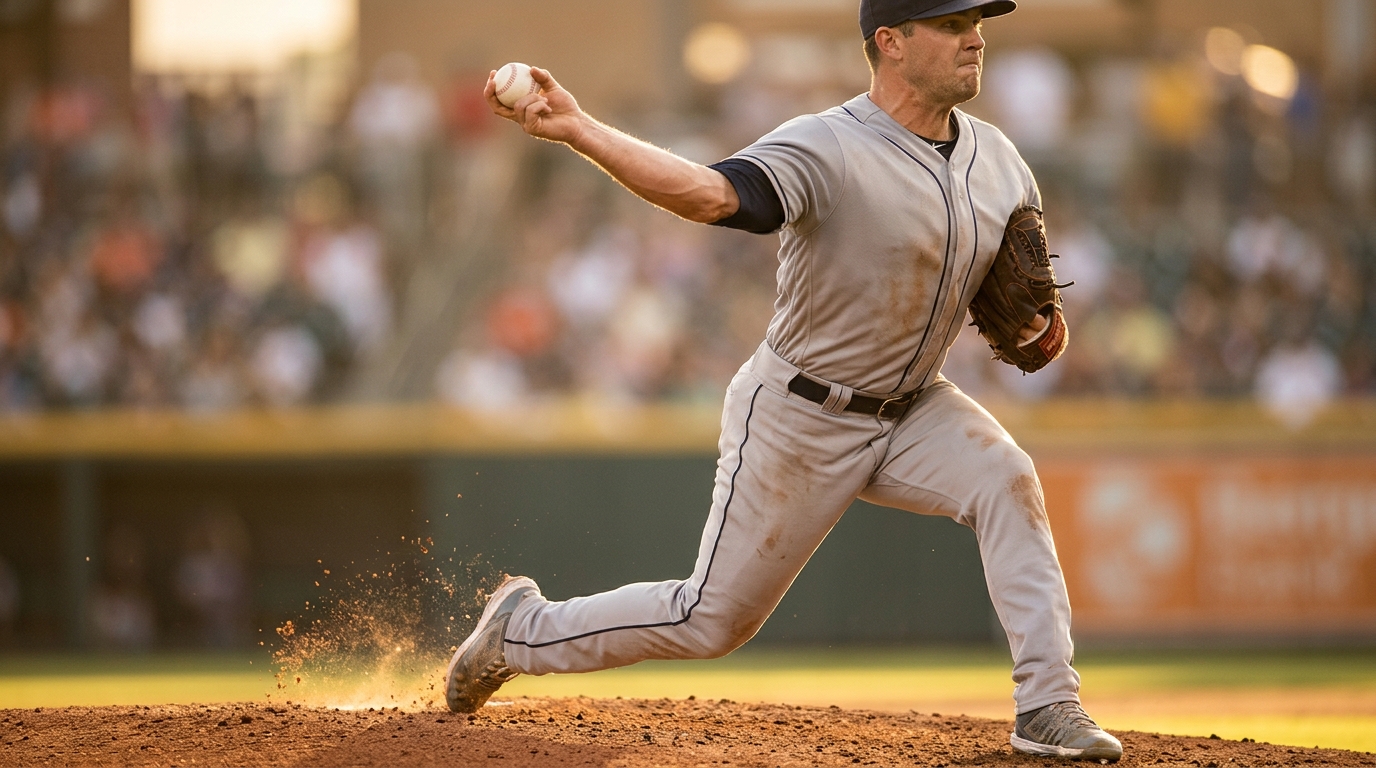
Participation in the World Baseball Classic does not lead to significant declines in subsequent Major League Baseball pitching workload or performance, according to a retrospective cohort study. Researchers evaluated pitchers across tournament cycles to determine whether competing in the international event during spring training compromised subsequent regular-season output. After balancing baseline characteristics using propensity score overlap weighting, the investigators found no statistically significant differences between participants and non-participants across primary season-long workload and performance metrics.
The research addressed longstanding concerns that the World Baseball Classic, which takes place during Major League Baseball spring training, may disrupt preseason preparation and recovery for professional pitchers. To evaluate this question systematically, the authors analyzed pitcher-edition observations from the 2017 and 2023 tournament cycles published in BMC Sports Science, Medicine and Rehabilitation. To qualify for inclusion in the retrospective cohort, pitchers were required to appear in both the Major League Baseball season preceding the tournament and the season immediately following it. Within this framework, tournament participation required at least one pitching appearance in the World Baseball Classic.
To account for differences between pitchers selected for the tournament and their non-participating peers, the investigators applied edition-specific propensity score overlap weighting to balance baseline characteristics across both groups. The primary outcomes tracked changes in both season-long pitching workload and pitching performance. Workload was assessed through innings pitched, total pitches thrown, and total batters faced. Pitching performance was evaluated across multiple metrics, including fielding independent pitching, strikeout-minus-walk percentage, wins above replacement, four-seam fastball velocity, and combined fastball velocity. Exploratory analyses were also designed to examine differences by baseline pitching role and tournament workload.
The primary cohort analyzed by the research team encompassed 140 World Baseball Classic pitcher-edition observations and 1,003 non-participating pitcher-edition observations. Following overlap weighting, no statistically significant between-group differences emerged for any primary outcome. The adjusted difference for innings pitched was 7.35 with a 95 percent confidence interval from negative 1.17 to 15.88 (P = 0.091). The adjusted difference for total pitches thrown was 128.84 with a 95 percent confidence interval spanning negative 5.74 to 263.43 (P = 0.061). In addition, fielding independent pitching yielded an adjusted difference of negative 0.44 with a 95 percent confidence interval from negative 0.96 to 0.08 (P = 0.098).
In exploratory analyses using role-specific overlap weighting, the researchers identified significant interactions between tournament participation and baseline role for innings pitched, total pitches thrown, and total batters faced, with all three outcomes demonstrating a false discovery rate-adjusted P value of 0.048. When evaluated by role, starting pitchers who took part in the tournament recorded greater subsequent regular-season workload in Major League Baseball, whereas relief pitchers did not experience a similar increase. However, the volume of tournament workload itself was not significantly associated with subsequent regular-season outcomes after adjustment for multiple comparisons.
The authors further evaluated their findings through sensitivity analyses assessing alternative eligibility criteria and propensity score specifications. In an expanded-cohort sensitivity analysis, the investigators observed greater subsequent workload as well as a higher probability of Major League Baseball appearance among tournament pitchers. Ultimately, the authors concluded that their findings do not support the hypothesis of poorer subsequent pitching outcomes following tournament participation. Nonetheless, they cautioned that the potential effects of World Baseball Classic participation on pitcher injury risk and physiological recovery remain uncertain.
Subject of Research: World Baseball Classic participation and subsequent Major League Baseball pitching workload and performance
Article Title: World Baseball Classic participation and subsequent workload and performance among Major League Baseball pitchers: an overlap-weighted cohort study
Article References: Tseng, T.-H., Fu, S.-H., Lo, Y.-C., Chen, C.-L., & Chiang, H. (2026). World Baseball Classic participation and subsequent workload and performance among Major League Baseball pitchers: an overlap-weighted cohort study. BMC Sports Science, Medicine and Rehabilitation. https://doi.org/10.1186/s13102-026-02303-6
Image Credits: AI Generated
DOI: 10.1186/s13102-026-02303-6
Keywords: World Baseball Classic, Major League Baseball, pitching workload, pitching performance, innings pitched, pitches thrown, batters faced, fielding independent pitching, strikeout-minus-walk percentage, wins above replacement, fastball velocity, starting pitchers, relief pitchers, propensity score overlap weighting, retrospective cohort study, spring training, BMC Sports Science, Medicine and Rehabilitation
News Source: Ophelia Keating. (November 28, 2026). World Baseball Classic Participation Does Not Reduce Subsequent Major League Pitching Performance. Scienmag.