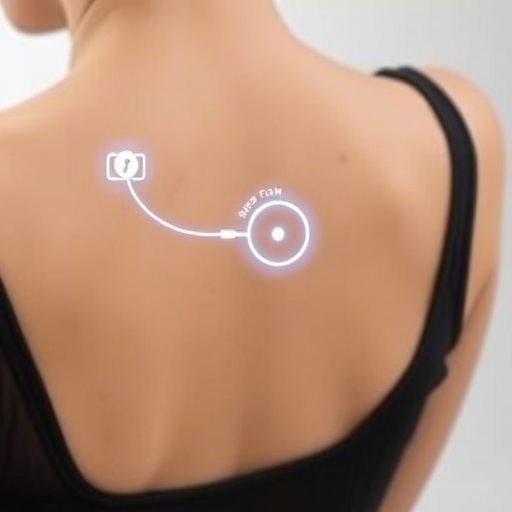
In a groundbreaking stride toward revolutionizing patient care, researchers have unveiled a wireless, skin-integrated system designed to continuously monitor pressure distribution in real time, addressing one of the most persistent challenges in healthcare: the prevention of pressure ulcers. This innovative technology promises to transform how clinicians monitor and manage patients at risk of developing these debilitating wounds, which have long been a significant cause of pain, morbidity, and increased healthcare costs worldwide.
Pressure ulcers, often referred to as bedsores, develop when sustained pressure cuts off blood flow to particular areas of the skin, leading to tissue damage and necrosis. They commonly afflict immobile or critically ill patients, including those confined to beds or wheelchairs for prolonged periods. Despite advances in medical protocols, effective continuous monitoring of pressure has remained elusive, largely due to limitations in existing sensor technologies that are either invasive, tethered by wires, or unable to conform comfortably and durably to the complex contours of human skin.
The new wireless sensor system, detailed in the recent publication in npj Flexible Electronics, represents a significant leap forward. Utilizing a flexible, ultra-thin construction that seamlessly integrates with the skin’s surface, the device can accurately detect and quantify pressure distribution over extended durations without compromising patient comfort or mobility. Its design leverages cutting-edge materials science and bioelectronics, enabling high sensitivity and long-term biocompatibility seldom achieved in previous iterations.
At the core of this system is an array of miniaturized, flexible pressure sensors employing capacitive or resistive sensing mechanisms, embedded within a stretchable polymer matrix that mimics the mechanical properties of skin. This biomimicry is crucial for maintaining adhesion and signal fidelity as the patient moves, ensuring that data remains consistent and reliable under conditions ranging from rest to movement. The sensor network is capable of mapping pressure gradients across multiple regions simultaneously, offering a comprehensive real-time profile of pressure distribution.
Signal acquisition and transmission are facilitated through an integrated microcontroller and a custom-designed low-power wireless communication module, enabling continuous data streaming without the need for cumbersome external connections. The device operates on minimal energy, permitting days of uninterrupted monitoring on a single battery charge, a critical factor for deployment in various healthcare settings, including intensive care units, long-term care facilities, and even home environments.
An equally important aspect of this technology is its compatibility with advanced data analytics platforms. The continuous stream of high-resolution pressure data can be fed into machine learning algorithms designed to identify early warning signs of tissue ischemia with unprecedented accuracy. These predictive models can alert healthcare providers well before visible ulceration occurs, allowing timely intervention to redistribute pressure and mitigate risk.
Moreover, the system’s wireless nature facilitates seamless integration into existing hospital monitoring infrastructures and patient electronic health records. Remote monitoring capabilities enable clinicians to supervise at-risk patients without constant bedside presence, optimizing staff resources while enhancing patient safety. The device also supports customizable alert thresholds, adaptable to individual patient needs and specific anatomical regions more vulnerable to pressure damage.
The implications of this technology extend beyond pressure ulcer prevention. Continuous pressure mapping has potential applications in optimizing prosthetics fit, improving athletic equipment design, and advancing human-machine interfaces in wearable robotics. Its foundational approach to unobtrusive, skin-compliant sensing could catalyze a new class of biomedical devices that merge seamlessly with the human body.
Despite its promise, the research team acknowledges challenges ahead, including large-scale manufacturing, ensuring robust wireless security in sensitive medical data transmission, and validating performance across diverse patient populations and clinical scenarios. Clinical trials are underway to rigorously assess efficacy, user acceptance, and potential integration hurdles in routine care.
If widely adopted, this skin-integrated sensor system may dramatically reduce the incidence of pressure ulcers, which currently affect millions globally and contribute significantly to patient morbidity and mortality rates. By providing clinicians with precise, continuous insights into skin integrity, this technology empowers proactive care strategies that transcend traditional reactive treatment paradigms.
The creation of this system synthesizes interdisciplinary expertise spanning materials science, bioengineering, electronics, and clinical medicine, exemplifying how collaborative innovation can tackle entrenched healthcare challenges. The potential to improve quality of life and clinical outcomes for vulnerable patient populations marks this development as a landmark achievement in medical device engineering.
Looking ahead, enhancements like integration with real-time therapeutic feedback systems, such as automated pressure-relief mattresses or dynamic compression garments, could further elevate the impact of this innovation, forming a closed-loop system for ulcer prevention. Additionally, expanding sensor capabilities to monitor other physiological parameters simultaneously could transform this platform into a comprehensive health monitoring tool.
In conclusion, this novel wireless, skin-integrated pressure distribution monitoring system heralds a new era in preventive healthcare technology. It embodies a confluence of advances in flexible electronics, wearable sensors, and artificial intelligence to deliver actionable, continuous data with minimal intrusion. As it moves towards broader clinical adoption, it offers hope for significantly reducing the burden of pressure ulcers and enhancing patient care across a spectrum of healthcare environments.
Subject of Research: Wireless, skin-integrated pressure distribution monitoring systems aimed at preventing pressure ulcers in healthcare settings.
Article Title: A wireless, skin-integrated system for continuous pressure distribution monitoring to prevent ulcers across various healthcare environments.
Article References:
Yoo, S., Lv, Z., Fadell, N. et al. A wireless, skin-integrated system for continuous pressure distribution monitoring to prevent ulcers across various healthcare environments. npj Flex Electron (2025). https://doi.org/10.1038/s41528-025-00501-9
Image Credits: AI Generated
Tags: bedsores management strategieschronic wound care breakthroughscontinuous patient care advancementsflexible electronic sensorshealthcare cost reduction innovationsInnovative healthcare technologiesnon-invasive medical devicespatient comfort in monitoringpressure ulcer prevention solutionsreal-time pressure monitoring systemstissue damage prevention methodswireless skin sensor technology