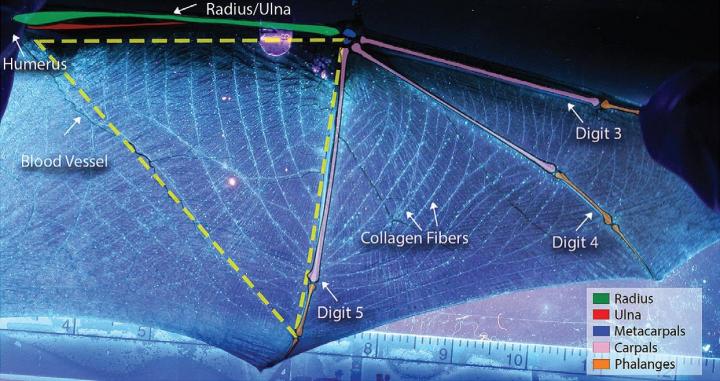
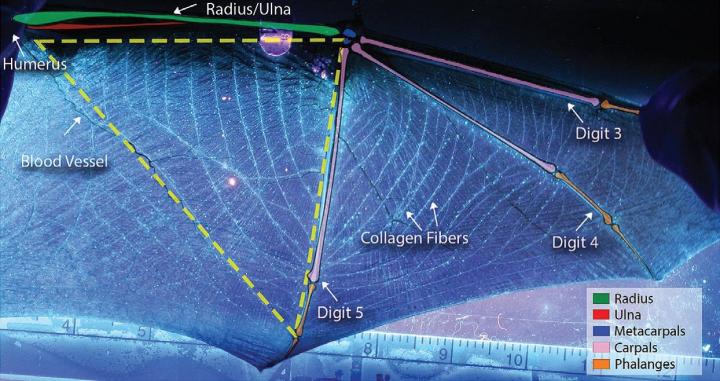
Credit: The image was used as Figure 1 in their study, 'Bat wing biometrics: using collagen-elastin bundles in bat wings as a unique individual identifier.'
Research by a USDA Forest Service scientist and her partners may solve a longtime problem in bat research by demonstrating that bats' wings are as reliable a method of identifying individual bats as fingerprints are for human beings.
The ability to recognize individual animals is key to wildlife research, but finding a reliable technique that does not imperil a bat or change its behavior has confounded bat researchers for decades. In a study published in the Journal of Mammalogy, Forest Service scientist Sybill Amelon and University of Missouri researchers Sarah Hooper and Kathryn Womack evaluated the use of patterns that are visible in bat wings as a method of identifying individual bats. If widely applied, this technique would be an easily employable identification system for bats that does not require adding markers to the animal that could negatively affect it.
The study, "Bat wing biometrics: using collagen-elastin bundles in bat wings as a unique individual identifier," is available at: https://www.nrs.fs.fed.us/pubs/54707.
Bat wing tissue is crisscrossed by what appear to be small lines; these lines are called collagen-elastin bundles, and they serve to make wing tissue strong but yet flexible enough for flight. Researchers analyzed little brown bats, northern long-eared bats, big brown bats, and tricolored bats to determine whether wing prints showing the crisscross of collagen-elastin bundles could satisfy scientific standards for measuring unique characteristics: universality, distinctiveness, permanence, and collectability.
"It is always important to use research techniques that do not diminish the health or survival of the animals we study, but white-nose syndrome has made this even more critical in bat research," Amelon said.
Wing tissue is a prime target of the fungus behind white-nose syndrome, however researchers found that even when wings were damaged, the collagen-elastin bundle network maintained the original wing print pattern. With basic training, people were able to successfully identify bats based on wing photographs with a success rate of 96 percent.
"Bats are a major predator of forest and agricultural insects and are important to forest health," said Tony Ferguson, Director of the Northern Research Station and the Forest Products Laboratory. "This research is one of the ways that the Forest Service is advancing knowledge of an elusive species and contributing to the national effort to control white-nose syndrome."
###
The mission of the Northern Research Station is to improve people's lives and help sustain the natural resources in the Northeast and Midwest through leading-edge science and effective information delivery.
The mission of the U.S. Forest Service, an agency of the U.S. Department of Agriculture, is to sustain the health, diversity and productivity of the nation's forests and grasslands to meet the needs of present and future generations. The agency manages 193 million acres of public land, provides assistance to state and private landowners, and maintains world-renowned forestry research and wildland fire management organizations. National forests and grasslands contribute more than $30 billion to the American economy annually and support nearly 360,000 jobs. These lands also provide 30 percent of the nation's surface drinking water to cities and rural communities; approximately 60 million Americans rely on drinking water that originated from the National Forest System.
USDA is an equal opportunity provider and employer. To file a complaint of discrimination, write to USDA, Assistant Secretary for Civil Rights, Office of the Assistant Secretary for Civil Rights, 1400 Independence Avenue, S.W., Stop 9410, Washington, DC 20250-9410, or call toll-free at (866) 632-9992 (English) or (800) 877-8339 (TDD) or (866) 377-8642 (English Federal-relay) or (800) 845-6136 (Spanish Federal-relay).
Media Contact
Jane Hodgins
[email protected]
651-649-5281
http://nrs.fs.fed.us
Original Source
https://www.nrs.fs.fed.us/news/release/bat-wing-prints http://dx.doi.org/10.1093/jmammal/gyx018