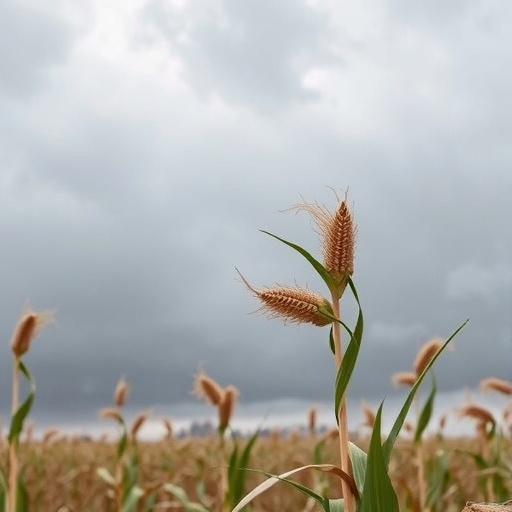
Since the dawn of modern agricultural science, understanding the multifaceted influences of climate on crop production has been a paramount challenge. Recent research published in Nature Communications by Zhang, Xu, Zhang, and colleagues unveils a groundbreaking perspective on how decadal fluctuations in wind speed have critically influenced maize yields across China over the last four decades. This insight not only sheds light on the intricate relationship between climate variables but also underscores how the interplay of warming trends and wind speed variations can alternately mitigate and exacerbate agricultural productivity.
Maize, a staple crop with global significance, has long been susceptible to climate-induced stresses. While much attention has traditionally focused on temperature increases and changing precipitation patterns, this comprehensive study reveals that wind speed, often relegated to a secondary role in crop ecology discussions, holds substantial sway over maize production outcomes. From 1980 onwards, China has experienced both warming and varying wind speeds that together weave a complex narrative of yield dynamics.
The researchers meticulously analyzed data spanning over four decades, employing sophisticated climate-crop models to disentangle the effects of temperature rise from those of wind speed changes. Initially, in the earliest decades, declining wind speeds appeared to counterbalance the adverse impacts of increasing temperatures, offering a temporary reprieve for maize farmers. Such an offset suggests that lowered wind stress may have helped maintain critical processes like evapotranspiration rates and plant mechanical stability, thereby sustaining yields despite warming.
However, as the timeline progressed, an alarming shift occurred: wind speeds began to increase in magnitude, no longer offering solace but instead compounding the negative consequences of rising temperatures. This cumulative effect has led to a more pronounced decline in maize production than warming alone would suggest. The dual stress created by heat and intensified wind conditions likely exacerbates plant water loss, disrupts physiological functions, and increases susceptibility to lodging, thereby impairing overall crop health.
A central element of this investigation lies in the application of high-resolution climate datasets coupled with advanced agronomic simulation models, enabling detailed spatial and temporal analyses. Such fine-grained examination highlights regional disparities within China, where some areas benefited from wind speed reductions while others faced starkly different conditions. These findings emphasize the need for localized adaptation strategies rather than one-size-fits-all solutions in agricultural planning.
The study also touches on the mechanistic underpinnings of wind’s influence on maize. Wind affects the crop microenvironment, moderating canopy temperature, humidity, and carbon dioxide exchange rates. Reduced wind speeds can diminish transpiration, potentially leading to heat stress, but excessive wind can physically damage plants and escalate evaporation from both soil and leaves, intensifying drought conditions. Therefore, the observed decadal fluctuations craft a nuanced balance between protective and detrimental physiological effects.
Moreover, this research underscores an often-overlooked feedback loop between climate variables and agriculture, demonstrating that changes in one climatic factor can modulate the impact of others in unexpected ways. Such insights are invaluable for predictive modeling of crop yields under future climate scenarios, as they highlight the interdependence of environmental stresses.
Importantly, the implications of this work extend beyond China’s borders, as maize remains a globally cultivated crop. Understanding how multiple climatic drivers interact to influence yield can inform international agricultural policies and adaptation frameworks, particularly in regions vulnerable to both warming and shifting wind regimes.
Future research directions proposed by the authors call for deeper investigation into the underlying biological responses of maize to combined heat and wind stress, as well as the exploration of genetic varieties better suited to withstand such extremes. Additionally, enhancing observational networks to monitor wind patterns with greater accuracy will be crucial for refining crop models and guiding agronomic interventions.
As climate change accelerates, integrating complex environmental factors into utility-focused agricultural research becomes indispensable. This study by Zhang et al. exemplifies how multidisciplinary approaches can unravel hidden dynamics, ultimately enabling more resilient food production systems.
In essence, the decade-long interplay between wind speed variations and warming trends in China reveals both the adaptive capabilities of maize and the vulnerabilities it faces in a changing world. Policymakers, scientists, and farmers alike must consider these compound stressors to safeguard food security in the years ahead.
The revelation that reduced wind speeds initially offset warming effects presents a hopeful narrative of natural compensation, albeit temporary. Yet, the subsequent aggravation caused by rising wind intensity serves as a stark warning about the cumulative impacts of climate change.
From a technical standpoint, this work showcases the power of coupling observational data with mechanistic crop growth simulations, offering a replicable framework for similar studies across other crop systems and geographies. Such methodological rigor enhances confidence in derived conclusions and provides actionable intelligence for agricultural adaptation.
In conclusion, this seminal research enriches our understanding of climate-agriculture interactions by highlighting the pivotal role of wind speed variability, a factor frequently overshadowed by temperature and precipitation analyses. As global climatic patterns continue their unpredictable trajectories, incorporating multidimensional environmental influences will be vital for sustaining productive and resilient agroecosystems into the future.
Subject of Research: The impact of decadal changes in wind speed and warming on maize production in China since 1980.
Article Title: Decadal changes in wind speed have offset and then aggravated the impact of warming on maize production in China since 1980.
Article References:
Zhang, Z., Xu, J., Zhang, Y. et al. Decadal changes in wind speed have offset and then aggravated the impact of warming on maize production in China since 1980. Nat Commun 16, 9739 (2025). https://doi.org/10.1038/s41467-025-64725-z
Image Credits: AI Generated
DOI: https://doi.org/10.1038/s41467-025-64725-z
Tags: agricultural productivity in Chinaclimate change on maize yieldsdecadal fluctuations in wind speedeffects of climate variables on maizeimpact of wind speed on agriculturelong-term climate impacts on agriculturemaize production and climate changemaize yield dynamics over four decadesrelationship between wind speed and crop yieldsresearch on climate influences in agriculturerole of wind speed in crop productionwarming trends and crop ecology