• HOME
  • NEWS
  • EXPLORE
    • CAREER
      • Companies
      • Jobs
    • EVENTS
    • iGEM
      • News
      • Team
    • PHOTOS
    • VIDEO
    • WIKI
  • BLOG
  • COMMUNITY
    • FACEBOOK
    • INSTAGRAM
    • TWITTER
Tuesday, June 16, 2026
BIOENGINEER.ORG
No Result
View All Result
  • Login
  • HOME
  • NEWS
  • EXPLORE
    • CAREER
      • Companies
      • Jobs
        • Lecturer
        • PhD Studentship
        • Postdoc
        • Research Assistant
    • EVENTS
    • iGEM
      • News
      • Team
    • PHOTOS
    • VIDEO
    • WIKI
  • BLOG
  • COMMUNITY
    • FACEBOOK
    • INSTAGRAM
    • TWITTER
  • HOME
  • NEWS
  • EXPLORE
    • CAREER
      • Companies
      • Jobs
        • Lecturer
        • PhD Studentship
        • Postdoc
        • Research Assistant
    • EVENTS
    • iGEM
      • News
      • Team
    • PHOTOS
    • VIDEO
    • WIKI
  • BLOG
  • COMMUNITY
    • FACEBOOK
    • INSTAGRAM
    • TWITTER
No Result
View All Result
Bioengineer.org
No Result
View All Result
Home NEWS Science News Chemistry

Why multipartite viruses infect plants rather than animals

Bioengineer by Bioengineer
October 1, 2019
in Chemistry
Reading Time: 2 mins read
0
IMAGE
Share on FacebookShare on TwitterShare on LinkedinShare on RedditShare on Telegram

IMAGE

Credit: Tokyo Tech

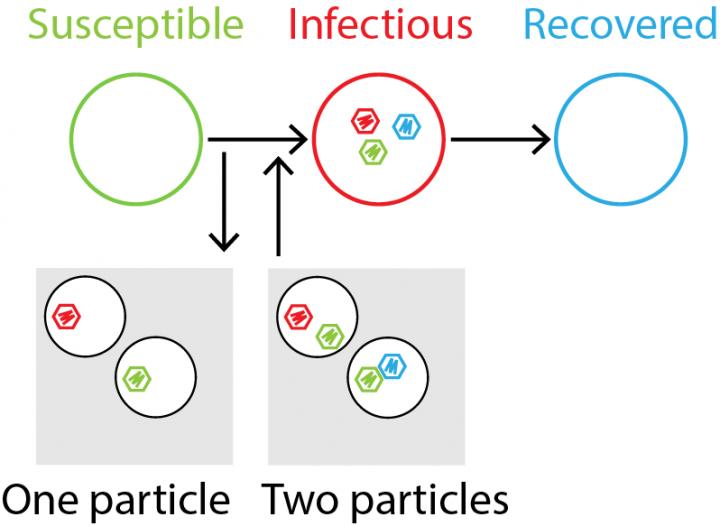
Multipartite viruses have a strange lifestyle. Their genome is split up into different viral particles that, in principle, propagate independently. Completing the replication cycle, however, requires the full genome such that a persistent infection of a host requires the concurrent presence of all types of particles (see Fig. 1). The origin of multipartite viruses is an evolutionary puzzle. Apart from the why they can have such a costly lifestyle, the most peculiar thing about them is that almost all known multipartite viruses infect either plants or fungi–very few viral species infects animals.

So far, most theoretical research has been trying focusing on explaining how it is viable to have the genome split into different particles. This paper provides a theoretical explanation why multipartite viruses primarily infect plants.

There has been great efforts to understand the mechanisms that give multipartite viruses an advantage that can compensates for their peculiar and costly lifestyle, and this is not yet a solved problem. In addition, our understanding of why most multipartite viruses infect only plants is limited. In a recent work, published in Physical Review Letters, Petter Holme of the World Research Hub Initiative, Tokyo Tech and colleagues from China and the USA, have explained why multipartite viruses primarily infect plants. In their work, the authors formulated a minimal network-epidemiological model.

They used mathematical models and computer simulations to show that multipartite viruses colonize structured population (representing the interaction patterns among plants) with less resistance, compared to a well-mixed population (representing the interaction patterns among animals). This is thus an explanation why multipartite viruses infect plants rather than animals.

The researchers from Tokyo Tech continue to investigate the epidemiology of different types of infectious diseases by theoretical methods. At the moment, they are interested in more common disease spreading scenarios such as how influenza spreads in cities and how that could be mitigated.

###

Media Contact
Kazuhide Hasegawa
[email protected]

Original Source

https://www.titech.ac.jp/english/news/2019/045333.html

Related Journal Article

http://dx.doi.org/10.1103/PhysRevLett.123.138101

Tags: Chemistry/Physics/Materials SciencesPharmaceutical/Combinatorial Chemistry
Share13Tweet8Share2ShareShareShare2

Related Posts

Nasal Spray’s Brain Impact Varies by Week, Shedding Light on Why a Promising Drug Seemed to Fail — Chemistry

Nasal Spray’s Brain Impact Varies by Week, Shedding Light on Why a Promising Drug Seemed to Fail

June 16, 2026
Transforming Lavender Waste into a High-Performance Sensor for Enhanced Ethylene Glycol Detection — Chemistry

Transforming Lavender Waste into a High-Performance Sensor for Enhanced Ethylene Glycol Detection

June 16, 2026

Researchers Create Innovative Method to Synthesize High-Value Cyanohydrins Using Nitrogen and Methane

June 16, 2026

Why Dissolved Black Carbon Persists in Water Instead of Disappearing

June 16, 2026
Please login to join discussion

POPULAR NEWS

  • ESMO 2025: mRNA COVID Vaccines Enhance Efficacy of Cancer Immunotherapy

    325 shares
    Share 130 Tweet 81
  • Saying Goodbye to PGY-6: Pediatric Fellowship Realities

    101 shares
    Share 40 Tweet 25
  • Multi-Hospital Study Reveals Long Covid Burden Is Twice as High as Current Estimates

    91 shares
    Share 36 Tweet 23
  • Detection of EDCs in Breast Milk and Infant Urine Up to Six Months Highlights Early Exposure Risks

    75 shares
    Share 30 Tweet 19

About

We bring you the latest biotechnology news from best research centers and universities around the world. Check our website.

Follow us

Recent News

Microbiota from Undernourished Kids Causes Mouse Enteropathy

Red-Shifted GRAB Sensors Enable In Vivo Multiplex Imaging

PAINT Database Enables FAIR Data for Solar Plants

Subscribe to Blog via Email

Enter your email address to subscribe to this blog and receive notifications of new posts by email.

Join 82 other subscribers
  • Contact Us

Bioengineer.org © Copyright 2023 All Rights Reserved.

Welcome Back!

Login to your account below

Forgotten Password?

Retrieve your password

Please enter your username or email address to reset your password.

Log In
No Result
View All Result
  • Homepages
    • Home Page 1
    • Home Page 2
  • News
  • National
  • Business
  • Health
  • Lifestyle
  • Science

Bioengineer.org © Copyright 2023 All Rights Reserved.