Biologists come up with new way to decide whether to lump together similar animal behaviors. It could help all animal behaviorists.
Credit: Michael Miller
Biologists often study animal sociality by collecting observations about several types of behavioral interactions. These interactions can be things like severe fights, minor fights, cooperative food sharing, or grooming each other.
But to analyze animal behavior, researchers need to make decisions about how to categorize these interactions and how to code these behaviors during data collection. Turns out, this question can be complicated.
Researchers at the University of Cincinnati dug into this tricky question while studying monk parakeets. In new research, published in the journal Current Zoology, the team asked: How do you properly categorize two seemingly similar behaviors? The study was led by UC postdoctoral researcher Annemarie van der Marel who worked with UC PhD students Sanjay Prasher, Claire O’Connell, and Chelsea Carminito and UC Assistant Professor Elizabeth Hobson.
“Biologists have to deal with this question: are the behaviors that we categorize as unique actually perceived as unique by the animals?” Hobson said. “How do the animals classify those behaviors?”
Biases can easily lead researchers astray in making these judgement calls. “If you look at chimpanzees, smiling is an aggressive behavior. But in humans, smiling is friendly,” said van der Marel. “The behaviors look similar to us but the nuances of how the behaviors are used are very different.”
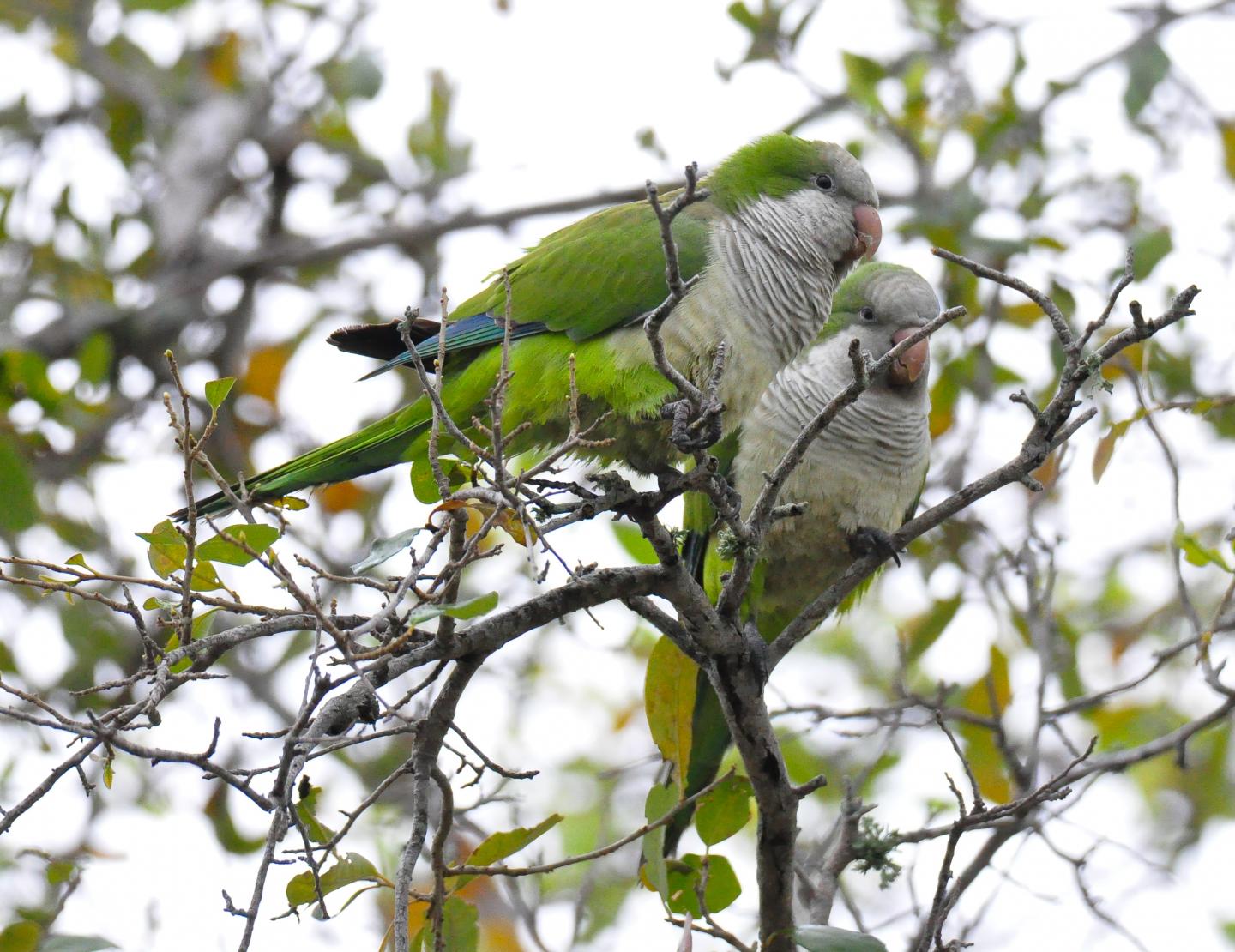
Monk parakeets are highly social parrots that live in large colonies where they often interact with other individuals. The parakeets spend a large proportion of the day fighting, especially top-ranked birds, which makes it easy to distinguish them from birds ranked lower in the dominance hierarchy, said O’Connell. The birds demonstrate aggression in many ways. They bite, of course. But monk parakeets also like to take another parrot’s perch through menace or sheer force.
UC biologists observed two types of this “king of the hill” behavior: “displacements”, where one bird lunges at another bird and can bite to force that bird away, and “crowding”, where a threatened bird moves before an aggressor is within biting range. The team coded these behaviors as distinct because they appeared to differ in the level of aggression, with displacements appearing as a more severe form of aggression with a higher potential for injury.
The parakeets also used these behaviors somewhat differently, with displacements occurring much more often than the crowding.
The question is: were these behaviors essentially used in the same ways by the birds, so that they could be treated as the same types of events in later analyses?
Pooling two behaviors has major research benefits such as creating a richer dataset for future analyses. But pooling also carries a risk — by generalizing, scientists could be losing nuances of behaviors that convey important information when considered alone, Hobson said.
To get to the bottom of this question, the team turned to computational analysis. They created a new computer model that compared the real aggression patterns to ones that were randomized. This approach allowed the team to test whether treating the two behaviors as interchangeable caused any changes in the social structure. “On top of being a great lab bonding experience, it was an exciting opportunity to learn how to use simulations to help answer research questions” Prasher said.
In the UC study, their computational analysis supported pooling the two behaviors. For the UC team, these results will help them plan their future analyses as they work to understand the complex social lives of these parakeets. More broadly, van der Marel said the new framework can also help other animal-behavior researchers make informed and data-driven decisions about when to pool together behaviors and when to separate them.
###
Media Contact
Michael Miller
[email protected]
Original Source
https:/
Related Journal Article
http://dx.