Mammoths, the massive pre-historic ice age cousins of the modern-day elephant, have always been understood to have inhabited parts of British Columbia, but the question of when has always been a bit woolly.
Credit: Simon Fraser University
Mammoths, the massive pre-historic ice age cousins of the modern-day elephant, have always been understood to have inhabited parts of British Columbia, but the question of when has always been a bit woolly.
Now, a new study from Simon Fraser University has given scientists the clearest picture yet when the giant mammals roamed Vancouver Island.
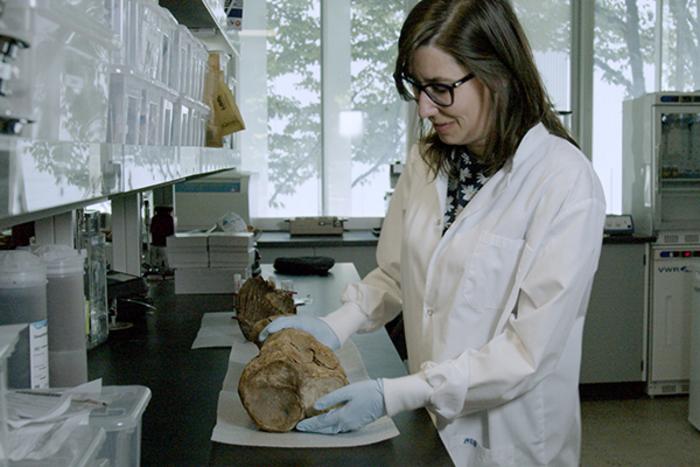
As part of SFU researcher Laura Termes’ PhD and published earlier this month in the Canadian Journal of Earth Sciences, the study examined 32 suspected mammoth samples collected on Vancouver Island. Of those samples, just 16 were deemed suitable for radiocarbon dating.
The youngest sample was found to be around 23,000 years old and the oldest turned out to be beyond the range radiocarbon dating could measure, meaning it was older than 45,000 years.
Prior to the study, only two mammoth remains found on Vancouver Island had ever been dated before. Both lived around 21,000 years ago, so the Termes’ study provides a greater understanding of when the massive mammals lived in the area.
“This is really exciting because it shows that mammoths have lived on Vancouver Island for a long time,” says Termes, a PhD candidate in the Department of Archaeology. “We were expecting similar results [to the two samples previously dated] but what we found were mammoths that were much older. It is fantastic that they could be preserved for that long.”
Termes says having the curatorial support at the Royal BC Museum and the Courtenay and District Museum and Palaeontology Centre allowing access to their collections was invaluable to the study.
“This research highlights the important role of museum collections for understanding how life has evolved and changed in British Columbia’s deep history,” says Victoria Arbour, curator of palentology at the Royal BC Museum. “It’s great to see Woolly’s relatives in the Royal BC Museum’s collections in the spotlight through this research study.”
The UBC ADaPT Facility (which was instrumental in helping determine if samples were indeed mammoths and not whales or other animals) also played an important role in the research, Termes says.
And archaeologists need all the help they can get because while mammoths were enormous, finding intact samples in British Columbia is actually quite rare.
“When we imagine great big giant animals of the last ice age being found, we might have imagined fully articulated and complete skeletons being systematically excavated. But in southern B.C., that simply does not happen,” says Termes. “Instead, we may get an isolated molar that’s been tumbled around in the water for a long time, or maybe a piece of a tusk. And these are what everyday people are encountering.”
For example, one sample she examined was a piece of mammoth tooth found by a child in the gravel at a local playground.
“So maybe it’s a dog owner, taking their puppy for a walk on a rainy day, or a gravel pit operator at work,” says Termes, who grew up in Qualicum Beach. “I really like how these magnificent animals are finding their way into people’s lives in routine and everyday ways.”
Termes says the study is part of a larger look at megafauna in B.C. and she plans on radiocarbon dating mammoth samples from other parts of the province.
AVAILABLE SFU EXPERTS
LAURA TERMES, PhD candidate, archaeology
250.816.1684 | [email protected]
VICTORIA ARBOUR, curator of palaeontology, Royal BC Museum
250.896.0217 | [email protected]
CONTACT
MATT KIELTYKA, SFU Communications & Marketing
236.880.2187 | [email protected]
Simon Fraser University
Communications & Marketing | SFU Media Experts Directory
778.782.3210
ABOUT SIMON FRASER UNIVERSITY
Who We Are
As Canada’s engaged university, SFU works with communities, organizations and partners to create, share and embrace knowledge that improves life and generates real change. We deliver a world-class education with lifelong value that shapes change-makers, visionaries and problem-solvers. We connect research and innovation to entrepreneurship and industry to deliver sustainable, relevant solutions to today’s problems. With campuses in British Columbia’s three largest cities—Vancouver, Burnaby and Surrey—SFU has eight faculties that deliver 364 undergraduate degree programs and 149 graduate degree programs to more than 37,000 students. The university now boasts more than 180,000 alumni residing in 145+ countries.
Journal
Canadian Journal of Earth Sciences
DOI
10.1139/cjes-2023-0102
Article Title
Survival of mammoths (Mammuthus sp.) into the Late Pleistocene in Southwestern British Columbia (Vancouver Island), Canada
Article Publication Date
26-Jul-2024