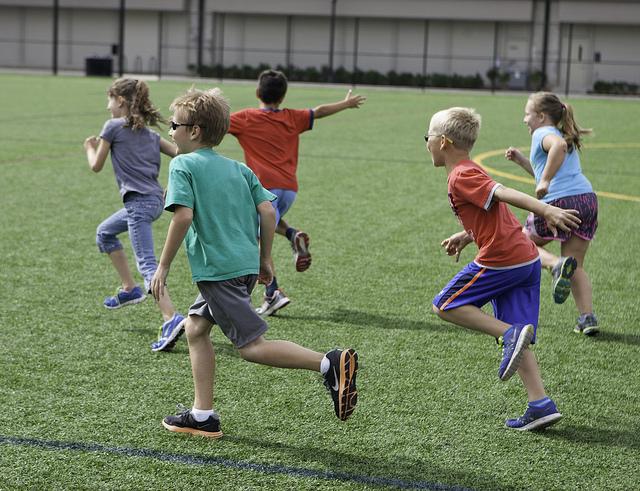
Credit: Oregon State University
CORVALLIS, Ore. – Recess periods can offer physical, cognitive, social and emotional benefits to elementary school children, but those benefits are tied closely to the quality of the playground experience.
Playground safety, access to play equipment, peer conflict resolution and quality engagement between adults and students are among the factors that contribute to a quality recess experience, new research from Oregon State University shows.
"Kids are inherently wired to play and they need recess," said William Massey, an assistant professor in OSU's College of Public Health and Human Sciences and lead author of the study. "But we can't just think of recess in terms of having it or not having it. Recess can be good for child development but it also can be an absolute disaster if not done well."
The findings were published recently in the journal BMC Public Health. Co-authors of the study are Megan Stellino of the University of Northern Colorado; Sean Mullen of University of Illinois at Urbana-Champaign; Jennette Claassen of Playworks Education Energized and Megan Wilkison of Concordia University Wisconsin.
The research was supported by Playworks Education Energized, a national non-profit organization with a mission to support safe and healthy play in schools.
Recess is seen by educators and policymakers as a valuable part of child's school day. The Academy of Pediatrics, for example, has deemed recess as essential, and some states are now mandating recess in schools, Massey said.
Past research has shown that participation in play can help facilitate the development of social and emotional skills such as goal-setting and teamwork. Recess can also provide opportunities for children to develop social skills through peer relationships, sharing and conflict resolution. But recess can also be seen as unsafe – a time and place where bullying, conflict and violence can occur, Massey said.
"We know that kids are better learners when they are more active," he said. "But the quality of the experience matters. I've seen a 20-minute recess where a third of the kids got in fights. Kids don't go back to class ready to learn after a recess like that."
Most existing research about recess focuses on its role as physical activity for children. Few studies have examined the quality of the recess experience from a child development standpoint beyond that, said Massey, whose research interests include the implications of play, sports and other physical activity on youth development, particularly in urban and low-income areas.
To better measure and define a quality recess experience for children, Massey and his co-authors developed and tested a new observational tool that will allow schools to study the outdoor recess environment.
"The Great Recess Framework" is a 17-item observational tool that can be used to observe and rate the recess experience. Researchers examined safety and structural issues such availability of recess equipment and availability of organized games; adult engagement and supervision, such as adult to student ratios and adult participation in games; student behavior, including the number of physical fights and student demonstration of conflict resolution strategies; and issues relating to transitions between recess and class.
To test the assessment tool, researchers collected data from 649 individual, school-based, outdoor recess periods in fall 2016. The recess sessions were held at 495 schools across 22 urban areas in the U.S. Researchers found that observing three days of recess sessions gave the most consistent results.
Through development and testing of the observation tool, the researchers found that quality recesses tended to be those where: transitions to and from went smoothly; children had plenty of choices of play equipment and games; they were able to resolve conflicts amongst themselves; there was little violence or bullying; and adult supervisors were engaged with the students, jumping into games or encouraging interaction.
"Do the kids have things to play with? Are they resolving their own conflicts? Are the adult supervisors engaged?" Massey said. "Our data suggests that engaged adults are critical to the flow of a high quality recess."
The researchers' next goal is to get the observational tool to as many schools as possible, so they can start to identify patterns and determine what is working best at schools around the country. They also want to begin tracking how a good or bad recess period affects a child's academic or behavioral performance in the classroom, Massey said.
###
Media Contact
Will Massey
[email protected]
541-737-3226
@oregonstatenews
http://oregonstate.edu/
Original Source
http://bit.ly/2xNz40O http://dx.doi.org/10.1186/s12889-018-5295-y