• HOME
  • NEWS
  • EXPLORE
    • CAREER
      • Companies
      • Jobs
    • EVENTS
    • iGEM
      • News
      • Team
    • PHOTOS
    • VIDEO
    • WIKI
  • BLOG
  • COMMUNITY
    • FACEBOOK
    • INSTAGRAM
    • TWITTER
Friday, December 12, 2025
BIOENGINEER.ORG
No Result
View All Result
  • Login
  • HOME
  • NEWS
  • EXPLORE
    • CAREER
      • Companies
      • Jobs
        • Lecturer
        • PhD Studentship
        • Postdoc
        • Research Assistant
    • EVENTS
    • iGEM
      • News
      • Team
    • PHOTOS
    • VIDEO
    • WIKI
  • BLOG
  • COMMUNITY
    • FACEBOOK
    • INSTAGRAM
    • TWITTER
  • HOME
  • NEWS
  • EXPLORE
    • CAREER
      • Companies
      • Jobs
        • Lecturer
        • PhD Studentship
        • Postdoc
        • Research Assistant
    • EVENTS
    • iGEM
      • News
      • Team
    • PHOTOS
    • VIDEO
    • WIKI
  • BLOG
  • COMMUNITY
    • FACEBOOK
    • INSTAGRAM
    • TWITTER
No Result
View All Result
Bioengineer.org
No Result
View All Result
Home NEWS Science News

When artificial intelligence evaluates chess champions

Bioengineer by Bioengineer
April 25, 2017
in Science News
Reading Time: 2 mins read
0
Share on FacebookShare on TwitterShare on LinkedinShare on RedditShare on Telegram
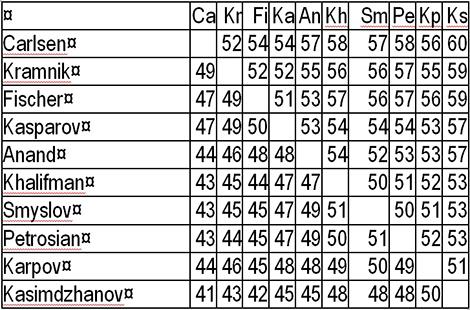
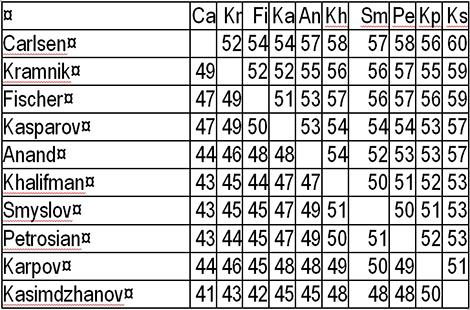
IMAGE

Credit: © Jean-Marc Alliot – IRIT (CNRS/INP Toulouse/Université Toulouse Paul Sabatier/Université Toulouse Jean Jaurès/Université Toulouse Capitole).

The ELO system, which most chess federations use today, ranks players by the results of their games. Although simple and efficient, it overlooks relevant criteria such as the quality of the moves players actually make. To overcome these limitations, Jean-Marc Alliot of the Institut de recherche en informatique de Toulouse (IRIT – CNRS/INP Toulouse/Université Toulouse Paul Sabatier/Université Toulouse Jean Jaurès/Université Toulouse Capitole) demonstrates a new system, published on 24 april 2017 in the ICGA Journal (International Computer Games Association) .

Since the 1970s, the system designed by the Hungarian, Arpad Elo, has been ranking chess players according to the result of their games. The best players have the highest ranking, and the difference in ELO points between two players predicts the probability of either player winning a given game. If players perform better or worse than predicted, they either gain or lose points accordingly. This method does not take into account the quality of the moves played during a game and is therefore unable to reliably rank players who have played at different periods. Jean-Marc Alliot suggests a direct ranking of players based on the quality of their actual moves.

His system computes the difference between the move actually played and the move that would have been selected by the best chess program to date, Stockfish. Running on the OSIRIM supercomputer1, this program executes almost perfect moves. Starting with those of Wilhelm Steinitz (1836-1900), all 26,000 games played since then by chess world champions have been processed in order to create a probabilistic model for each player. For each position, the model estimates the probability of making a mistake, and the magnitude of the mistake. These models can then be used to compute the win/draw/lose probability for any given match between two players. The predictions have proven not only to be extremely close to the actual results when players have played concrete games against one another, they also fare better than those based on ELO scores. The results demonstrate that the level of chess players has been steadily increasing. The current world champion, Magnus Carlsen, tops the list, while Bobby Fischer is third.

Under current conditions, this new ranking method cannot immediately replace the ELO system, which is easier to set up and implement. However, increases in computing power will make it possible to extend the new method to an ever-growing pool of players in the near future.

###

Media Contact

Jean-Marc Alliot
[email protected]
33-056-155-8208
@IOSPress_STM

http://www.iospress.com

############

Story Source: Materials provided by Scienmag

Share12Tweet8Share2ShareShareShare2

Related Posts

Exploring Anticancer Potential of Novel Dibromodibenzoazepines

December 12, 2025
Genomic Study Reveals Widespread Resistance Genes in Serratia

Genomic Study Reveals Widespread Resistance Genes in Serratia

December 12, 2025

Folic Acid Enhances Canola’s Mercury Stress Resistance

December 12, 2025

Eudrilus Eugeniae Fluid Shows Promise Against Cancer

December 12, 2025
Please login to join discussion

POPULAR NEWS

  • New Research Unveils the Pathway for CEOs to Achieve Social Media Stardom

    New Research Unveils the Pathway for CEOs to Achieve Social Media Stardom

    205 shares
    Share 82 Tweet 51
  • Scientists Uncover Chameleon’s Telephone-Cord-Like Optic Nerves, A Feature Missed by Aristotle and Newton

    121 shares
    Share 48 Tweet 30
  • Neurological Impacts of COVID and MIS-C in Children

    108 shares
    Share 43 Tweet 27
  • Nurses’ Views on Online Learning: Effects on Performance

    69 shares
    Share 28 Tweet 17

About

BIOENGINEER.ORG

We bring you the latest biotechnology news from best research centers and universities around the world. Check our website.

Follow us

Recent News

Exploring Anticancer Potential of Novel Dibromodibenzoazepines

Genomic Study Reveals Widespread Resistance Genes in Serratia

Folic Acid Enhances Canola’s Mercury Stress Resistance

Subscribe to Blog via Email

Enter your email address to subscribe to this blog and receive notifications of new posts by email.

Join 69 other subscribers
  • Contact Us

Bioengineer.org © Copyright 2023 All Rights Reserved.

Welcome Back!

Login to your account below

Forgotten Password?

Retrieve your password

Please enter your username or email address to reset your password.

Log In
No Result
View All Result
  • Homepages
    • Home Page 1
    • Home Page 2
  • News
  • National
  • Business
  • Health
  • Lifestyle
  • Science

Bioengineer.org © Copyright 2023 All Rights Reserved.