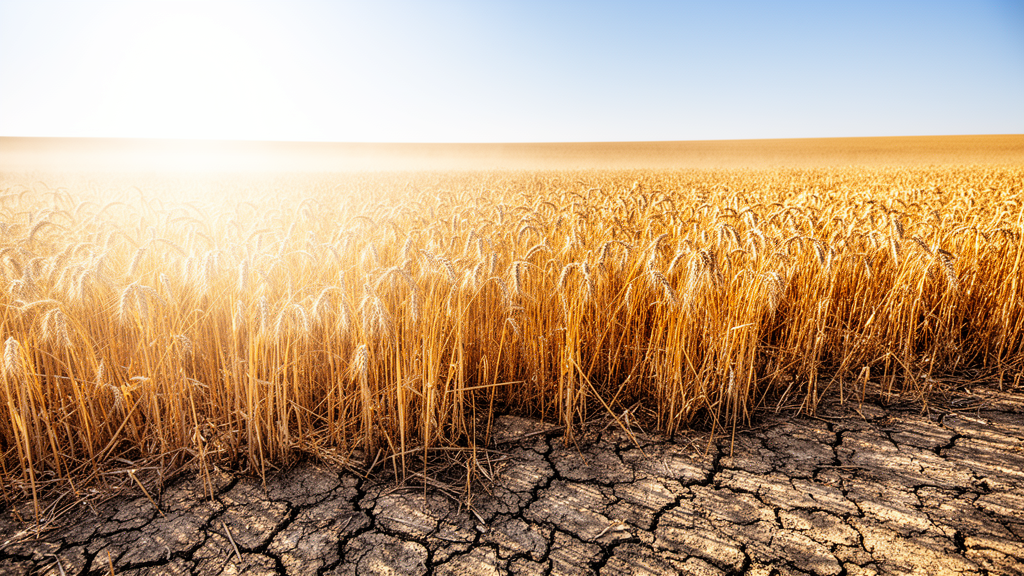
Compound hot, dry, and windy events are becoming more frequent and increasingly damaging to wheat yields in China’s wheat belt, underscoring the need for improved crop management, breeding, and climate adaptation. A News & Views article in Nature Food, authored by Xiaomao Lin, David B. Lobell, Buchun Liu, and Liang Tang, highlights emerging evidence that these short-lived atmospheric events pose a distinct risk to wheat production that conventional seasonal metrics may fail to capture. The analysis focuses on the work of Jiang et al., who studied different types of these compound events across China’s wheat belt by combining long-term county-level yields, national field-trial observations, and hourly weather data.
Rising atmospheric evaporative demand has contributed to frequent and intense droughts globally, with land–atmosphere feedbacks further amplifying heat and dryness as soils and vegetation lose moisture. For crops, water stress is a function of both water availability and atmospheric demand. High temperature increases atmospheric water demand, typically measured as vapour pressure deficit, and can constrain crop function even before severe soil-water deficits develop. When high temperature and high vapour pressure deficit coincide with strong winds, particularly during sensitive reproductive stages, they can sharply increase the potential for rapid crop water loss over hours rather than days or weeks. Such short-lived, compound hot–dry–windy events suggest a dimension of crop climate risk that may not be captured by conventional assessments based on seasonal or monthly temperature or drought metrics alone.
Evidence that these compound events matter for wheat is emerging across major production regions. Across the US Great Plains, exposure to hot, dry, and windy conditions during the heading-to-maturity stage has increased over recent decades and was associated with substantial winter-wheat yield losses. In the study highlighted by Lin et al., Jiang et al. examined different hot–dry–windy types across China’s wheat belt. In their study, yield sensitivity describes the statistically estimated yield response per hour of exposure, measured in kilograms per hectare per hour. Among the three types examined, high temperature and low humidity was associated with the largest yield losses and increased most strongly across northwestern wheat-growing regions.
Wheat yield sensitivity to high temperature and low humidity has been increasing over time, with a range of estimated increases from negative 31.5 to negative 15.6 kilograms per hectare per hour during the period 1981 to 2018 across alternative model specifications. This trend is particularly pronounced during the middle reproductive stage. Field trials corroborated this temporal pattern, with cultivars from later breeding cohorts also showing increasingly negative responses to these conditions. Across counties, these changes were closely associated with increasing exposure to high temperature and low humidity, particularly during the middle and late reproductive stages, even after accounting for major climatic and production-related factors, including irrigation, fertilizer, mechanization, and seed costs. Whether this increasing sensitivity reflects physiological responses to intensifying atmospheric demand, limits to breeding and management adaptation, or their interaction remains an important open question for future research.
March through May may represent a common window of seasonal atmospheric vulnerability across the US and Chinese winter-wheat belts. As spring temperatures rise rapidly, atmospheric moisture does not necessarily increase at the same pace, and entrainments of continental dry air can further limit moisture supply. This differential change in temperature and atmospheric water vapour lowers relative humidity and elevates vapour pressure deficit, while active spring winds can further enhance atmospheric water demand. Heat, dryness, and wind therefore do not arise independently; rather, they emerge from a coupled land–atmosphere circulation system. In the US Great Plains, large-scale circulation changes can suppress moisture transport from the Gulf of Mexico and favour warm and dry conditions, whereas across northern China, Eurasian circulation patterns can enhance subsidence and surface heating while promoting moisture divergence, contributing to regional warming and drying.
More broadly, temperature-moisture coupling operates via two pathways: large-scale circulation and land–atmosphere feedbacks. While clear skies, subsidence, and suppressed rainfall drive concurrent atmospheric warming and drying, declining soil moisture limits evapotranspiration and funnels available energy into sensible heating. Within this coupled climate context, Jiang et al. found that increasing low-humidity exposure during wheat heading to maturity closely tracked the spatial increases in high temperature and low humidity exposure. In contrast, trends in high-temperature and wind-threshold hours alone were relatively insignificant. The exceptional 2022 compound hot–dry event in eastern China, an important wheat-producing region, provides a concrete example of this temperature–moisture coupling. Severe soil drying shifted the land surface from an energy-limited regime towards a water-limited regime, suppressing latent heat flux and increasing sensible heating, which further intensified near-surface temperatures.
The prominence of low humidity has direct physiological implications for wheat. When high temperature and low humidity occur together, increased atmospheric water demand places greater pressure on crop water use and stomatal regulation, challenging the balance between water conservation and carbon assimilation. This physiological stress ultimately decreases the potential kernel weights and yields. A figure in the source material illustrates winter wheat following exposure to a high temperature and low humidity event during the reproductive stage. Specifically, exposure impaired grain filling and reduced potential kernel weight in May 2019 at Hengshui, China.
Yield response to high temperature and low humidity provides meaningful implications for adaptation. Conventional agronomic improvements can alleviate soil-water, nutrient, and other production constraints, but they may be less effective against the high atmospheric water demand imposed by concurrent heat and low humidity. Implementing phenology-informed early warnings, adjusting sowing times and cultivar maturity, and targeting soil-water management can mitigate exposure and buffer stress during reproductive stages. For example, in major farming regions such as China’s wheat belt, vapour pressure deficit is rising faster than climate models anticipated, potentially altering the effectiveness of adaptations based primarily on warming. Irrigation and soil-water conservation can buffer soil-water deficits and sustain crop water supply; however, they cannot fully offset acute atmospheric demand during these compound events.
Breeding provides a complementary strategy for longer-term adaptation. Specifically, traits that improve root water acquisition, regulate water loss, and sustain carbon assimilation could help to maintain crop performance under high evaporative demand. Wheat breeding programmes may therefore need to extend beyond conventional drought or heat tolerance towards resilience to flash and episodic compound atmospheric stress.
Translating these insights into policy and practice will require a regionally integrated adaptation developed collaboratively with agronomists, engineers, and farmers. The regional patterns of hot, dry, and windy events across China offer a strategic foundation for targeted breeding, water management, and climate services. Instead of prescribing a uniform response, investment in cultivar development, climate services, and water management should therefore reflect the dominant compound stresses, local resource constraints, and adaptive capacity. Yet these adaptation priorities cannot be based on changing exposure alone. The increasing sensitivity to high temperature and low humidity conditions identified by Jiang et al. shows that wheat resilience itself may change as climate changes. Consequently, adaptation should anticipate a moving target and agricultural decision-making needs to consider not only the spatial and temporal variations of compound climate risks, but also the sensitivity of the crops themselves.
Subject of Research: Impact of compound hot, dry, and windy atmospheric events on wheat yield sensitivity and adaptation strategies in China.
Article Title: Wheat resilience under compound stress
Article References: Lin, X., Lobell, D. B., Liu, B., & Tang, L. (2026). Wheat resilience under compound stress. Nature Food, 7(11), 1044-1045. https://doi.org/10.1038/s43016-026-01459-1
Image Credits: AI Generated
DOI: 10.1038/s43016-026-01459-1
Keywords: wheat yield, compound stress, hot dry windy events, vapour pressure deficit, climate adaptation, crop breeding, atmospheric demand, reproductive stage, soil moisture, land-atmosphere feedback, winter wheat, China wheat belt, yield sensitivity, grain filling, kernel weight, irrigation management, phenology, climate services, evaporative demand, crop resilience
News Source: Alan Morgan. (November 21, 2026). Wheat Yield Sensitivity to Hot Dry Windy Events Increases. Scienmag.