• HOME
  • NEWS
  • EXPLORE
    • CAREER
      • Companies
      • Jobs
    • EVENTS
    • iGEM
      • News
      • Team
    • PHOTOS
    • VIDEO
    • WIKI
  • BLOG
  • COMMUNITY
    • FACEBOOK
    • INSTAGRAM
    • TWITTER
Tuesday, May 12, 2026
BIOENGINEER.ORG
No Result
View All Result
  • Login
  • HOME
  • NEWS
  • EXPLORE
    • CAREER
      • Companies
      • Jobs
        • Lecturer
        • PhD Studentship
        • Postdoc
        • Research Assistant
    • EVENTS
    • iGEM
      • News
      • Team
    • PHOTOS
    • VIDEO
    • WIKI
  • BLOG
  • COMMUNITY
    • FACEBOOK
    • INSTAGRAM
    • TWITTER
  • HOME
  • NEWS
  • EXPLORE
    • CAREER
      • Companies
      • Jobs
        • Lecturer
        • PhD Studentship
        • Postdoc
        • Research Assistant
    • EVENTS
    • iGEM
      • News
      • Team
    • PHOTOS
    • VIDEO
    • WIKI
  • BLOG
  • COMMUNITY
    • FACEBOOK
    • INSTAGRAM
    • TWITTER
No Result
View All Result
Bioengineer.org
No Result
View All Result
Home NEWS Science News

What’s your brand?

Bioengineer by Bioengineer
February 5, 2020
in Science News
Reading Time: 3 mins read
0
IMAGE
Share on FacebookShare on TwitterShare on LinkedinShare on RedditShare on Telegram

A new algorithm analyzes social media data to help brands improve their marketing
IMAGE

Credit: © 2020 Yamasaki et al.


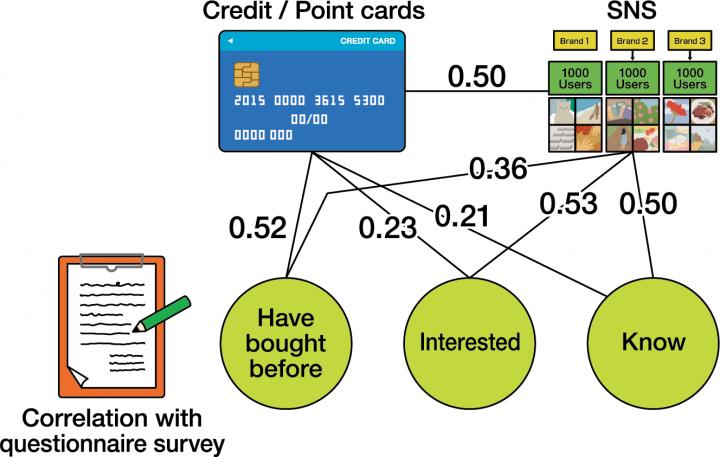
Researchers created an algorithm that successfully predicted consumer purchases. The algorithm made use of data from the consumers’ daily activity on social media. Brands could use this to analyze potential customers. The researchers’ method combines powerful statistical modeling techniques with machine learning-based image recognition.

Associate Professor Toshihiko Yamasaki and his team from the Graduate School of Information Science and Technology at the University of Tokyo explore new and interesting ways to make use of data such as social media data. Some applications they develop are useful for entities like companies to improve their effectiveness in different ways, but in particular in how they reach and influence potential customers.

“I posed two questions to my team: ‘Is it possible to calculate the similarity between different brands based on the way customers engage with them on social media?’ And, ‘If so, can brands use this information to improve the way they market themselves?'” said Yamasaki. “And with some time, effort and patience, they came back with a simple but confident answer: ‘Yes!'”

But the way their team deduced this was anything but simple. The computational analysis of social media data is often called mining, as the term suggests it is a monumental and laborious task. For this reason, researchers in this field make use of various computational tools to analyze social media in ways that human beings cannot.

“In the past, many companies improved their marketing strategies with the use of customer surveys and projections based on their sales data,” explained lead researcher Yiwei Zhang. “However, these are time-consuming and imprecise. Now we have access to and expertise in tools such as machine learning and complex statistical analysis.”

The team began its work by gathering publicly available social media data from followers of selected brands. They used proven image recognition and machine-learning methods to analyze and categorize photos and hashtags relating to the brands’ followers. This revealed patterns of behavior of consumers towards different brands. These patterns meant the researchers could calculate the similarity between different or even unrelated brands.

“We evaluated our proposed algorithm against purchase history and questionnaires, which are still useful to provide context to purchase information,” continued Zhang. “The experimental results show that credit card or point card companies could predict customers’ past purchasing behavior well. Our algorithm could accurately predict customers’ willingness to try new brands.”

This research could be extremely useful for new promotions of brands that make use of social media networks. It could also be used by shopping centers and malls to plan which stores they include or for stores themselves to choose which brands to stock. And the research could even help match brands with suitable social media influencers to help better advertise their products.

“To visualize what has not been visible before is always very interesting,” concluded Yamasaki. “People might say that professionals already ‘see’ these kinds of patterns, but being able to show the similarity between brands numerically and objectively is a new innovation. Our algorithm is demonstrably more effective than judging these things based on intuition alone.”

###

Media Contact
Toshihiko Yamasaki
[email protected]
81-358-416-698

Original Source

https://www.u-tokyo.ac.jp/focus/en/press/z0508_00090.html

Related Journal Article

http://dx.doi.org/10.1145/3338533.3366600

Tags: Advertising/Public RelationsAlgorithms/ModelsBehaviorComputer ScienceDemographyInformation Management/Tracking SystemsInternetSocioeconomicsSoftware EngineeringTechnology/Engineering/Computer Science
Share13Tweet8Share2ShareShareShare2

Related Posts

Humans and Zebra Finches Share Similar Speech Learning Techniques #ASA190 — Chemistry

Humans and Zebra Finches Share Similar Speech Learning Techniques #ASA190

May 11, 2026
New Study Uncovers How Fungal Parasites Attack Strawberries and Raspberries — Agriculture

New Study Uncovers How Fungal Parasites Attack Strawberries and Raspberries

May 11, 2026

City of Hope Researchers to Present Groundbreaking Immunotherapy and Precision Medicine Advances Across Multiple Cancer Types at ASCO 2026

May 11, 2026

Medicaid Expansion Reduces Mortality in Young Adults with Kidney Failure

May 11, 2026
Please login to join discussion

POPULAR NEWS

  • Research Indicates Potential Connection Between Prenatal Medication Exposure and Elevated Autism Risk

    841 shares
    Share 336 Tweet 210
  • New Study Reveals Plants Can Detect the Sound of Rain

    728 shares
    Share 290 Tweet 182
  • Salmonella Haem Blocks Macrophages, Boosts Infection

    62 shares
    Share 25 Tweet 16
  • Breastmilk Balances E. coli and Beneficial Bacteria in Infant Gut Microbiomes

    57 shares
    Share 23 Tweet 14

About

We bring you the latest biotechnology news from best research centers and universities around the world. Check our website.

Follow us

Recent News

Humans and Zebra Finches Share Similar Speech Learning Techniques #ASA190

New Study Uncovers How Fungal Parasites Attack Strawberries and Raspberries

City of Hope Researchers to Present Groundbreaking Immunotherapy and Precision Medicine Advances Across Multiple Cancer Types at ASCO 2026

Subscribe to Blog via Email

Enter your email address to subscribe to this blog and receive notifications of new posts by email.

Join 82 other subscribers
  • Contact Us

Bioengineer.org © Copyright 2023 All Rights Reserved.

Welcome Back!

Login to your account below

Forgotten Password?

Retrieve your password

Please enter your username or email address to reset your password.

Log In
No Result
View All Result
  • Homepages
    • Home Page 1
    • Home Page 2
  • News
  • National
  • Business
  • Health
  • Lifestyle
  • Science

Bioengineer.org © Copyright 2023 All Rights Reserved.