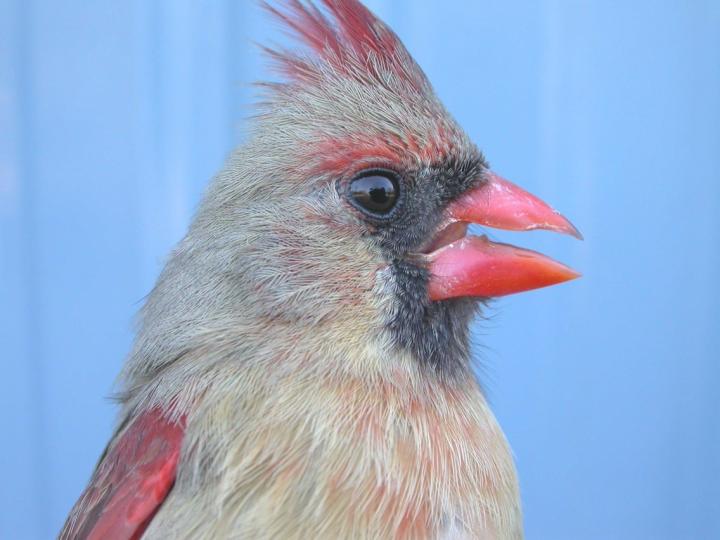
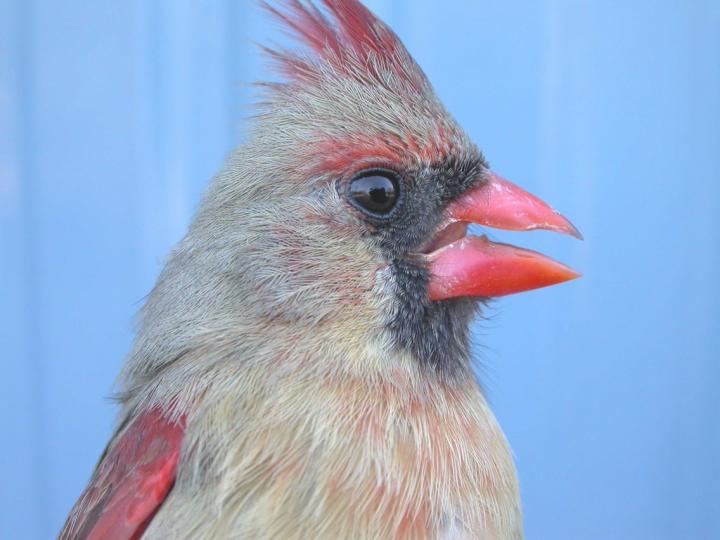
Credit: J. Jawor
Both male and female birds use traits like plumage brightness to size each other up, but a new study on Northern Cardinals in The Auk: Ornithological Advances shows that the meanings of female birds' markings may vary from one place to another, even within the same species.
Though they're often not as showy as the males, female birds have plumage ornaments that can convey information to other members of their species. A previous study found that among Northern Cardinals in Ohio, the brightness of females' facial markings indicated how aggressive they would be in defending their nests. However, when Caitlin Winters and Jodie Jawor of the University of Southern Mississippi repeated the study in Mississippi's longleaf pine forest to determine if the same held true there, they were surprised to learn that the variation among females' facial masks in their southern study population had no relationship to their aggressive behavior.
One of the key differences between the northern and southern cardinal populations studied is that unlike in Ohio, the researchers did not observe any evidence of brood parasitism, where one female cardinal sneaks an egg into another's nest, among cardinals in Mississippi. The Mississippi birds also had more habitat available to them and defended larger territories, leaving female cardinals there with less need to defend their nests. "This is an indication that selection pressures vary between northern and southern populations and that the information a female in the north needs to convey to other cardinals differs from what a female in the south has to say," explains Jawor, who has since moved on to New Mexico State University. "The ornament and behavior are both malleable."
To collect their data, Winters and Jawor captured female cardinals early in the breeding season and measured the brightness of their face masks with a color reflectance spectrometer. They tested aggressive nest defense behavior by waiting until a female left for a break in incubation and then placing a female Northern Cardinal decoy near the nest, observing the bird's reaction when it returned.
"This is a timely paper, as current research is demonstrating that the factors involved in the display of female aggression are widely varied throughout species," according to M. Susan DeVries of Edgewood College, who was not involved in the current study. "Considering that different populations are potentially subjected to different selective pressures that can influence behavior, this study's findings imply that the rules governing aggressive signals and behavior in females are much more complex than we once realized."
###
"Melanin ornament brightness and aggression at the nest in female Northern Cardinals (Cardinalis cardinalis)" will be available November 23, 2016, at http://americanornithologypubs.org/doi/full/10.1642/AUK-16-83.1 (issue URL http://americanornithologypubs.org/toc/tauk/134/1).
About the journal: The Auk: Ornithological Advances is a peer-reviewed, international journal of ornithology that began in 1884 as the official publication of the American Ornithologists' Union, which merged with the Cooper Ornithological Society in 2016 to become the American Ornithological Society. In 2009, The Auk was honored as one of the 100 most influential journals of biology and medicine over the past 100 years.
Media Contact
Rebecca Heisman
[email protected]
http://www.aoucospubs.org
############
Story Source: Materials provided by Scienmag