• HOME
  • NEWS
  • EXPLORE
    • CAREER
      • Companies
      • Jobs
    • EVENTS
    • iGEM
      • News
      • Team
    • PHOTOS
    • VIDEO
    • WIKI
  • BLOG
  • COMMUNITY
    • FACEBOOK
    • INSTAGRAM
    • TWITTER
Thursday, April 2, 2026
BIOENGINEER.ORG
No Result
View All Result
  • Login
  • HOME
  • NEWS
  • EXPLORE
    • CAREER
      • Companies
      • Jobs
        • Lecturer
        • PhD Studentship
        • Postdoc
        • Research Assistant
    • EVENTS
    • iGEM
      • News
      • Team
    • PHOTOS
    • VIDEO
    • WIKI
  • BLOG
  • COMMUNITY
    • FACEBOOK
    • INSTAGRAM
    • TWITTER
  • HOME
  • NEWS
  • EXPLORE
    • CAREER
      • Companies
      • Jobs
        • Lecturer
        • PhD Studentship
        • Postdoc
        • Research Assistant
    • EVENTS
    • iGEM
      • News
      • Team
    • PHOTOS
    • VIDEO
    • WIKI
  • BLOG
  • COMMUNITY
    • FACEBOOK
    • INSTAGRAM
    • TWITTER
No Result
View All Result
Bioengineer.org
No Result
View All Result
Home NEWS Science News Chemistry

What does DNA’s repair shop look like? New research identifies the tools

Bioengineer by Bioengineer
December 5, 2019
in Chemistry
Reading Time: 3 mins read
0
IMAGE
Share on FacebookShare on TwitterShare on LinkedinShare on RedditShare on Telegram

IMAGE

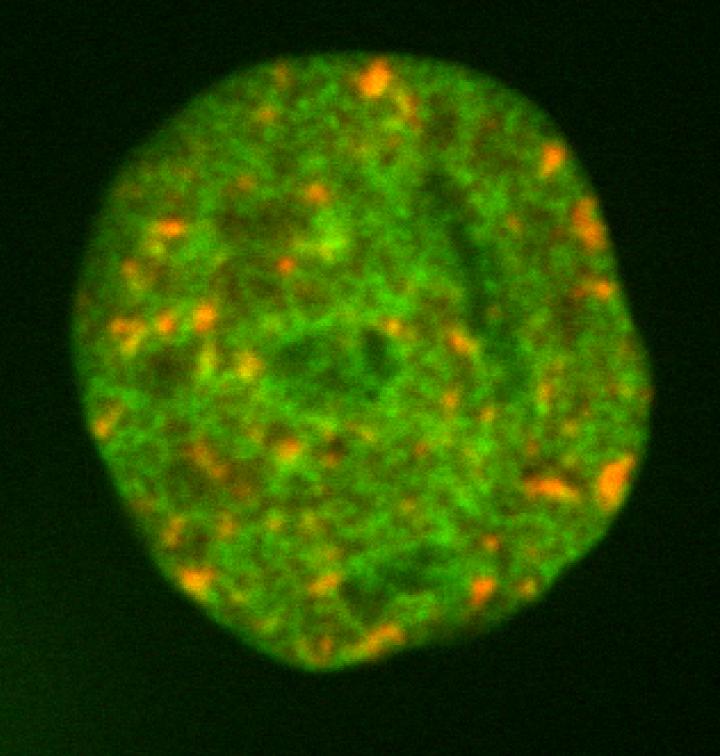
Credit: Jonah A. Eaton and Alexandra Zidovska, Department of Physics, New York University.


A team of scientists has identified how damaged DNA molecules are repaired inside the human genome, a discovery that offers new insights into how the body works to ensure its health and how it responds to diseases that stem from impaired DNA.

“Our findings show that a DNA repair process is very robust, engineered through intricate structural and dynamical signatures where breaks occur,” explains Alexandra Zidovska, an assistant professor in New York University’s Department of Physics and the senior author of the study, which appears in Biophysical Journal. “This knowledge can help us understand human genome in both healthy and disease-stricken states–and potentially offer a pathway for enhancing cancer diagnosis and therapy.”

The human genome consists, remarkably, of two meters of DNA molecules packed inside a cell nucleus, which is ten micrometers in diameter. The proper packing of the genome is critical for its healthy biological function such as gene expression, genome duplication, and DNA repair. However, both the genome’s structure and function are highly sensitive to DNA damage, which can range from chemical change to the DNA molecule to full break of DNA’s well-known double helix.

Yet, such harm is not unusual. In fact, the human genome experiences about thousand DNA damage events every day, which can occur naturally or due to the external factors such as chemicals or UV radiation (e.g. sunlight).

But, if left unrepaired, DNA damage can have devastating consequences for the cell, note Zidovska and study co-author Jonah Eaton, NYU doctoral student. For example, an unrepaired DNA double strand break can lead to cell death or cancer; therefore, DNA repair mechanisms are crucial for cellular health and survival.

In the Biophysical Journal study, the scientists examined the formation, behavior, and motion of DNA double strand breaks in the human genome. To do so, they chemically induced DNA breaks inside of live human cells, tracing these breaks using fluorescent markers. With the help of microscopy and machine learning technologies, they followed the motion of the DNA breaks and genome in both space and time.

In their analysis of more than 20,000 DNA breaks in over 600 cells, the researchers found that genome tends to change the nature of its packing around a DNA break.

“This new packing state for DNA undergoing repair, is unlike any packing state found for a healthy DNA,” says Zidovska. “Around a DNA break we find that DNA becomes denser than its surrounding DNA, forming a small island of highly condensed DNA immersed in the sea of uncondensed DNA.”

In addition, they observed that DNA breaks also move in a unique way–different from that of undamaged parts of genome. The islands of condensed DNA around a DNA break move faster than do healthy DNA, yet the mobility of such islands strongly depends on their size.

“The human genome is constantly exposed to events that damage the DNA molecule,” notes Zidovska. “The cell has robust repair processes that work to eliminate such damage before it can give cause to cancer or other diseases. Now we have a better understanding of how a DNA break behaves differently than the undamaged DNA, which allows us not only to gain insight into these repair processes but also inform our efforts in cancer diagnosis and therapy.”

###

This research was supported by grants from the National Institutes of Health (R00-GM104152) and the National Science Foundation (CAREER PHY-1554880, CMMI-1762506).

Media Contact
James Devitt
[email protected]
212-998-6808

Original Source

https://www.nyu.edu/about/news-publications/news/2019/december/what-does-dna-s-repair-shop-look-like–new-research-identifies-t.html

Related Journal Article

http://dx.doi.org/10.1016/j.bpj.2019.10.042

Tags: BiologyCell BiologyChemistry/Physics/Materials Sciences
Share12Tweet8Share2ShareShareShare2

Related Posts

Engineered Biochar Harnesses Soil Chemistry to Degrade Antibiotic Pollution

Engineered Biochar Harnesses Soil Chemistry to Degrade Antibiotic Pollution

April 2, 2026
From Coffee Waste to Cutting-Edge Biodegradable Insulation: A Green Innovation

From Coffee Waste to Cutting-Edge Biodegradable Insulation: A Green Innovation

April 2, 2026

Study Uncovers Early Origins of Atypical Alterations in Dalí’s The Temptation of St. Anthony (1946), Highlighting Crucial Roles of Amber and Zinc White

April 2, 2026

Racetrack-Shaped Lasers Revolutionize Bright and Stable Frequency Combs

April 2, 2026
Please login to join discussion

POPULAR NEWS

  • blank

    Revolutionary AI Model Enhances Precision in Detecting Food Contamination

    96 shares
    Share 38 Tweet 24
  • Imagine a Social Media Feed That Challenges Your Views Instead of Reinforcing Them

    1007 shares
    Share 398 Tweet 249
  • Promising Outcomes from First Clinical Trials of Gene Regulation in Epilepsy

    51 shares
    Share 20 Tweet 13
  • Popular Anti-Aging Compound Linked to Damage in Corpus Callosum, Study Finds

    44 shares
    Share 18 Tweet 11

About

We bring you the latest biotechnology news from best research centers and universities around the world. Check our website.

Follow us

Recent News

Revolutionary Magnetic Biochar Gel Tackles Arsenic and Antimony Pollution in Rice Cultivation

Engineered Biochar Harnesses Soil Chemistry to Degrade Antibiotic Pollution

Leading Cancer Scientist Thales “PapaG” Papagiannakopoulos Joins Salk Institute

Subscribe to Blog via Email

Enter your email address to subscribe to this blog and receive notifications of new posts by email.

Join 78 other subscribers
  • Contact Us

Bioengineer.org © Copyright 2023 All Rights Reserved.

Welcome Back!

Login to your account below

Forgotten Password?

Retrieve your password

Please enter your username or email address to reset your password.

Log In
No Result
View All Result
  • Homepages
    • Home Page 1
    • Home Page 2
  • News
  • National
  • Business
  • Health
  • Lifestyle
  • Science

Bioengineer.org © Copyright 2023 All Rights Reserved.