• HOME
  • NEWS
  • EXPLORE
    • CAREER
      • Companies
      • Jobs
    • EVENTS
    • iGEM
      • News
      • Team
    • PHOTOS
    • VIDEO
    • WIKI
  • BLOG
  • COMMUNITY
    • FACEBOOK
    • INSTAGRAM
    • TWITTER
Sunday, February 8, 2026
BIOENGINEER.ORG
No Result
View All Result
  • Login
  • HOME
  • NEWS
  • EXPLORE
    • CAREER
      • Companies
      • Jobs
        • Lecturer
        • PhD Studentship
        • Postdoc
        • Research Assistant
    • EVENTS
    • iGEM
      • News
      • Team
    • PHOTOS
    • VIDEO
    • WIKI
  • BLOG
  • COMMUNITY
    • FACEBOOK
    • INSTAGRAM
    • TWITTER
  • HOME
  • NEWS
  • EXPLORE
    • CAREER
      • Companies
      • Jobs
        • Lecturer
        • PhD Studentship
        • Postdoc
        • Research Assistant
    • EVENTS
    • iGEM
      • News
      • Team
    • PHOTOS
    • VIDEO
    • WIKI
  • BLOG
  • COMMUNITY
    • FACEBOOK
    • INSTAGRAM
    • TWITTER
No Result
View All Result
Bioengineer.org
No Result
View All Result
Home NEWS Science News Chemistry

What decides the ferromagnetism in the non-encapsulated few-layer CrI3

Bioengineer by Bioengineer
February 6, 2020
in Chemistry
Reading Time: 2 mins read
0
IMAGE
Share on FacebookShare on TwitterShare on LinkedinShare on RedditShare on Telegram

IMAGE

Credit: ©Science China Press


Since the discovery of two ferromagnetic (FM) atomically thin CrI3 and Cr2Ge2Te6 in 2017 (Nature 2017, 546, 270?Nature 2017, 546, 265), intrinsic ferromagnetism in two-dimensional (2D) van der Waals (vdWs) materials, maintaining long-range magnetic orders at the atomic monolayer limit, has received growing attention. Each individual layer is FM; however adjacent layers are antiferromagnetically (AFM) coupled together. The physical property of 2D ferromagnetism CrI3 are significantly influenced by interlayer spacing and stacking order; the interlayer magnetic states are switched between FM and AFM through electric gating or electrostatic doping and pressure.

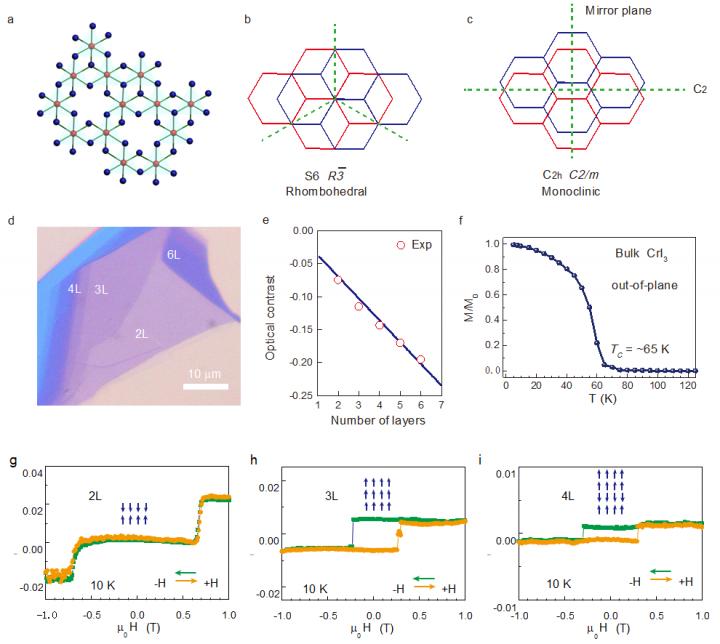
However, there remains debate on the stacking order of CrI3 at low temperature. Previous studies have reported that CrI3 is rhombohedral structure at low temperature (Nat. Mater. 2019, 18, 1303; Phys. Rev. B 2018, 98, 104307), but recent experiments and theory demonstrate that the BN-encapsulated bi- and few-layer CrI3 and CrCl3 belong to monoclinic structure (Nature 2019, 572, 497; Nat Phys, 2019, 15, 1255). Therefore, a complete understanding of lattice dynamics and stacking order of CrI3 is crucial for 2D vdW ferromagnetic materials; however, to data, this is rare.

Recently, Prof. Bo Peng from the University of Electronic Science and Technology of China and his cooperators published a paper entitled “Layer dependence of stacking order in non-encapsulated few-layer CrI3” in Science China Materials, and demonstrated the layer, polarization and temperature dependence of the Raman features of non-encapsulated 2-5 layer and bulk CrI3 (Fig. 1), illustrating that the non-encapsulated few-layer and bulk CrI3 are rhombohedral stacking order at low temperature, rather than monoclinic structure. The helicity of incident light can be maintained by Ag modes at 10 K, while it is reversed by Eg modes, which is independent of the magnetic field and only originates from the phonon symmetry. Strikingly, the spin-phonon coupling occurs below ~60 K, which modifies the Hamiltonian of Raman modes and results in a deviation behavior of the linewidth from phonon-phonon coupling modes.

This work opens up an insight into lattice stacking order and spin-phonon coupling in 2D ferromagnets, and highlights the feasibility for the manipulation of the electron spin and spin waves through spin-phonon coupling toward novel spintronic devices. This work has far-ranging impact and will stimulate the interest in several communities, e.g., layered 2D materials, spintronics, ferromagnetic 2D materials.

###

See the article:
http://engine.scichina.com/publisher/scp/journal/SCMs/doi/10.1007/s40843-019-1214-y?slug=fulltext

Media Contact
Yan Bei
[email protected]

Related Journal Article

http://dx.doi.org/10.1007/s40843-019-1214-y

Tags: Chemistry/Physics/Materials Sciences
Share12Tweet8Share2ShareShareShare2

Related Posts

blank

Breakthrough in Environmental Cleanup: Scientists Develop Solar-Activated Biochar for Faster Remediation

February 7, 2026
blank

Cutting Costs: Making Hydrogen Fuel Cells More Affordable

February 6, 2026

Scientists Develop Hand-Held “Levitating” Time Crystals

February 6, 2026

Observing a Key Green-Energy Catalyst Dissolve Atom by Atom

February 6, 2026
Please login to join discussion

POPULAR NEWS

  • Robotic Ureteral Reconstruction: A Novel Approach

    Robotic Ureteral Reconstruction: A Novel Approach

    82 shares
    Share 33 Tweet 21
  • Digital Privacy: Health Data Control in Incarceration

    63 shares
    Share 25 Tweet 16
  • Breakthrough in RNA Research Accelerates Medical Innovations Timeline

    53 shares
    Share 21 Tweet 13
  • Mapping Tertiary Lymphoid Structures for Kidney Cancer Biomarkers

    50 shares
    Share 20 Tweet 13

About

We bring you the latest biotechnology news from best research centers and universities around the world. Check our website.

Follow us

Recent News

Community Involvement Eases Depression in China’s Empty Nesters

Group Therapy Boosts Recovery in Elderly Depression

Evaluating Biosimilar Trastuzumab for Breast Cancer in Thailand

Subscribe to Blog via Email

Enter your email address to subscribe to this blog and receive notifications of new posts by email.

Join 74 other subscribers
  • Contact Us

Bioengineer.org © Copyright 2023 All Rights Reserved.

Welcome Back!

Login to your account below

Forgotten Password?

Retrieve your password

Please enter your username or email address to reset your password.

Log In
No Result
View All Result
  • Homepages
    • Home Page 1
    • Home Page 2
  • News
  • National
  • Business
  • Health
  • Lifestyle
  • Science

Bioengineer.org © Copyright 2023 All Rights Reserved.