Credit: Robert Gill/Dartmouth College
HANOVER, N.H. – March 28, 2018 – The West Greenland Ice Sheet melted at a dramatically higher rate over the last twenty years than at any other time in the modern record, according to a study led by Dartmouth College. The research, appearing in the journal Geophysical Research Letters, shows that melting in west Greenland since the early 1990s is at the highest levels in at least 450 years.
While natural patterns of certain atmospheric and ocean conditions are already known to influence Greenland melt, the study highlights the importance of a long-term warming trend to account for the unprecedented west Greenland melt rates in recent years. The researchers suggest that climate change most likely associated with human greenhouse gas emissions is the probable cause of the additional warming.
"We see that west Greenland melt really started accelerating about twenty years ago," said Erich Osterberg, assistant professor of earth sciences at Dartmouth and the lead scientist on the project. "Our study shows that the rapid rise in west Greenland melt is a combination of specific weather patterns and an additional long-term warming trend over the last century."
According to research cited in the study, loss of ice from Greenland is one of the largest contributors to global sea level rise. Although glaciers calving into the ocean cause much of the ice loss in Greenland, other research cited in the study shows that the majority of ice loss in recent years is from increased surface melt and runoff.
While satellite measurements and climate models have detailed this recent ice loss, there are far fewer direct measurements of melt collected from the ice sheet itself. For this study, researchers from Dartmouth and Boise State University spent two months on snowmobiles to collect seven ice cores from the remote "percolation zone" of the West Greenland Ice Sheet.
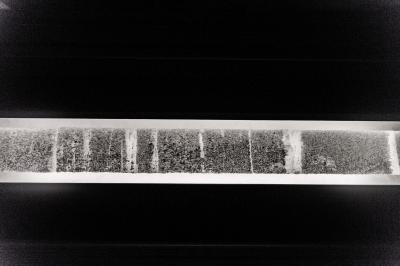
When warm temperatures melt snow on the surface of the percolation zone, the melt water trickles down into the deeper snow and refreezes into ice layers. Researchers were easily able to distinguish these ice layers from the surrounding compacted snow in the cores, preserving a history of how much melt occurred back through time. The more melt, the thicker the ice layers.
"Most ice cores are collected from the middle of the ice sheet where it rarely ever melts, or on the ice sheet edge where the meltwater flows into the ocean. We focused on the percolation zone because that's where we find the best record of Greenland melt going back through time in the form of the refrozen ice layers," said Karina Graeter, the lead author of the study as a graduate student in Dartmouth's Department of Earth Sciences.
The cores, some as long as 100-feet, were transported to Dartmouth where the research team used a light table to measure the thickness and frequency of the ice layers. The cores were also sampled for chemical measurements in Dartmouth's Ice Core Laboratory to determine the age of each ice layer.
The cores reveal that the ice layers became thicker and more frequent beginning in the 1990s, with recent melt levels that are unmatched since at least the year 1550 CE.
"The ice core record ends about 450 years ago, so the modern melt rates in these cores are the highest of the whole record that we can see," said Osterberg. "The advantage of the ice cores is that they show us just how unusual it is for Greenland to be melting this fast".
Year-to-year changes in Greenland melt since 1979 were already known to be closely tied to North Atlantic ocean temperatures and high-pressure systems that sit above Greenland during the summer – known as summer blocking highs. The new study extends the record back in time to show that these were important controls on west Greenland melt going back to at least 1870.
The study also shows that an additional summertime warming factor of 2.2 degrees Fahrenheit is needed to explain the unusually strong melting observed since the 1990s. The additional warming caused a near-doubling of melt rates in the twenty-year period from 1995 to 2015 compared to previous times when the same blocking and ocean conditions were present.
"It is striking to see how a seemingly small warming of only 2.2 degrees Fahrenheit can have such a large impact on melt rates in west Greenland," said Graeter.
The study concludes that North Atlantic ocean temperatures and summer blocking activity will continue to control year-to-year changes in Greenland melt into the future. Some climate models suggest that summer blocking activity and ocean temperatures around Greenland might decline in the next several decades, but it remains uncertain. However, the study points out that continued warming from human activities would overwhelm those weather patterns over time to further increase melting.
"Cooler North Atlantic ocean temperatures and less summer blocking activity might slow down Greenland melt for a few years or even a couple decades, but it would not help us in the long run," said Osterberg. "Beyond a few decades, Greenland melting will almost certainly increase and raise sea level as long as we continue to emit greenhouse gases."
###
Editor's Notes
A video detailing the 2016 research expedition to collect ice cores in West Greenland Ice Sheet "percolation zone" can be viewed at: https://www.youtube.com/watch?v=eef0_rXvAUU
About Dartmouth
Founded in 1769, Dartmouth is a member of the Ivy League and offers the world's premier liberal arts education, combining its deep commitment to outstanding undergraduate and graduate teaching with distinguished research and scholarship in the arts and sciences and its three leading professional schools: the Geisel School of Medicine, Thayer School of Engineering and Tuck School of Business.
Media Contact
David Hirsch
[email protected]
@dartmouth
http://www.dartmouth.edu
Related Journal Article
http://dx.doi.org/10.1002/2017GL076641