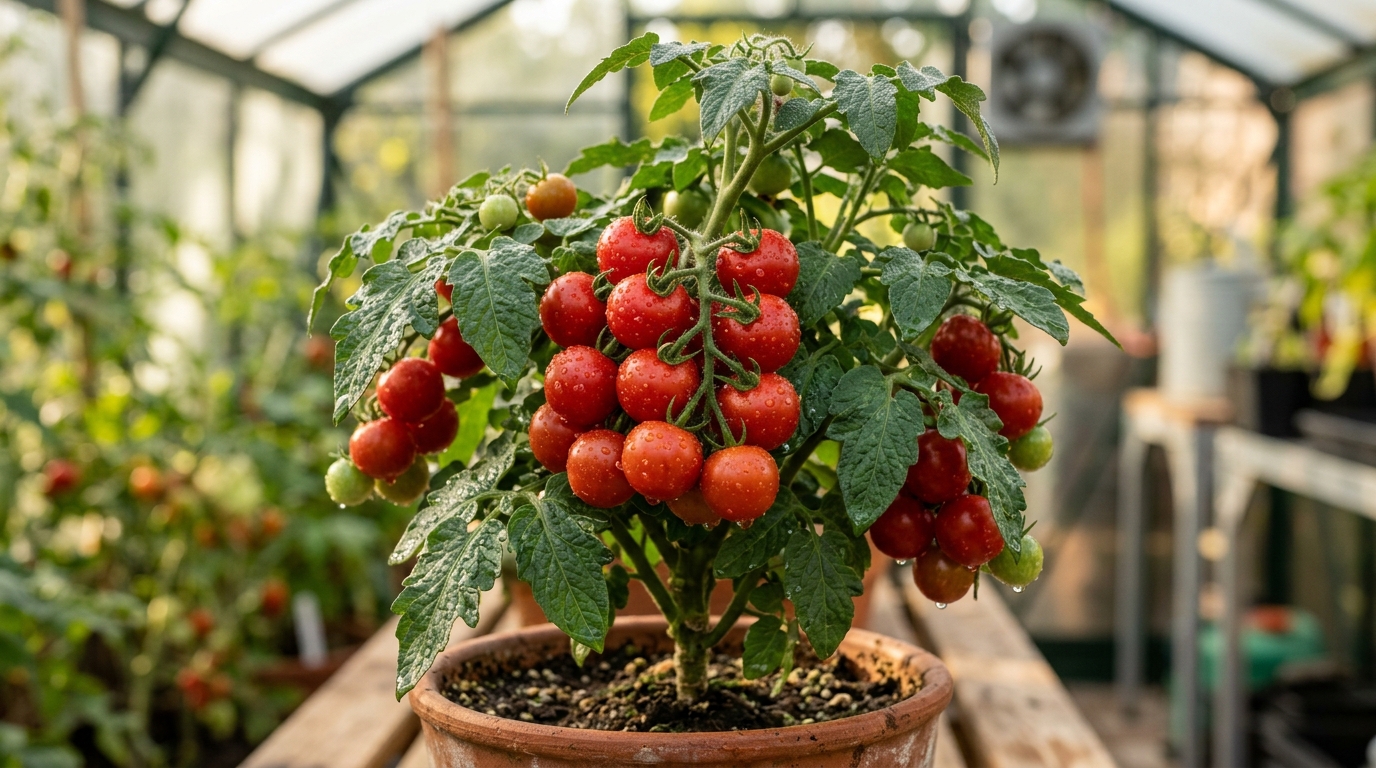
Foliar application of isosorbide at a concentration of 2.5 millimolar significantly increased total fruit fresh weight and mean individual fruit fresh weight in Micro-Tom tomato (Solanum lycopersicum) when applied once weekly, according to a brief report published in Discover Agriculture. Researchers observed that the treatment boosted average fruit yield without changing the total number of fruits per plant or altering fruit sweetness as measured by Brix percentage.
The investigation addresses the demand for sustainable crop production strategies that improve agricultural yields while minimizing environmental impacts, focusing on biostimulants that enhance plant performance without functioning as conventional chemical fertilizers or synthetic pesticides. Recent advances in the circular bioeconomy have highlighted pathways for transforming biomass-derived polymers into value-added materials, including poly(isosorbide carbonate), a bio-based polymer that can be chemically recycled into urea as its primary product alongside isosorbide as a secondary by-product. While urea is an established agricultural nitrogen source, the potential physiological utility of isosorbide in agricultural crop development has only recently begun to receive scientific attention.
Chemically classified as a glucose-derived bicyclic sugar alcohol belonging to the polyol family—which also includes naturally occurring compounds like sorbitol and mannitol—isosorbide was previously shown to enhance vegetative growth, improve nutrient uptake and use efficiency, and modulate stress responses in Arabidopsis thaliana. Although earlier horticultural research noted that applying naturally occurring polyols could favorably modify fruit quality and metabolic dynamics in grapevines, structural similarities do not guarantee identical physiological functions, leaving the efficacy of isosorbide in edible fruit-bearing crops largely unexplored prior to this study.
To evaluate whether the growth-promoting properties observed in model weeds translate to horticultural production, the researchers selected Micro-Tom tomato as an experimental model system well-suited for controlled-environment research due to its compact stature and rapid lifecycle spanning 70 to 90 days from sowing to fruit ripening. Plants were cultivated from seed in soil-filled pots housed within an environmental growth chamber maintained at a constant temperature of 23 degrees Celsius (plus or minus 1 degree) under a controlled photoperiod consisting of 16 hours of light and 8 hours of darkness. All pots received identical soil volumes and uniform nutrient solution applications to maintain uniform developmental conditions ahead of experimental treatments.
Foliar treatments commenced at the flowering stage, exactly 40 days after sowing, using an automated spraying apparatus designed to deliver standardized coverage across experimental units. Plants were treated with either a 0 millimolar control solution or a 2.5 millimolar isosorbide solution, a concentration selected based on prior Arabidopsis trials where it consistently stimulated growth and nutrient use efficiency. To promote foliar uptake, solutions were supplemented with 0.01 percent (by volume) of the wetting agent Makupika, while control plants received water containing only the surfactant; each pot was sprayed for approximately 25 seconds until leaf surfaces were thoroughly wetted without visible liquid runoff.
The experimental design tested two application schedules, administering the foliar spray either once weekly or twice weekly across three biological replicates per treatment combination, with each single plant serving as an independent experimental unit. Harvesting took place at full fruit maturity, approximately 90 days after sowing, at which point researchers recorded total fruit fresh weight per plant alongside the total fruit count. Individual fruit fresh weights were recorded for all harvested fruits to determine the mean individual fruit weight for each plant replicate.
To determine whether isosorbide exposure altered internal fruit quality parameters, total soluble solids were quantified as Brix percentages from juice extracted from five randomly selected ripe fruits per plant. These measurements were performed using a digital pocket Brix meter (model PAL-BX|ACID, manufactured by ATAGO Co., Ltd., Tokyo, Japan). Statistical evaluations of all collected yield and quality metrics were performed through two-way analysis of variance (ANOVA) assessing isosorbide treatment, spray frequency, and their interaction as fixed factors, followed by Tukey’s honestly significant difference post-hoc tests with significance established at P < 0.05.
The results demonstrated a pronounced yield enhancement under the once-weekly isosorbide regime, where total fruit fresh weight increased from an average of 68.5 grams per plant in once-weekly control specimens to 95.1 grams per plant in once-weekly isosorbide-treated specimens. This cumulative yield gain was directly reflected in an increase in mean individual fruit fresh weight rather than an increase in the number of fruits produced per plant. Conversely, plants subjected to the twice-weekly isosorbide treatment did not exhibit a statistically significant increase in total fruit fresh weight or individual fruit biomass relative to control groups.
Two-way ANOVA confirmed significant main effects for isosorbide treatment (F1,8 = 27.14, P = 0.0008) and application frequency (F1,8 = 16.46, P = 0.0036), as well as a statistically significant treatment-by-frequency interaction (F1,8 = 11.42, P = 0.0097). This significant interaction demonstrates that tomato plant biomass accumulation in response to isosorbide was strictly dependent upon application frequency. Furthermore, statistical analysis confirmed that neither isosorbide treatment nor spray frequency exerted any significant effect on total fruit number per plant, and no significant pairwise differences in soluble solids (Brix %) were detected among any of the treatment combinations.
Because fruit biomass accumulation is largely governed by source-sink relationships and the allocation of photoassimilates to developing sink organs, the authors noted that isosorbide may influence assimilate partitioning, although the exact underlying physiological mechanisms remain to be elucidated. The study authors emphasized several key limitations: vegetative biomass was not directly quantified, and the preliminary investigation was restricted to a single dwarf tomato cultivar grown under controlled growth-chamber conditions. While the findings provide preliminary evidence that foliar-applied isosorbide can act as an effective biostimulant for fruit biomass production, further investigations across commercial cultivars and field environments are required to clarify its broader agricultural applicability.
The research, conducted by Raj Kishan Agrahari, Daisuke Aoki, Toru Fujiwara, and Takehiro Kamiya, highlights an unexpected bridge between polymer chemistry and agricultural science. Within circular bioeconomy frameworks, poly(isosorbide carbonate) can be chemically recycled into urea as a major nitrogen fertilizer, producing isosorbide as a secondary by-product. While urea is an established agricultural nutrient, the biological function of isosorbide in plants remained virtually uncharacterized until recent work demonstrated its capacity to promote growth, improve nutrient use efficiency, and modulate stress responses in Arabidopsis thaliana. By testing whether these properties extend to a horticultural crop, the authors sought to determine whether an industrial recycling by-product could offer functional agricultural utility.
Structurally, isosorbide is a glucose-derived bicyclic diol belonging to the polyol family, which includes naturally occurring compounds such as mannitol and sorbitol. In botanical systems, endogenous polyols play established roles in carbon transport, osmotic regulation, and abiotic stress responses. Prior horticultural literature has demonstrated that foliar-applied sugar alcohols and related compounds are readily absorbed across leaf surfaces, influencing metabolic processes and fruit quality in fruit crops such as grapevines. However, the researchers emphasized that chemical resemblance to natural sugar alcohols does not inherently confer identical physiological functions, underscoring the necessity of testing isosorbide directly on crop growth and yield.
To ensure high reproducibility across treatments, the experimental setup relied on automated execution and precise environmental regulation. Plants were cultivated in soil-filled pots under a 16-hour light and 8-hour dark photoperiod at a constant 23 degrees Celsius, receiving uniform soil and nutrient solution volumes. Foliar treatments began at the flowering stage, exactly 40 days after sowing, using an automated spraying system operating for 25 seconds per plant to achieve thorough leaf wetting without runoff. Formulations paired 2.5 millimolar isosorbide from TCI (Tokyo, Japan) with 0.01 percent Makupika from ISK (Osaka, Japan), applying a concentration previously validated to consistently stimulate growth and nutrient efficiency in Arabidopsis.
The pronounced difference between once-weekly and twice-weekly applications provides critical insight into the dynamics of biostimulant delivery. While once-weekly spraying increased total fruit fresh weight from 68.5 grams to 95.1 grams per plant, twice-weekly spraying generated no significant gain. The authors emphasized that this outcome should not be assumed to reflect a detrimental effect from more frequent spraying. Instead, the statistically significant treatment-by-frequency interaction confirmed that tomato responsiveness is intrinsically dependent on application frequency, demonstrating that escalating spray frequency does not necessarily amplify plant growth benefits or promote additional biomass accumulation.
The physiological pattern of the yield increase further clarifies how isosorbide influences reproductive development. Because fruit count remained unchanged while both total fruit fresh weight and mean individual fruit fresh weight increased significantly under once-weekly treatment, the authors concluded that higher individual fruit biomass drove the observed yield response. In fruiting crops, final yield is largely governed by source-sink relationships and the efficient allocation of photoassimilates to developing fruits. The researchers suggested that foliar isosorbide may alter assimilate partitioning toward developing fruit sinks, although the underlying physiological mechanisms remain to be fully characterized.
Finally, the authors framed their conclusions around the inherent boundaries of a brief report. The study evaluated a single compact cultivar under growth-chamber conditions and did not assess vegetative biomass, leaving questions about whole-plant biomass partitioning unanswered. The team noted that future investigations using additional tomato genotypes and physiological evaluations will be essential to establish the generality of the response and clarify the underlying mode of action. Nonetheless, the findings establish preliminary evidence that foliar-applied isosorbide can influence fruit biomass, providing a basis for evaluating bio-based recycled compounds in sustainable crop production.
Subject of Research: Effects of foliar-applied isosorbide on tomato fruit biomass production
Article Title: Foliar application of isosorbide influences fruit fresh weight in Micro-Tom tomato
Article References: Agrahari, R. K., Aoki, D., Fujiwara, T., & Kamiya, T. (2026). Foliar application of isosorbide influences fruit fresh weight in Micro-Tom tomato. Discover Agriculture, 4(1), Article 333. https://doi.org/10.1007/s44279-026-00820-z
Image Credits: AI Generated
DOI: 10.1007/s44279-026-00820-z
Keywords: isosorbide, Micro-Tom tomato, plant biostimulants, foliar application, fruit fresh weight, crop yield, polyols, Solanum lycopersicum, Foliar, application, influences, fruit
News Source: Alan Morgan. (November 7, 2026). Weekly Foliar Isosorbide Sprays Boost Fruit Weight in Micro-Tom Tomatoes. Scienmag.