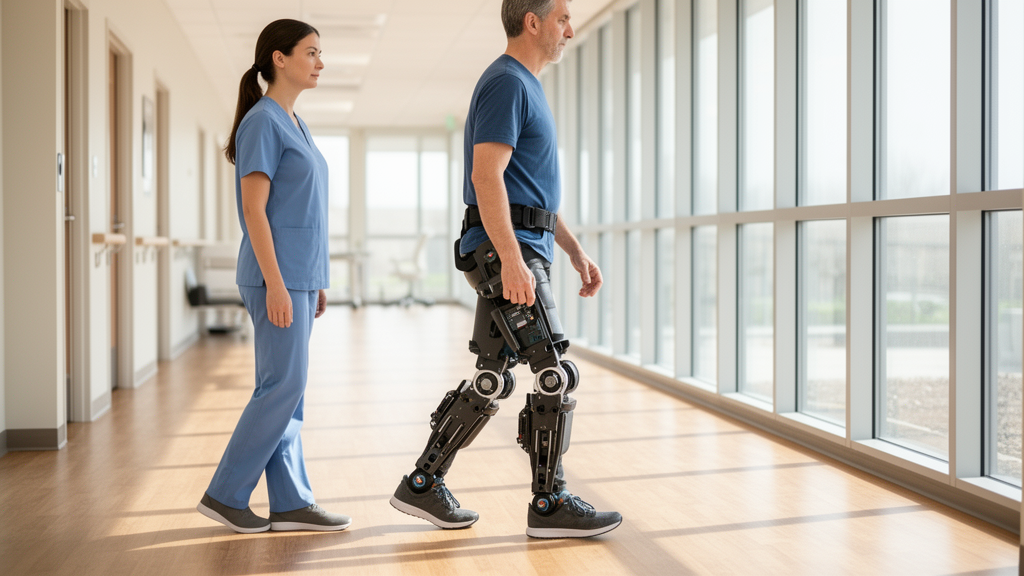
Reporting in BMC Sports Science, Medicine and Rehabilitation, investigators Joon Hee Lee, Min Ho Chun, An Na Lee, and Hyo Jin Jeon assessed mobility outcomes before and after five weeks of structured rehabilitation. While the primary comparison between the intervention group and the control group showed no significant divergence across the combined study population, specific functional gains emerged when researchers examined participants according to their initial ambulatory capabilities.
In a targeted subgroup analysis categorized by baseline mobility levels, individuals who entered the trial with greater functional independence demonstrated measurable therapeutic benefits from the wearable robotic system. Among patients classified with a score of 4 on the Functional Ambulatory Category scale, those assigned to the Myosuit training protocol achieved statistically significant improvements in their 10-meter walking test performance, Berg Balance Scale scores, and overall gait velocity.
The clinical trial was conducted between April 2022 and September 2022 to examine how robotic-assisted walking and balance training influences chronic hemiparetic stroke recovery.
A total of 30 adult patients over the age of 19 who presented with hemiparesis secondary to chronic stroke were enrolled in the study.
Both groups completed an identical scheduling framework consisting of ten 50-minute exercise sessions distributed over a 5-week intervention period. Each individual session was structured methodically into warmup exercises, main functional training routines, and structured cooldown activities. The core training regimen was divided into two distinct exercise protocols dedicated to walking and balance rehabilitation, with each protocol further graduated into easy, medium, and hard difficulty levels according to mechanical and physiological intensity.
To capture changes in physical performance and movement dynamics, the investigators administered a wide battery of validated functional assessments before and after the five-week intervention. Ambulation and motor function were evaluated using the Functional Ambulatory Category scale, the 10-meter walking test, the Timed Up and Go test, the Motricity Index of the lower extremity, the 6-minute walking test, and the Berg Balance Scale. In addition to these clinical tests, researchers utilized a specialized Gait Analysis Training System to quantify kinematic and kinetic gait parameters, providing detailed instrumental data regarding lower-limb biomechanics.
Statistical evaluations confirmed that baseline demographic and clinical characteristics did not differ significantly between the Myosuit group and the control group at the start of the study. Following the intervention, comparative analysis revealed no significant divergence between the groups across the general cohort, leading the authors to conclude that gait training using the Myosuit soft wearable robot may primarily benefit patients who already maintain better baseline gait function.
Subject of Research: Soft wearable robot gait training in chronic stroke rehabilitation
Article Title: Effects of training with a soft wearable robot (Myosuit®) on the walking ability of patients with chronic stroke
Article References: Lee, J. H., Chun, M. H., Lee, A. N., & Jeon, H. J. (2026). Effects of training with a soft wearable robot (Myosuit®) on the walking ability of patients with chronic stroke. BMC Sports Science, Medicine and Rehabilitation. https://doi.org/10.1186/s13102-026-02135-4
Image Credits: AI Generated
DOI: 10.1186/s13102-026-02135-4
Keywords: Myosuit, soft wearable robot, chronic stroke, gait training, hemiparesis, Functional Ambulatory Category, 10-meter walking test, Berg Balance Scale, gait velocity, Timed Up and Go test, 6-minute walking test, Motricity Index, Gait Analysis Training System, kinematic gait parameters, kinetic gait parameters, stroke rehabilitation
News Source: Cassandra Pierce. (November 11, 2026). Wearable Robot Aids Walking Ability in Higher Functioning Chronic Stroke Patients. Scienmag.