


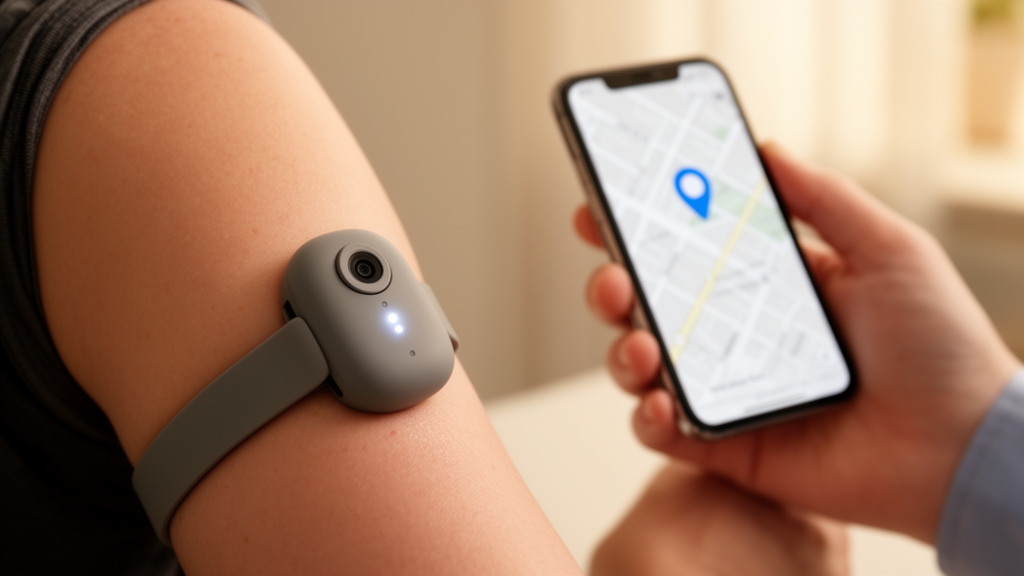
Researchers have built a wrist-worn device that detects epileptic seizures in real time using artificial intelligence running entirely on the device itself, then immediately texts caregivers an SMS message containing a Google Maps link to the wearer’s exact location. The prototype, described in BMC Biomedical Engineering, combines motion sensing, heart-rate monitoring and GPS tracking in a single unit that costs roughly 45 to 55 US dollars to produce, a fraction of the price of leading commercial seizure-detection wearables.
The system was developed by Tsion Fekadu, Kidist Dagnachew and Abdi Bekele, who set out to address four persistent shortcomings of existing wearable seizure detectors: reliance on a single sensor, dependence on remote servers for data analysis, high purchase cost, and false alarm rates that often exceed 1.5 per day. Epilepsy affects nearly 50 million people worldwide, and approximately 80 percent of those cases are found in low- and middle-income countries, where access to diagnostic equipment, specialists and continuous monitoring remains scarce. The team argues that this is precisely where affordable, self-contained technology could make the greatest difference.
At the heart of the prototype is a Raspberry Pi 3B+ single-board computer that processes signals from three sensors. An MPU-6050 module provides six-axis motion data, sampling acceleration and gyroscope readings at 100 hertz, a rate chosen to capture the dominant frequency components of convulsive movements, which typically fall below 20 to 30 hertz. A MAX30102 sensor records photoplethysmography signals at 25 hertz, tracking the cardiovascular changes such as ictal tachycardia that often accompany seizures. A NEO-6M GPS unit with 2.5-meter accuracy handles location, while a SIM800L GSM module sends alerts over the cellular network without any internet connection.
Raw sensor streams are cleaned in real time using wavelet-based noise reduction and session-specific normalization, which the developers report improves the signal-to-noise ratio by approximately 40 percent compared with unprocessed data. The cleaned signals then feed a machine learning model that classifies each five-second analysis window as either normal activity or seizure. Because all of this computation happens locally, the system avoids the delays and connectivity requirements of cloud-based alternatives, which the paper notes can add several seconds to tens of seconds of latency due to data upload and remote inference.
To choose the best algorithm, the team trained and compared three supervised models off-device on the SHAR-100-20 synthetic dataset obtained from Kaggle, which simulates a range of human activities using acceleration, angular velocity and heart-rate measurements. The candidates were a random forest classifier, a linear support vector machine and a shallow feedforward neural network. After preprocessing, which included converting activity labels into binary seizure or normal categories, addressing missing values, applying MinMax normalization and balancing classes through undersampling, the data was split with 80 percent for training and 20 percent for testing. The random forest achieved the best balance of accuracy, robustness and projected inference speed, so it alone was deployed to the prototype.
The deployed model is deliberately lightweight. It consists of 35 decision trees with a maximum depth of five and a minimum of two samples per split, parameters chosen empirically for strong generalization with low computational overhead. Serialized in pickle format, the model occupies about 3.8 megabytes and requires no quantization, since tree-based models are inherently efficient on CPU-only hardware. During continuous operation on the Raspberry Pi 3B+, it uses less than 120 megabytes of RAM, keeps CPU utilization below 25 percent, and achieves a median inference time of 28 milliseconds per five-second window, measured across 500 windows.
In simulation, the fused multi-sensor model reached 99.2 percent sensitivity for convulsive seizures and 96.3 percent sensitivity for non-convulsive seizures, with specificity exceeding 99.96 percent and an estimated false alarm rate of 0.94 per day. Ablation experiments underscored why sensor fusion matters: an accelerometer and gyroscope-only model managed 98.7 percent sensitivity for convulsive events but only 82.1 percent for non-convulsive ones, while a PPG-only model achieved 78.4 percent overall sensitivity. Combining motion and cardiovascular signals lifted non-convulsive sensitivity to 96.3 percent, a 31.3 percentage-point improvement the authors attribute to the complementary information carried by the two modalities. Non-convulsive events account for nearly 40 percent of epileptic seizures and are frequently missed by current wearables.
Speed is a headline feature. Measured over 100 simulated seizure events on the physical prototype, the median end-to-end latency from seizure onset detection to successful SMS transmission was 142 milliseconds, encompassing feature extraction, model inference, GPS acquisition, message formatting and GSM transmission. The alerting sequence itself, which captures the user’s location, generates a message with a Google Maps link and dispatches it to designated emergency contacts, completes in under 500 milliseconds. The authors emphasize that this fully on-device pipeline eliminates the network-dependent delays typical of cloud-based systems, enabling near-instant local alerting that can be critical for rapid caregiver response.
Battery life and cost were engineered with low-resource settings in mind. The prototype ran for more than 23 hours on a single charge of its 2000 milliamp-hour lithium-ion battery, with the processor accounting for roughly 60 to 65 percent of power draw, the two sensors about 15 percent, the GSM module 15 to 20 percent and the GPS unit less than 5 percent, since it activates only upon detection. The estimated bill of materials comes to approximately 45 to 55 dollars in small quantities, including the Raspberry Pi at 35 dollars, the motion sensor at 2 dollars, the PPG sensor at 3 dollars, the GPS unit at 10 dollars and the GSM module at 5 dollars, plus casing and battery. That represents a 55 to 62 percent reduction compared with leading commercial devices such as the Empatica Embrace2, which retails at 249 dollars plus a subscription.
The authors are careful to frame these results as simulated performance. All detection metrics were obtained on a synthetic Kaggle dataset under simulated conditions, and the paper states plainly that they are not directly comparable to the published clinical validation figures for commercial devices, which come from real-patient studies focused primarily on convulsive seizures. The false alarm rate was extrapolated from the test-set false positive rate to continuous 24-hour monitoring. The team notes that long-term clinical trials involving diverse patient populations are necessary to confirm generalizability against standardized benchmarks, that the 23-hour battery life requires daily charging, and that dependence on GSM networks limits functionality in areas without cellular coverage. Future work will explore adaptive personalization, additional sensing modalities such as electrodermal activity, alternative communication protocols including LoRaWAN and satellite networks, and energy harvesting. The developers also plan to release the hardware designs and simulation tools as open-source resources to support broader development of affordable medical IoT solutions for the estimated 50 million people living with epilepsy worldwide.
Subject of Research: An edge-AI wearable platform for real-time epileptic seizure detection with geolocated SMS alerting
Article Title: An edge-AI enabled wearable platform for real-time epileptic seizure detection with geolocated alerting
Article References: Fekadu, T., Dagnachew, K., & Bekele, A. (2026). An edge-AI enabled wearable platform for real-time epileptic seizure detection with geolocated alerting. BMC Biomedical Engineering, 8(1), Article 13. https://doi.org/10.1186/s42490-026-00116-9
Image Credits: AI Generated
DOI: 10.1186/s42490-026-00116-9
Keywords: epilepsy, wearable technology, edge AI, random forest, sensor fusion, seizure detection, GPS alerting, low-resource settings, biomedical engineering, machine learning, SMS alerts, Raspberry Pi
News Source: Denise Maddox. (October 28, 2026). Wearable edge-AI device detects epileptic seizures and texts caregivers a map link in under half a second. Scienmag.



