In a groundbreaking development that promises to transform mental health monitoring and personalized medicine, researchers have unveiled a quantitatively advanced, multimodal wearable bioelectronic device engineered for comprehensive stress assessment and precise sub-classification of stress types. This innovative technology, detailed in a recent publication in Nature Communications, marks a significant leap forward in our ability to continuously and accurately monitor physiological and psychological states, thereby paving the way for real-time, individualized interventions aimed at mitigating stress-related health issues.
The device integrates a suite of sensors capable of capturing a diverse array of physiological signals associated with stress responses. Unlike traditional biometric monitoring tools that rely on single-parameter measurements, this multimodal system synergistically combines data streams, including electrodermal activity, heart rate variability, skin temperature, and potentially additional biomarkers such as cortisol levels or cerebral hemodynamics. This holistic approach enables a more nuanced and precise detection of stress as a multifaceted phenomenon, embracing its complex biological manifestations rather than oversimplifying it into binary states.
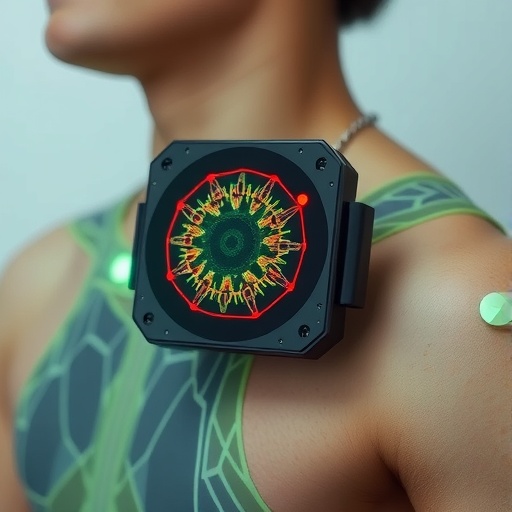
At the core of the innovation lies a sophisticated bioelectronic architecture designed for unobtrusive, continuous wear. The bioelectronic interface employs flexible, skin-compatible materials that ensure high-fidelity signal acquisition while maximizing wearer comfort and minimizing motion artifacts. Advanced analog front-end circuitry and signal conditioning modules are integrated to preprocess biosignals in real-time, which are then digitized and relayed to onboard processing units. The compact design leverages low-power electronics, ensuring prolonged device operation suitable for everyday use, a critical factor for capturing authentic, context-rich stress data throughout daily life.
A unique feature of this system is its embedded multimodal data fusion algorithm, incorporating machine learning frameworks trained on extensive physiological datasets. These models are adept at discerning subtle interrelationships between disparate biosignals, enabling the device not only to quantify stress intensity but to sub-classify stress into specific categories, such as physical stress, psychological stress, or emotional stress. This capacity to differentiate stress types is unprecedented in wearable technology, offering an empirical basis for tailored therapeutic recommendations rather than generic stress management advice.
The device’s robustness is further enhanced by integration with cloud-based analytics platforms for long-term data aggregation and trend analysis. Users and clinicians alike benefit from dynamic dashboards that visualize stress patterns over days, weeks, or months, facilitating early intervention strategies and improving clinical decision-making. This longitudinal perspective on stress trajectories has substantial implications for chronic disease prevention and mental health management, particularly in high-risk populations vulnerable to stress-induced pathologies.
Behind the scenes, the engineering team confronted formidable challenges in harmonizing biosensor calibration, noise suppression, and data integrity under real-world, ambulatory conditions. The development process involved iterative prototyping cycles and extensive validation trials encompassing diverse demographic cohorts to ensure device reliability and generalizability. Importantly, the researchers prioritized user-centric design elements, including intuitive interfaces and customizable notification systems, to promote adherence and behavioral engagement with the monitoring regimen.
An intriguing aspect of this research is the exploration of biofeedback loops facilitated by the device. Beyond passive data collection, the system can prompt psycho-physiological interventions such as breathing exercises or mindfulness prompts tailored to detected stress subtypes. This interactive dimension transforms the wearable from a mere sensor to an active participant in stress management, fostering enhanced self-regulation and resilience in users.
Experts in neurobiology and wearable technology herald this advancement as a confluence of disciplines—combining insights from molecular biology, signal processing, materials science, and artificial intelligence. Such interdisciplinary synergy exemplifies the future path of digital health innovations, where comprehensive physiological characterization is melded with actionable intelligence to address complex health challenges holistically.
Importantly, the implications of this technology extend beyond individual health applications. On a societal scale, aggregated anonymized data could inform public health policies related to workplace stress, urban living conditions, and social determinants of mental health. This epidemiological potential underscores the device’s dual role as both a personalized tool and a data source for broader behavioral health research.
The researchers also address ethical considerations related to data privacy and security, implementing robust encryption protocols and complying with stringent regulatory standards to protect sensitive health information. Transparency in data handling and user control over data sharing further reinforce the ethical framework supporting widespread adoption.
Looking ahead, future iterations of the device are envisaged to incorporate additional sensing modalities, such as neuroimaging-inspired optical sensors or biochemical assays for inflammatory markers, to enrich the physiological context of stress assessment further. Integration with augmented reality platforms and smart environments may also offer real-time contextualization of stress triggers, enabling seamless ambient interventions.
In conclusion, this multimodal bioelectronic wearable represents a monumental stride towards nuanced, quantitative understanding and management of human stress. By merging cutting-edge sensor technology, intelligent analytics, and user-centered design, the device embodies a new paradigm in personalized mental health care, with the potential to alleviate the global burden of stress-related disorders and enhance overall well-being in an increasingly complex world.
Subject of Research: Development of a quantitative, multimodal wearable bioelectronic device for comprehensive assessment and sub-classification of stress
Article Title: A quantitative, multimodal wearable bioelectronic device for comprehensive stress assessment and sub-classification
Article References:
Pei, X., Ghandehari, A., Chakoma, S. et al. A quantitative, multimodal wearable bioelectronic device for comprehensive stress assessment and sub-classification. Nat Commun (2026). https://doi.org/10.1038/s41467-025-67747-9
Image Credits: AI Generated
Tags: advanced biometric sensorscontinuous physiological monitoringelectrodermal activity measurementheart rate variability analysisinnovative healthcare technologymultimodal physiological assessmentpersonalized mental health interventionsreal-time stress analysisskin temperature monitoringstress monitoring technologystress response biomarkerswearable bioelectronic device