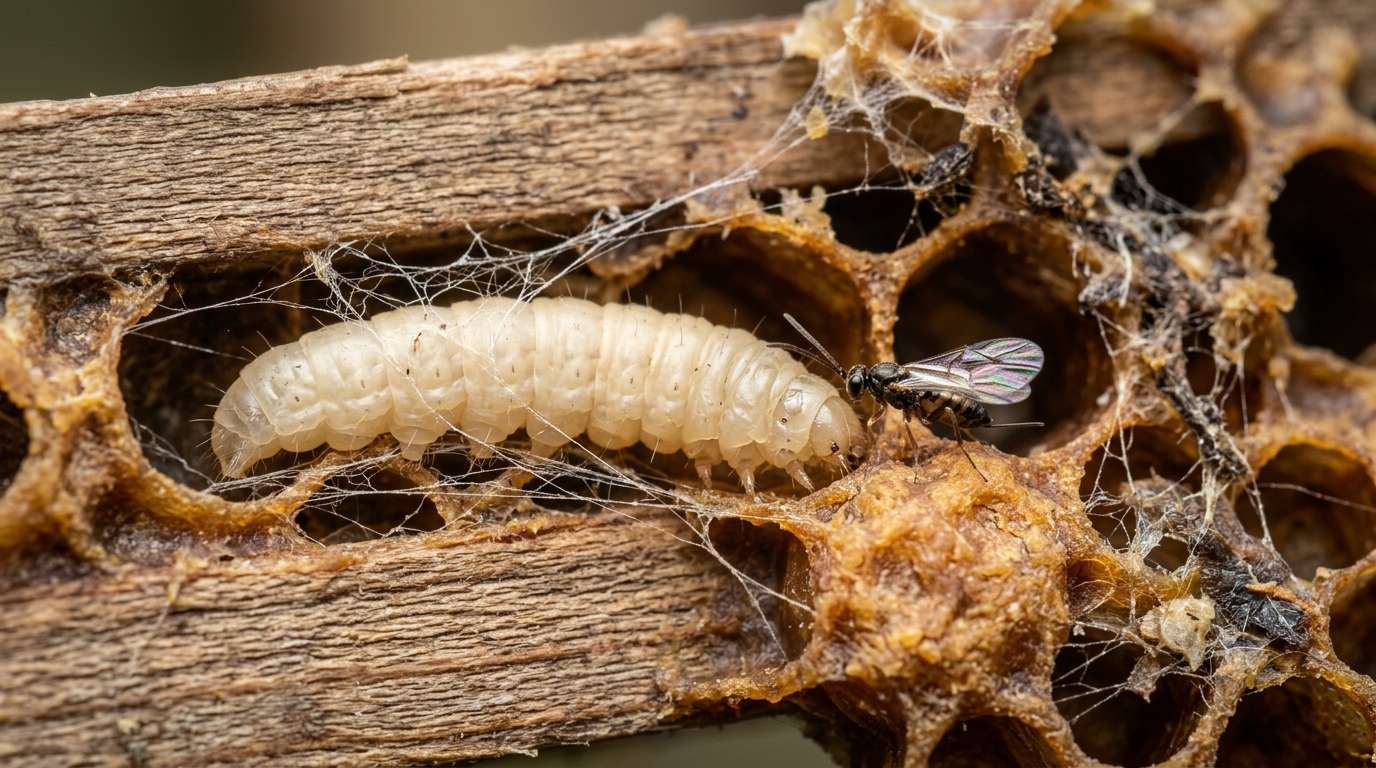
Researchers conducted a laboratory study between 2023 and 2025 to evaluate the biological performance and life table parameters of the parasitoid wasp Habrobracon hebetor on three different host species. The study, published in the Egyptian Journal of Biological Pest Control, focused on the Indian meal moth, the fig moth, and the wax moth. The primary objective was to determine which host species best supports the development and reproduction of the parasitoid, a key consideration for mass rearing programs aimed at biological control of stored product pests.
The experiments were carried out in the Idlib Governorate under controlled room conditions, with a temperature maintained at 27 ± 2 °C and a relative humidity of 65 ± 5%. The research team collected last-stage larvae of the three host species from local fig storages and beekeeping apiaries. Adult parasitoids were also gathered from the region, where they were observed parasitizing pests in stored products. Colonies were established to ensure a continuous supply of larvae and parasitoids for the duration of the experiments.
The study design included two main components: a life cycle analysis and an estimation of life table parameters. For the life cycle study, fifty homogeneous larvae of each host species were placed in Petri dishes with five pairs of the parasitoid. The wasps were left with the hosts for 24 hours to allow for parasitism. Subsequently, larvae containing parasitoid eggs were isolated, and excess eggs were removed to ensure only one egg remained per larva. This process was repeated 25 times for each host species to record the duration of egg incubation, larval growth, and pupal stages until adult emergence.
The results indicated that all three hosts were suitable for rearing the parasitoid, but significant differences were observed in developmental duration. The average total development time for the immature stages of the parasitoid was 12.36 days on the fig moth, 12.16 days on the Indian meal moth, and 11.54 days on the wax moth. Statistical analysis revealed that the larval stage duration was significantly shorter on the wax moth compared to the other two hosts, while the incubation and pupal durations did not show significant differences among the host species.
Life table parameters were estimated to assess the population growth potential of the parasitoid on each host. The net reproductive rate (R0), which measures the average number of female offspring produced by a single female over her lifespan, was highest when the parasitoid was reared on the wax moth, reaching a value of 49.73. This was followed by the Indian meal moth with a value of 43.28 and the fig moth with 43.23. The gross reproductive rate (GRR), representing the total lifetime egg production, was also highest on the wax moth at 110.87 eggs, compared to 107.02 on the Indian meal moth and 89.96 on the fig moth.
The intrinsic rate of increase (rm), a measure of population growth under constant environmental conditions, was also maximized on the wax moth host, with a value of 0.22 female per female per day. The Indian meal moth supported an rm of 0.19, and the fig moth supported an rm of 0.18. Correspondingly, the finite rate of increase (λ), which indicates the population growth rate from one generation to the next, was highest on the wax moth at 1.25, followed by the Indian meal moth at 1.21 and the fig moth at 1.19.
Generation time (T) and doubling time (DT) were shortest when the parasitoid was reared on the wax moth. The generation time was 17.58 days on the wax moth, compared to 19.79 days on the Indian meal moth and 21.22 days on the fig moth. The doubling time, which represents the time required for the population to double in size, was 3.12 days on the wax moth, 3.65 days on the Indian meal moth, and 3.92 days on the fig moth. These metrics suggest that the wax moth allows for the most rapid population expansion of the parasitoid.
The sex ratio (SR) of the emerging parasitoids was female-biased across all three host species. The SR was 0.86 on the wax moth, 0.76 on the Indian meal moth, and 0.68 on the fig moth. The higher SR on the wax moth further supports its suitability as a host for mass rearing purposes.
To provide context for the parasitoid’s performance, the researchers also recorded life table data for the Indian meal moth pest population itself. The pest exhibited a higher gross reproductive rate of 133.86 eggs and a net reproductive rate of 79.15 compared to the parasitoid on any of the hosts. However, the parasitoid demonstrated a higher intrinsic rate of increase and a shorter generation time than the pest. The pest’s generation time was 50.20 days, and its doubling time was 7.69 days, both of which were longer than those of the parasitoid on any of the tested hosts.
The discussion highlights that the superior performance of the parasitoid on the wax moth may be attributed to the larger size of the wax moth larvae, which provides a more adequate food supply and reduces competition among immature parasitoids. These findings are consistent with previous studies that identified the wax moth as a preferred host for H. hebetor rearing due to its ability to support higher cumulative fertility and adult production. The results suggest that using the wax moth as a host could enhance the efficiency of biological control programs targeting pyralid pests in stored product environments.
The study emphasizes the importance of host selection in improving parasitoid rearing strategies. By identifying the wax moth as the optimal host, the research provides a basis for developing more effective mass rearing protocols. This could lead to increased production of H. hebetor, thereby strengthening its potential as a biological control agent in integrated pest management programs. The findings underscore the value of understanding the specific biological interactions between parasitoids and their hosts to optimize pest control efforts.
Limitations of the study include the laboratory conditions under which the experiments were conducted. While these conditions allow for precise control and measurement, they may not fully replicate the complexities of real-world environments where host densities, availability, and other ecological factors vary. The researchers note that further studies at different host densities and in field conditions would be beneficial to validate these findings and assess the practical applicability of the results. Nonetheless, the study provides valuable insights into the biological dynamics of H. hebetor and its potential for use in managing stored product pests.
Subject of Research: Biological control of stored product pests using the parasitoid wasp Habrobracon hebetor
Article Title: Biological study and life table estimation of the parasitoid species Habrobracon hebetor say (Hymenoptera: Braconidae) on three hosts: indian meal moth, fig moth and wax moth
Article References: alhamdo, M., Abdulhai, M., Taweel, K., & Abboud, R. A. (2026). Biological study and life table estimation of the parasitoid species Habrobracon hebetor say (Hymenoptera: Braconidae) on three hosts: indian meal moth, fig moth and wax moth. Egyptian Journal of Biological Pest Control, 36(1), Article 6. https://doi.org/10.1186/s41938-025-00882-z
Image Credits: AI Generated
DOI: 10.1186/s41938-025-00882-z
Keywords: biological control, parasitoid wasp, Habrobracon hebetor, stored product pests, life table analysis, wax moth, Indian meal moth, fig moth, mass rearing, population dynamics, Biological, life
News Source: Drew Townsend. (November 8, 2026). Wax Moth Identified as Optimal Host for Parasitoid Rearing. Scienmag.