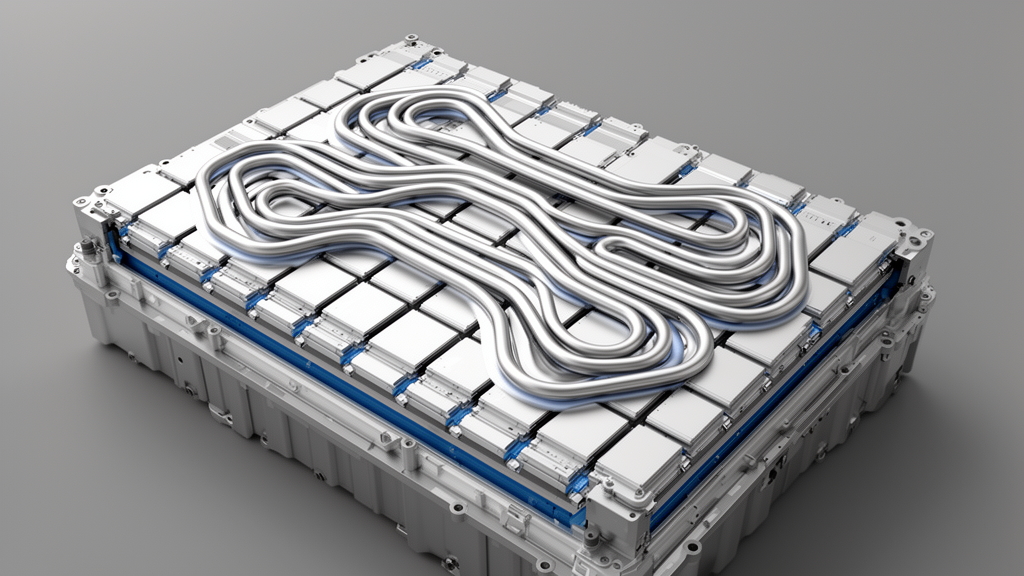
Mechanical engineers investigating battery thermal management have demonstrated that coupling surrogate modeling with evolutionary optimization can substantially improve temperature uniformity across cylindrical lithium-ion cell packs. Operating under a steady four-C-rate discharge load, a forty-cell module equipped with an optimized side-contact wavy liquid-cooling channel achieved a 19.048 percent reduction in cell-to-cell temperature difference alongside a modest 0.361 percent decrease in maximum module temperature. The optimization procedure simultaneously adjusted channel-wall thickness, channel height, and coolant inlet velocity to reconcile competing thermal demands without incurring excessive computational burdens. While the optimized architecture enhanced thermal balance across the pack, full computational fluid dynamics evaluations confirmed that this thermal gain incurred a 10.744 percent increase in coolant pressure drop. The investigation highlights the viability of combining high-fidelity numerical fluid simulations, Gaussian process regression surrogate models, and multi-objective genetic algorithms to design compact, high-performance liquid-cooling systems for demanding electric vehicle energy storage applications.
Maintaining lithium-ion battery packs within safe, stable temperature regimes remains a foundational engineering requirement for commercial electric vehicle powertrains. Lithium-ion chemistry provides substantial energy density and extended cycle life, but operational safety and long-term durability remain acutely sensitive to internal temperatures. Elevated operating levels accelerate electrochemical degradation mechanisms, reduce service lifespan, and elevate the danger of catastrophic thermal runaway cascades. Furthermore, uneven spatial temperature profiles across adjacent cells induce disparate localized aging rates, which prematurely degrades the overall capacity and usable operational window of the integrated pack. Conventional automotive engineering standards require battery modules to maintain operating temperatures between 20 degrees Celsius and 40 degrees Celsius, while constraining the module-wide temperature gradient between the hottest and coldest cells to less than 5 kelvins. Achieving these stringent criteria requires robust active cooling architectures, particularly under high-discharge transients where internal Joule heating and reversible entropic reactions release substantial heat across tightly packed cylindrical geometries.
To address these thermal constraints, the research team modeled a compact module containing forty cylindrical 18650 lithium iron phosphate cells organized in four parallel rows. Liquid cooling was selected over forced-air cooling due to the significantly higher volumetric heat capacity and thermal conductivity of liquid water. The investigated thermal architecture employed a continuous wavy aluminum channel running horizontally between the staggered cell rows, providing direct side-contact heat exchange along the curved cylindrical boundaries. Heat generated throughout each cell conducts through the cell casing, passes across the aluminum channel walls, and dissipates into the circulating coolant stream. The geometric configuration was parameterized using three primary continuous variables: the channel-wall thickness ranging from 0.60 to 1.20 millimeters, the channel height spanning 50.00 to 65.00 millimeters, and the water coolant inlet velocity varied between 0.03 and 0.30 meters per second, defining a bounded design space governed by distinct conduction, contact, and convection mechanisms.
The physical heat transfer within the module was resolved using a steady-state conjugate heat transfer framework implemented in computational fluid dynamics. The numerical domain explicitly captured the solid battery cells, the conductive aluminum channel body, and the internal incompressible Newtonian water stream. To evaluate performance under severe electrical operating conditions, the cells were subjected to a continuous 4C thermal load based on a 1.35 ampere-hour nominal capacity and a 5.4-ampere discharge current. Applying the Bernardi energy balance formulation with an internal cell electrical resistance of 0.04 ohms and an open-circuit potential baseline yielded approximately 1.227 watts of heat generation per cell, equating to an equivalent uniform volumetric generation rate of 74,163 watts per cubic meter and a total pack thermal load of 49.067 watts. Hydraulic calculations confirmed that the highest local Reynolds number within the wavy channel remained at approximately 1,047, ensuring that laminar flow conditions prevailed across all tested operating combinations.
Numerical fidelity was confirmed through rigorous mesh-independence assessments and validation against established literature benchmarks. The computational grid was evaluated using three refinement levels containing 397,942, 645,232, and 915,964 elements, designated respectively as grids G1, G2, and G3. Comparing the baseline coarsest mesh against the finest reference grid revealed absolute discrepancies of merely 0.050 kelvins for the maximum cell temperature and 0.040 kelvins for the module temperature difference, representing relative deviations below two percent and justifying the selection of the 397,942-element mesh for broad parametric screening. In parallel, the simulation setup was benchmarked against independent numerical data from published literature modeling a cylindrical module at a 3C discharge rate. The comparative model predicted a peak cell temperature of 301.17 kelvins and a module temperature spread of 3.70 kelvins, matching published benchmark values of 301.73 kelvins and 3.74 kelvins within 0.19 percent and 1.07 percent relative difference, respectively.
To explore the multi-variable design domain efficiently without executing hundreds of costly full-scale fluid simulations, the researchers deployed an advanced surrogate-assisted modeling methodology. Latin hypercube sampling was applied to generate forty-five distinct geometric and operational configurations distributed evenly throughout the defined three-dimensional parameter bounds. Each sampled configuration was evaluated using the validated conjugate heat transfer solver to extract the resulting maximum module temperature and spatial temperature differential. Using this structured input-output dataset, the authors constructed separate Gaussian process regression surrogate models utilizing constant basis functions and automatic relevance determination squared-exponential covariance kernels. During regression training, the models achieved exceptional correlation with the computational fluid dynamics training data, demonstrating coefficients of determination of 0.9997 for maximum temperature and 0.9996 for temperature uniformity, with corresponding root mean square error values of only 0.0195 kelvins and 0.0205 kelvins across the sampled response space.
Parametric sensitivity analyses derived from the trained Gaussian process regression models revealed that convective fluid mechanics exerted the strongest influence over both thermal response variables. Normalizing the relative influence across the investigated parameter ranges demonstrated that coolant inlet velocity governed 50.94 percent of the variance in maximum module temperature and 49.73 percent of the module temperature gradient. Channel height served as the second most influential factor, accounting for 36.26 percent and 34.00 percent of the respective thermal responses, whereas channel-wall thickness contributed only 12.80 percent and 16.27 percent. The response surfaces illustrated pronounced non-linear interaction dynamics, particularly regarding coolant velocity. Increasing inlet velocity yielded dramatic temperature reductions across the lower velocity spectrum, but the thermal improvements flattened noticeably beyond 0.20 meters per second as convective boundary layer resistance diminished, exposing internal solid-side conduction limits within the aluminum channel walls and cell bodies.
Multi-objective optimization was subsequently executed across the dual surrogate response surfaces using the non-dominated sorting genetic algorithm, NSGA-II. Operating with a population size of 400 individuals, a tournament selection scheme, an intermediate crossover fraction of 0.85, and an adaptive mutation strategy, the evolutionary search converged after 121 generations, identifying 279 non-dominated Pareto solutions. The resulting Pareto front formed an unbroken, highly constrained trade-off curve where incremental reductions in maximum cell temperature inevitably produced minor increases in internal module temperature disparity. To identify a singular, objective operational balance from the non-dominated set without applying arbitrary manual weighting, the researchers implemented a normalized Euclidean distance minimization technique relative to an ideal utopia point of zero normalized error, locating the optimal compromise solution at a minimum distance of 0.405483.
The automatically selected compromise design established optimal design parameters of a 0.664-millimeter wall thickness, a 65.000-millimeter channel height, and a 0.292-meter-per-second coolant inlet velocity. Full conjugate heat transfer computational fluid dynamics re-evaluation of this optimal configuration yielded a maximum module temperature of 305.232 kelvins and a module temperature disparity of 4.641 kelvins. Comparing these re-evaluated values against surrogate predictions revealed deviations of merely 0.005 percent for peak temperature and 1.745 percent for the module spread, confirming the local out-of-sample predictive accuracy of the Gaussian process models. Relative to the unoptimized baseline geometry, peak cell temperature decreased by 1.105 kelvins while the module-wide temperature gradient dropped from 5.733 kelvins down to 4.641 kelvins, successfully bringing the module within target thermal thresholds at the expense of increasing coolant pressure drop from 522.891 to 579.073 pascals.
The authors emphasized that while the proposed optimization framework is readily adaptable to other battery architectures, the specific performance numbers remain bounded by the underlying modeling assumptions. The numerical simulations treated the 18650 cells as homogeneous equivalent solids with an isotropic thermal conductivity of 2.7 watts per meter-kelvin, leaving detailed anisotropic radial and axial conduction within the wound internal jelly-roll unrepresented. Furthermore, the analysis applied a steady-state volumetric heat source rather than dynamic, state-of-charge-dependent electrochemical heat generation, and neglected ambient radiative heat loss and interfacial thermal contact resistances. Because hydraulic resistance was evaluated post-optimization rather than incorporated as a direct objective function within NSGA-II, practical vehicle implementation requires weighing the verified 19 percent improvement in cell thermal uniformity against the associated auxiliary pumping power penalties, pointing toward future investigations incorporating transient drive cycles and coupled thermo-hydraulic objective sets.
Subject of Research: Thermal optimization of wavy liquid-cooling channels for cylindrical lithium-ion battery modules
Article Title: Surrogate-assisted multi-objective optimization of wavy-channel geometry and coolant velocity for cylindrical lithium-ion battery modules
Article References: Thi Thu Phuong, N., Thanh Cong, N., Ngoc Khanh, D., Trung Kien, N., Minh Chau, N., Ngoc Thien, T., Khac Minh, N., & Van Quynh, L. (2026). Surrogate-assisted multi-objective optimization of wavy-channel geometry and coolant velocity for cylindrical lithium-ion battery modules. Frontiers in Mechanical Engineering, 12, 1952624. https://doi.org/10.3389/fmech.2026.1952624
Image Credits: AI Generated
DOI: 10.3389/fmech.2026.1952624
Keywords: battery thermal management, lithium-ion batteries, 18650 cylindrical cells, liquid cooling, wavy channels, computational fluid dynamics, Gaussian process regression, multi-objective optimization, NSGA-II, Pareto front, temperature uniformity, pressure drop, coolant inlet velocity, channel geometry, conjugate heat transfer, electric vehicles
News Source: Faith Mcneil. (November 16, 2026). Wavy Cooling Channels Cut Battery Temperature Differences by Nineteen Percent. Scienmag.