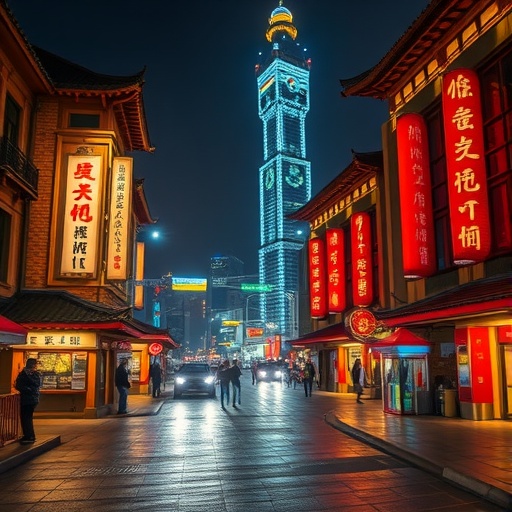
As urbanization accelerates globally, cities are becoming brighter than ever before, with artificial light at night (ALAN) permeating metropolitan skylines and neighborhoods. While the convenience and perceived safety offered by increased nighttime lighting are undeniable, mounting evidence suggests a darker side to this illumination surge — detrimental effects on residents’ mental health. Despite growing awareness, the precise ways in which different wavelengths of artificial light impact human sentiment remain inadequately explored. A groundbreaking new study in China leverages satellite data and social media analytics to unravel these wavelength-specific effects, revealing novel insights that could transform urban lighting design and mental health preservation.
The research team integrated extensive nighttime light spectral data captured by satellites with an innovative sentiment analysis of millions of geotagged social media posts across urban China. This unprecedented synthesis allowed them to quantify how various spectral components of ALAN correlate with public mood as expressed in digital communication. Their results provide compelling evidence that not all artificial light wavelengths influence human sentiment equally — blue light and green light, in particular, show starkly contrasting effects with significant public health implications.
Blue light, spanning wavelengths roughly between 424 and 526 nanometers, was found to amplify negative sentiment by a striking 15.9 percent. This finding aligns with known physiological mechanisms where blue light suppresses melatonin production, disrupts circadian rhythms, and heightens alertness and anxiety levels. Conversely, moderate exposure to green light in the 506–612 nanometer range enhanced positive sentiment by 5.0 percent, suggesting that some spectral components may mitigate negative psychological effects or even foster wellbeing.
Spatial analyses revealed marked disparities in sentiment impacts across different urban zones and between cities. Higher exposure to detrimental blue light and associated negative sentiment clustered predominantly in commercial districts—areas characterized by dense, intense lighting. Similarly, cities in eastern China exhibited greater prevalence of sentiment risk compared to western counterparts, possibly reflecting variations in lighting infrastructure, urban density, economic activity, and cultural factors influencing light usage and public mood.
One particularly compelling insight from the study was the remarkable efficacy of optimizing correlated color temperature (CCT) in reducing sentiment risk. Whereas simply dimming lights alleviated negative sentiment to a limited extent, adjusting the spectral quality of urban lighting to lessen blue wavelengths and balance other colors reduced the risk by an extraordinary 89.7 percent. This suggests that public health-oriented lighting strategies should prioritize spectral tuning over mere brightness reduction to meaningfully enhance urban residents’ mental wellbeing.
These findings emerge in the context of rapid urban lighting expansion across China and many parts of the world, where ALAN intensity has escalated with widespread electrification and implementation of LED technologies. Unlike traditional lighting sources, modern LEDs often emit higher proportions of short-wavelength blue light, potentially exacerbating insomnia, mood disturbances, and other mental health challenges. The study’s granular analysis enables policymakers and urban planners to move beyond one-size-fits-all lighting regulations towards nuanced, color-specific interventions.
Methodologically, the research marks a formidable achievement in big data integration and geospatial sentiment analysis. By combining remote sensing of spectral light composition with natural language processing techniques applied to social media posts, the researchers constructed dynamic maps depicting the interplay between urban light environments and collective emotional expressions. This fusion of environmental monitoring and digital behavioral data paves new paths for interdisciplinary urban epidemiology and mental health surveillance.
Moreover, the investigation addressed confounding factors, calibrating for socioeconomic variables, population density, and seasonal effects, ensuring that the associations observed between specific wavelength exposures and sentiment were robust and not artifacts of unrelated urban characteristics. The statistical models employed disentangle the complex causal pathways, lending greater confidence that targeted spectral modifications could yield tangible mood stabilization outcomes.
The implications of wavelength-dependent effects in urban lighting extend beyond mental health into energy efficiency, wildlife conservation, and crime prevention, suggesting that holistic design principles must balance multifaceted urban dynamics. For instance, reducing problematic blue light emissions could benefit not only human wellbeing but also reduce disruption to nocturnal ecosystems highly sensitive to short-wavelength illumination.
In light of these findings, urban lighting designers are urged to reconsider current practices that prioritize intensity escalation or cost reduction without spectral impact assessment. Future public lighting infrastructures might incorporate tunable light sources able to dynamically adjust spectral output based on time of night, neighborhood characteristics, and health risk profiles. With smart city technologies, adaptive lighting could become personalized and responsive rather than uniform and static.
Furthermore, this research underscores the importance of citizen-centric data in illuminating the invisible costs of urban environmental change. Social media platforms, often critiqued for misinformation and trivial content, here serve as invaluable real-time barometers of population mood, enabling responsive urban management aligned with community wellbeing. The scalability of this approach offers a model for other contexts worldwide facing similar ALAN challenges.
As artificial light continues to reshape the nocturnal environment, this study delivers a crucial message: tuning light’s spectral features is as vital as controlling brightness. Embracing spectral optimization as a core principle can transform urban nightscapes into environments that nurture, rather than undermine, mental health. This novel paradigm challenges existing lighting policies and opens fresh avenues for collaborations among neuroscientists, urban planners, lighting engineers, and policymakers.
Future research avenues may involve experimental interventions deploying optimized lighting in pilot urban zones, longitudinal tracking of mental health outcomes, and cross-cultural comparisons to validate the generalizability of the wavelength-sentiment relationships discovered. Additionally, deeper inquiry into the physiological and neurobiological mechanisms by which wavelengths influence mood will enhance mechanistic understanding.
In sum, this visionary study offers a paradigm shift in how we perceive and manage nocturnal urban lighting. It reveals that the spectral fingerprint of city lights exerts profound influence on collective sentiment—and by extension mental health—highlighting the critical need to integrate spectral considerations into urban design. The path forward involves harnessing these insights to create healthier, more humane cities glowing with lights harmonized to human wellbeing.
Subject of Research: Effects of wavelength-specific artificial light at night on expressed sentiment and mental wellbeing in urban China.
Article Title: Wavelength-specific urban nighttime light modulates expressed sentiment across China.
Article References: Zhang, C., Meng, M., Chen, Z. et al. Wavelength-specific urban nighttime light modulates expressed sentiment across China. Nat Cities (2026). https://doi.org/10.1038/s44284-025-00384-x
Image Credits: AI Generated
DOI: https://doi.org/10.1038/s44284-025-00384-x
Tags: artificial light at night (ALAN) researchblue light and mental health correlationgeotagged social media researchnighttime light pollution in citiespsychological effects of urban lightingpublic health implications of urban illuminationsatellite data in urban studiessocial media sentiment analysis in urban settingstransformative urban lighting design strategiesurban lighting effects on mental healthurbanization and public mood dynamicswavelength-specific impact of artificial light