In a groundbreaking development in the study of pest behavior, researchers at the University of California, Riverside, have uncovered a surprising aversion that bed bugs—a pervasive household nemesis—exhibit toward water and moist environments. This discovery, recently detailed in the Journal of Ethology, not only sheds light on a novel behavioral trait in these notoriously resilient insects but also opens new potential pathways for pest control strategies.
Bed bugs, scientifically classified under Hemiptera: Cimicidae, have long been a scourge to households worldwide due to their ability to survive across a variety of environments and their notorious bite. What makes these insects particularly challenging to eradicate is their resilience to many common insecticides and their ability to hide in tiny crevices. The research led by entomology professor Dong-Hwan Choe at UC Riverside represents the first documentation of bed bugs’ behavioral response to water, a crucial piece of knowledge that was previously unexplored in entomological studies.
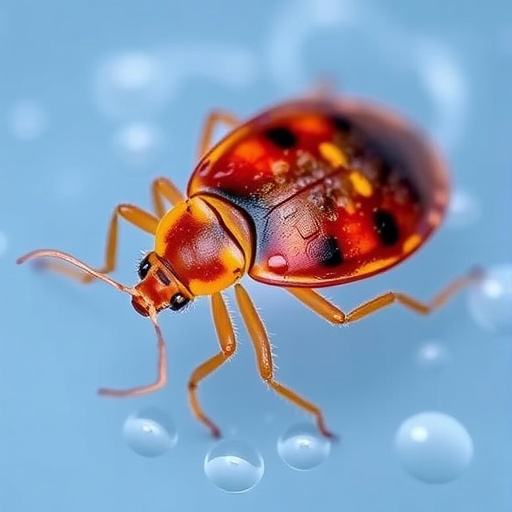
The premise behind this discovery is rooted in the anatomical and physiological characteristics that define bed bugs. These insects possess exceedingly flat bodies, an adaptive trait that allows them to conceal themselves effectively in narrow spaces such as mattress seams or cracks in furniture. Moreover, their respiration occurs through tiny openings termed spiracles, located on the underside of their abdomens. When these spiracles come into contact with water, the high surface tension creates an adhesive effect that can trap the insects, effectively compromising their respiratory function—a fact that provides a plausible explanation for their observed aversion to wet surfaces.
The observation that led to this insight was serendipitous. While maintaining laboratory colonies of bed bugs, the researchers noticed an unexpected behavior. Typically, the insects climb to the top of their vials to feed from an artificial blood feeder placed over the opening. However, one day when the membrane of this feeder was slightly damaged, causing blood to leak and saturate the textured paper lining inside the vial, the bugs noticeably avoided the wet paper area rather than congregating near the readily accessible blood source.
This peculiar avoidance prompted further experimental interventions. The research team wetted the substrate within the vials using pure water, confirming that the bed bugs actively avoided any damp areas, irrespective of whether the moisture was blood or simple water. These preliminary observations challenged longstanding assumptions about bed bug behavior and initiated a series of controlled behavioral assays that would rigorously quantify their response to wet environments.
To study the bed bugs’ motions precisely, postdoctoral researcher Jorge Bustamante employed advanced video tracking technology combined with an infrared camera enhanced by a magnifying lens. This approach allowed for detailed monitoring of the insects’ movements against contrasting backgrounds. The data revealed that bed bugs exhibit an immediate escape response when they encounter moisture, retreating faster from wet surfaces than they approach dry ones. This escape velocity underscores the potential lethality or at least considerable danger that water poses to them, beyond simply a mild deterrent effect.
Further analysis uncovered a fascinating age-related sensitivity. Younger bed bugs, smaller and more vulnerable, performed rapid U-turn maneuvers upon sensing moisture, avoiding it more decisively than their older counterparts. This indicates a developmental variation in sensory perception or risk tolerance, suggesting evolutionary optimization where the more delicate younger bed bugs prioritize survival by maximizing avoidance of threats such as water.
The implications of this discovery are manifold, particularly for pest management. Current water-based insecticide sprays, designed to penetrate crevices and treated surfaces where bed bugs hide, might inadvertently encourage the insects to flee treated zones, thereby spreading to other locations within an infested environment. This behavioral response could reduce the overall effectiveness of treatments if insecticides do not achieve immediate lethality.
Hence, pest control formulations may require reevaluation, with considerations for delivery methods and additives that compensate for or overcome the bugs’ repellant reaction to moisture. Manufacturers and researchers might look toward combining hydrophobic compounds or developing non-liquid treatment modalities to circumvent this avoidance behavior. Understanding the crucial balance between immediate toxicity and behavioral deterrence could revolutionize integrated pest management protocols.
On a more practical note for individuals dealing with bed bug infestations, this study delivers a simple yet effective piece of advice: bathing thoroughly can dislodge bed bugs from the body. Since the insects actively avoid wet surfaces, immersion in water can help remove them before they establish a foothold. However, it is essential to emphasize that this approach targets only those bugs that have attached transiently to skin or clothing; infestation within living spaces requires comprehensive eradication strategies.
This research thereby offers a fresh perspective on a pest problem that has escalated globally over recent decades. The nuanced understanding of bed bug behavior in response to moisture contributes not only to academic entomology but also to the development of smarter, behaviorally informed pest control tactics that could reduce both human suffering and economic costs associated with infestations.
Future studies may expand upon this work to explore the molecular and neurological mechanisms that enable bed bugs to detect and respond so selectively to water. The roles of chemosensory and mechanosensory inputs in guiding avoidance behavior remain intriguing fields for investigation. Additionally, exploring the impact of environmental humidity gradients and surface textures on bed bug locomotion and habitat preference may yield further operational insights for pest management.
In conclusion, the integration of detailed behavioral assays with anatomical and physiological insights has unveiled water aversion as a significant, previously unrecognized survival strategy in bed bugs. This revelation stands to transform contemporary approaches to managing infestations and invites a reevaluation of current pest control methodologies, potentially leading to more effective mitigation of these resilient ectoparasites.
Subject of Research: Behavioral ecology and physiology of bed bugs (Hemiptera: Cimicidae) in response to wet surfaces
Article Title: Behavioral response of bed Bugs (Hemiptera: Cimicidae) to wet surfaces
News Publication Date: 17-Dec-2025
Web References:
https://link.springer.com/article/10.1007/s10164-025-00880-6
References:
UC Riverside study published in the Journal of Ethology, DOI: 10.1007/s10164-025-00880-6
Image Credits: Dong-Hwan Choe/UCR
Keywords: Bed bugs, Hemiptera, Cimicidae, insect behavior, water aversion, ethology, pest control, entomology, insect physiology, parasite avoidance, ectoparasites, behavioral ecology
Tags: bed bug anatomical adaptationsbed bug behavior researchbed bug hiding and survival tacticsbed bug resilience to insecticidesbed bug respiration and water interactionbed bug water aversionentomology study on bed bugsHemiptera Cimicidae pest managementimpact of moisture on bed bugsnovel bed bug pest control methodspest control strategies against bed bugsUniversity of California Riverside pest research