• HOME
  • NEWS
  • EXPLORE
    • CAREER
      • Companies
      • Jobs
    • EVENTS
    • iGEM
      • News
      • Team
    • PHOTOS
    • VIDEO
    • WIKI
  • BLOG
  • COMMUNITY
    • FACEBOOK
    • INSTAGRAM
    • TWITTER
Saturday, February 7, 2026
BIOENGINEER.ORG
No Result
View All Result
  • Login
  • HOME
  • NEWS
  • EXPLORE
    • CAREER
      • Companies
      • Jobs
        • Lecturer
        • PhD Studentship
        • Postdoc
        • Research Assistant
    • EVENTS
    • iGEM
      • News
      • Team
    • PHOTOS
    • VIDEO
    • WIKI
  • BLOG
  • COMMUNITY
    • FACEBOOK
    • INSTAGRAM
    • TWITTER
  • HOME
  • NEWS
  • EXPLORE
    • CAREER
      • Companies
      • Jobs
        • Lecturer
        • PhD Studentship
        • Postdoc
        • Research Assistant
    • EVENTS
    • iGEM
      • News
      • Team
    • PHOTOS
    • VIDEO
    • WIKI
  • BLOG
  • COMMUNITY
    • FACEBOOK
    • INSTAGRAM
    • TWITTER
No Result
View All Result
Bioengineer.org
No Result
View All Result
Home NEWS Science News Chemistry

Water could modulate the activity and selectivity of CO2 reduction

Bioengineer by Bioengineer
November 15, 2019
in Chemistry
Reading Time: 2 mins read
0
IMAGE
Share on FacebookShare on TwitterShare on LinkedinShare on RedditShare on Telegram

IMAGE

Credit: ©Science China Press


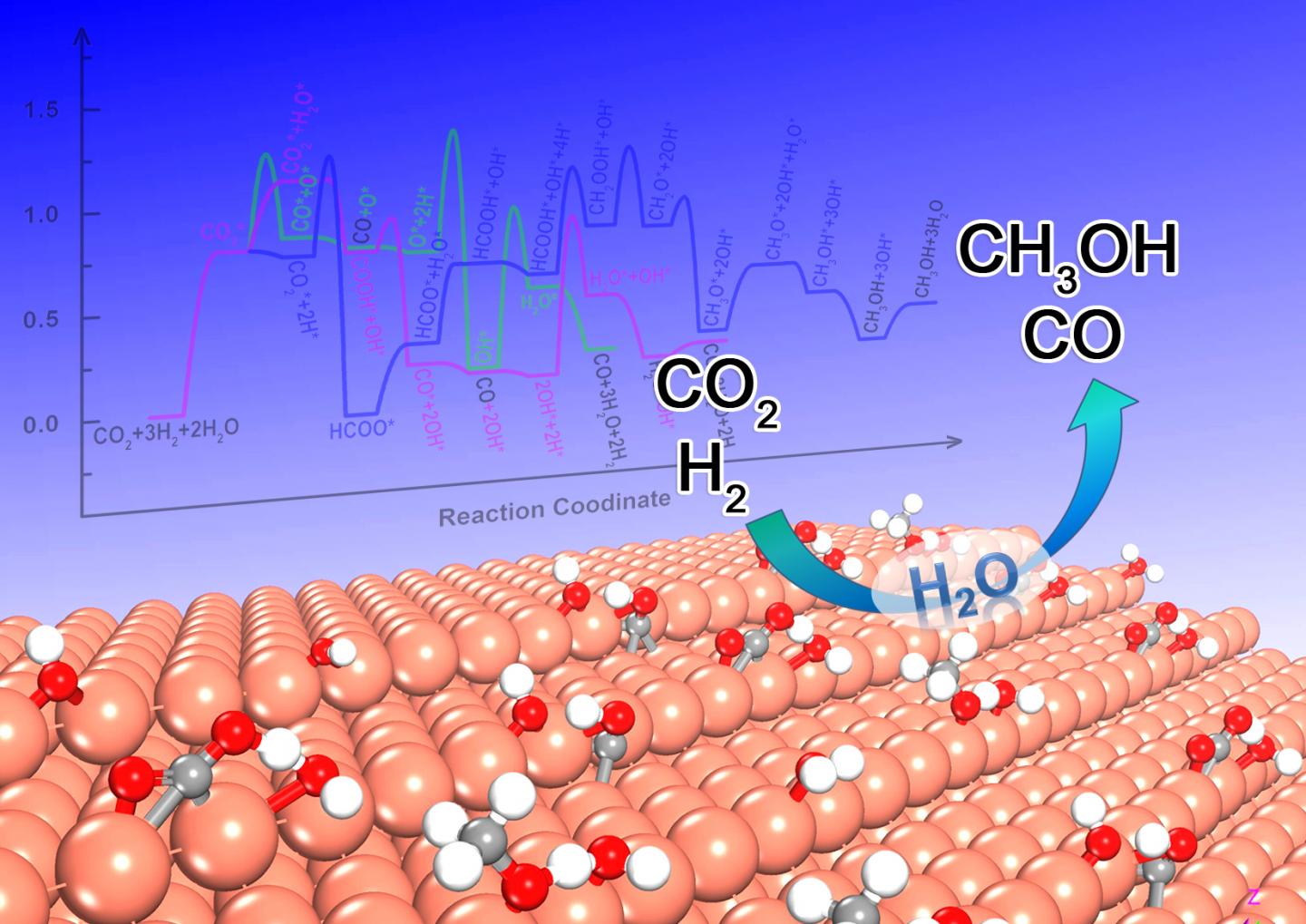
As an alternative to the depletion of fossil resources, the reduction of CO2 emitted from fossil fuel combustion into valuable chemicals and fuel has drawn increasing attention. Due to the highly thermodynamic stability of CO2, it is still very challenging to find a sustainable and cost-efficient route to selectively convert inert CO2 at a high conversion rate under mild conditions.
The water could also be a significant factor governing the reaction mechanism. On the one hand, water is one product accompanied with CH3OH. H2O might trigger the autocatalysis to accelerate CO2 activation and methanol production. On the other hand, Cu is also a highly active catalyst for water-gas shift (WGS) reaction and its reverse reaction (RWGS). The water is also possible to launch or to suppress the side reaction, which could influence the selectivity.

Very recently, Dr. Cao and Prof. P. Hu’s group at East China University of Technology systematically analyzed the effect of surface water on each elementary step to disclose its role in CO2 hydrogenation over the stepped Cu(211) surface. The influence of water on CO2 hydrogenation was respectively discussed at the levels of the electronic structure, energy and kinetics. The mechanisms between in the absence and presence of water were quantitatively compared based on microkinetic simulation upon density functional theory (DFT) calculations.

It has been found that the autocatalysis of water could be in favor of the formation of COOH intermediate through the proton transfer. This accelerates the CO generation while does not improve the methanol synthesis, giving rise to the higher CO2 conversion and the selectivity towards CO. In addition, the microkinetic analysis also sheds light on the fact that the too high initial partial pressure of water will thermodynamically inhibit the CO2 conversion due to the too high coverage of OH*. Hence, it is the first time to disclose how to modulate the activity and selectivity of CO2 hydrogenation through changing the H2O pressure.

###

This research was funded by the National Key Research and Development Program of China (2018YFA0208600), the National Natural Science Foundation of China (21673072, 21333003, 91845111), and Program of Shanghai Subject Chief Scientist (17XD1401400).

See the article: Sun X, Wang P, Shao Z, Cao X, P. Hu. A first-principles microkinetic study on the hydrogenation of carbon dioxide over Cu(211) in the presence of water. Sci. China Chem., 2019, DOI: 10.1007/s11426-019-9639-0.

http://engine.scichina.com/publisher/scp/journal/SCC/doi/10.1007/s11426-019-9639-0?slug=fulltext

Media Contact
Xiaoming Cao
[email protected]

Related Journal Article

http://dx.doi.org/10.1007/s11426-019-9639-0

Tags: Chemistry/Physics/Materials Sciences
Share14Tweet9Share2ShareShareShare2

Related Posts

blank

Breakthrough in Environmental Cleanup: Scientists Develop Solar-Activated Biochar for Faster Remediation

February 7, 2026
blank

Cutting Costs: Making Hydrogen Fuel Cells More Affordable

February 6, 2026

Scientists Develop Hand-Held “Levitating” Time Crystals

February 6, 2026

Observing a Key Green-Energy Catalyst Dissolve Atom by Atom

February 6, 2026
Please login to join discussion

POPULAR NEWS

  • Robotic Ureteral Reconstruction: A Novel Approach

    Robotic Ureteral Reconstruction: A Novel Approach

    82 shares
    Share 33 Tweet 21
  • Digital Privacy: Health Data Control in Incarceration

    63 shares
    Share 25 Tweet 16
  • Study Reveals Lipid Accumulation in ME/CFS Cells

    57 shares
    Share 23 Tweet 14
  • Breakthrough in RNA Research Accelerates Medical Innovations Timeline

    53 shares
    Share 21 Tweet 13

About

We bring you the latest biotechnology news from best research centers and universities around the world. Check our website.

Follow us

Recent News

Digital Health Perspectives from Baltic Sea Experts

Florida Cane Toad: Complex Spread and Selective Evolution

Exploring Decision-Making in Dementia Caregivers’ Mobility

Subscribe to Blog via Email

Enter your email address to subscribe to this blog and receive notifications of new posts by email.

Join 73 other subscribers
  • Contact Us

Bioengineer.org © Copyright 2023 All Rights Reserved.

Welcome Back!

Login to your account below

Forgotten Password?

Retrieve your password

Please enter your username or email address to reset your password.

Log In
No Result
View All Result
  • Homepages
    • Home Page 1
    • Home Page 2
  • News
  • National
  • Business
  • Health
  • Lifestyle
  • Science

Bioengineer.org © Copyright 2023 All Rights Reserved.