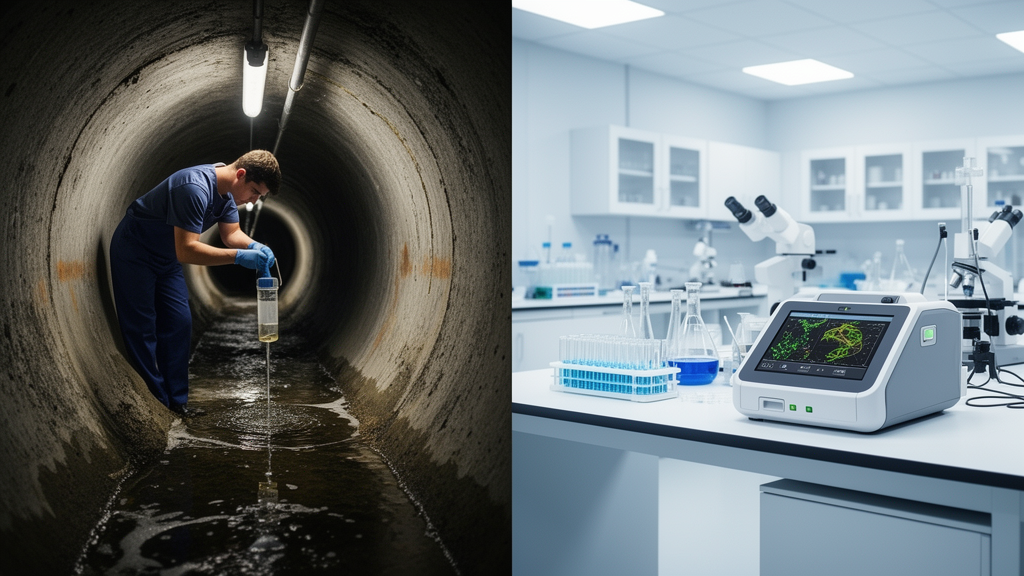
Researchers at Tohoku University have developed and tested a screening method that combines environmental DNA from sewer wastewater, ecological modeling and machine learning to identify pipe sections at elevated risk of severe corrosion. The study took place in a residential sewer network, where the approach was evaluated against inspection records covering 3,498 pipe sections. Adding microbial information improved the model’s ability to distinguish severely corroded pipes from other sections, providing municipalities with a potential way to prioritize inspection of hidden infrastructure.
Underground sewer pipes are difficult to access, making their condition hard to monitor, while conventional camera inspections are costly and time-consuming. Damaged pipes can leak wastewater and contaminate surrounding water, and severe failures can damage infrastructure above them, including causing sinkholes in city streets. Regular inspections are therefore important for aging sewer networks, but the new study addresses the practical challenge of deciding where inspections should be concentrated when resources and access are limited.
For the field test, the researchers collected wastewater samples from 40 manholes across the residential network. They measured DNA associated with sulfate-reducing bacteria, a group that can contribute to pipe corrosion. Information on pipe slope and the area of upstream buildings was used to estimate where these organisms were more likely to occur across the sewer system. These ecological estimates of bacterial habitat potential were then combined with sewer-network characteristics—pipe age, diameter and slope—and entered into a Random Forest machine-learning model. Among the bacteria studied, Desulfobulbus showed the strongest relationship with pipe deterioration and was the most important microbial predictor. Professor Daisuke Sano said the team was surprised by how useful it was for predicting corrosion and noted that among all the biological factors tested, its predictive importance ranked second only to pipe age.
The model was tested against inspection records for 3,498 pipe sections, and the results showed that adding the wastewater-derived microbial information improved its ability to identify severely corroded pipes. Rather than directly examining the condition of every buried pipe, the method uses biological signals detected in wastewater to create geographic estimates that can be compared with the sewer network. The approach thus converts microbial DNA measurements into a network-scale screening tool. It also reduces the need to treat each manhole sample as an isolated observation: the ecological model estimates potential bacterial habitat between sampling locations, while the machine-learning model relates those estimates to pipe characteristics and known inspection outcomes.
The findings support wastewater monitoring and habitat mapping as tools for directing further inspection toward sections that may warrant closer attention. Municipalities could compare the modeled risk areas with existing infrastructure records to focus camera inspections and other assessments on pipes with a higher likelihood of severe corrosion. The study tested the method in one residential sewer network using samples from 40 manholes and validation against 3,498 pipe-section inspection records, so its reported performance is specific to that setting. The method remains a screening and prioritization strategy rather than a substitute for direct inspection, which is still required to evaluate the condition of individual pipes. As Sano explained, combining wastewater DNA with ecological modeling converted invisible biological signals into geographic maps that may help cities identify high-risk areas and allocate limited inspection resources more efficiently.
Subject of Research: Environmental DNA and ecological modeling for network-scale screening of sewer-pipe corrosion risk.
Article Title: AI and wastewater DNA-based mapping helps identify sewer pipes at risk of corrosion
Article References: AI and wastewater DNA-based mapping helps identify sewer pipes at risk of corrosion. Original publication (Bibliographic details unavailable.)
Image Credits: AI Generated
DOI: Not provided
Keywords: sewer corrosion, wastewater DNA, environmental DNA, sulfate-reducing bacteria, Desulfobulbus, species distribution modeling, machine learning, Random Forest, infrastructure monitoring, pipe inspection, wastewater, DNA-based
News Source: Denise Maddox. (October 20, 2026). Wastewater DNA mapping improves corrosion-risk screening in sewer network. Scienmag.