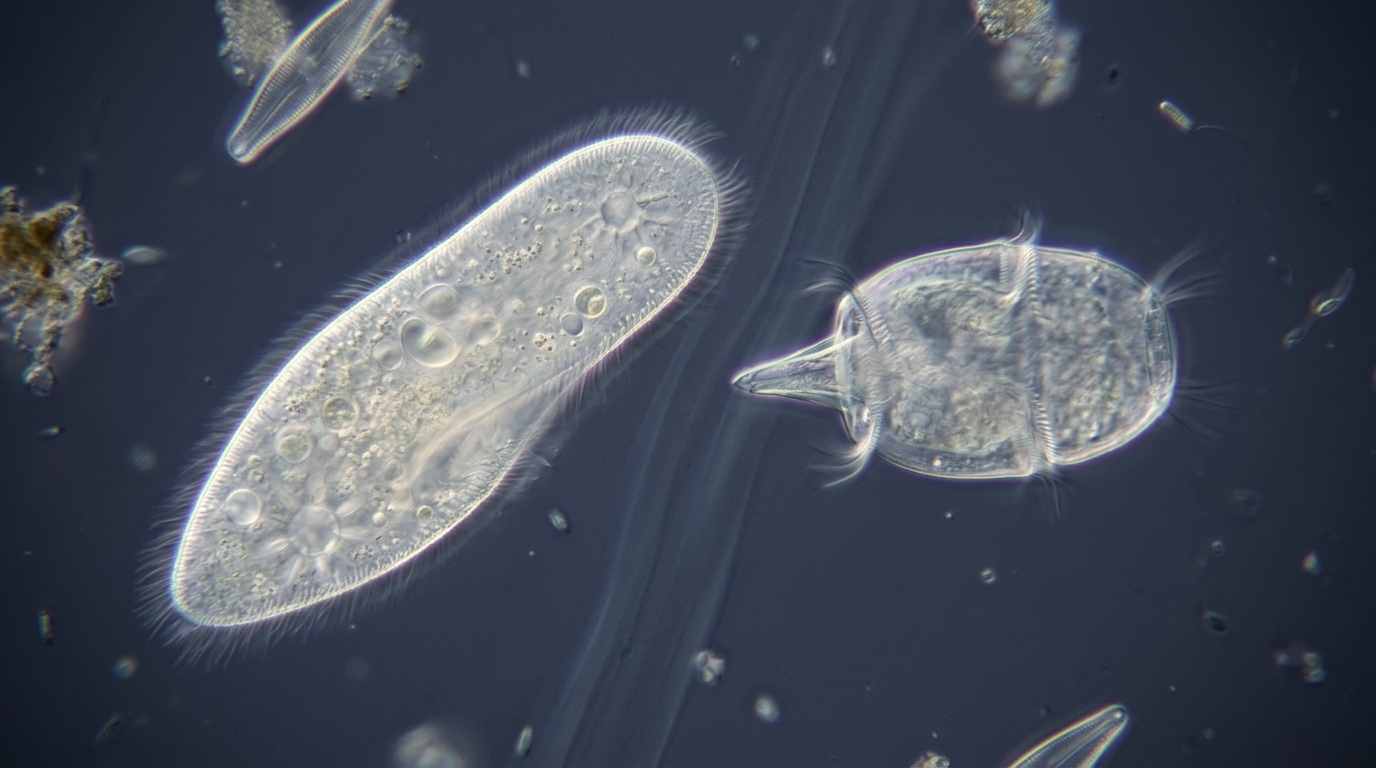
An experimental evolution investigation using the freshwater ciliate protist Dexiostoma campylum reveals that exposure to simultaneous environmental drivers alters adaptive evolutionary trajectories and reshapes subsequent trophic interactions with an unevolved predator. Anthropogenic environmental change subjects aquatic ecosystems to multiple simultaneous stressors, including elevated ambient temperatures and freshwater salinization. Organisms exposed to these changing conditions frequently exhibit phenotypic plasticity, defined as non-genetic phenotypic adjustments, alongside evolutionary adaptation resulting from selection on inherited genetic variation. While empirical research has often documented short-term plastic shifts or single-driver evolutionary changes in isolated laboratory cultures, predicting how multi-driver evolution modifies functional traits and trophic interactions remains an outstanding challenge in ecological science. The newly reported findings demonstrate that evolutionary adaptation to temperature and salinity altered prey morphological and behavioral traits in ways that short-term plastic responses could not predict, while concurrently modifying the search efficiency of the predatory ciliate Spathidium species under common garden test conditions.
To investigate the interplay between phenotypic plasticity, multi-driver evolution, and trophic dynamics, researchers established an experimental evolution experiment using Dexiostoma campylum strain CCAP 1611/1 maintained in sterile culture medium. The experimental design factorially crossed two levels of temperature with two levels of salinity to produce four distinct selection environments: an ancestral control baseline maintained at 24 degrees Celsius with 0 grams of sodium chloride per liter, an elevated salinity environment maintained at 24 degrees Celsius with 2.5 grams of sodium chloride per liter, a high-temperature environment set at 28 degrees Celsius with 0 grams of sodium chloride per liter, and a combined high-salinity and high-temperature environment set at 28 degrees Celsius with 2.5 grams of sodium chloride per liter. The control temperature reflected the ancestral thermal optimum of the species, while 28 degrees Celsius approached its critical thermal maximum. The elevated salinity concentration was chosen to impose substantial abiotic stress without causing immediate population collapse. Cultures were sustained on Chalkley medium supplemented with alfalfa powder and bacterized with three distinct bacterial species—Serratia fonticola, Brevibacillus brevis, and Bacillus subtilis—which served as the ciliate food source.
The evolutionary selection phase was sustained for approximately six months across 54 serial transfers executed every 3.5 days, spanning roughly 300 ciliate generations across four biological replicates per treatment. Transfers were conducted by inoculating fresh bacterized culture media with aliquots from previous cultures, ensuring that the bacterial community composition at the start of each growth cycle was dominated by stock strains rather than evolved bacterial populations. One replicate lineage from the high-temperature selection environment went extinct toward the end of the selection phase, leaving 15 surviving lines across the four regimes. Following the selection period, the team evaluated phenotypic outcomes across two discrete assays: a comprehensive trait assay examining growth rates, cell sizes, and movement velocities across all factorial combinations of temperature and salinity, and an exploratory functional response assay testing consumption dynamics by an unevolved ciliate predator in a common garden setting. To isolate persistent evolutionary divergence from transient parental carryover or maternal effects, all selection lines were acclimated to their respective assay conditions for one week prior to measurement.
In the trait assay, researchers quantified intrinsic population growth rates and phenotypic traits across 60 acclimated cultures by recording digital video microscopy samples and processing particle movement data using the automated tracking package bemovi in R. Immediate plastic responses to assay environments supported the team’s initial hypothesis that abiotic variables induce substantial phenotypic shifts, though the two drivers acted through markedly different physiological avenues. Exposure to elevated salinity prompted an immediate plastic increase in population growth rate of 741 percent and elevated movement velocity by 44 percent, while prompting a 20 percent plastic reduction in average cell size. In contrast, elevated assay temperature alone did not significantly alter population growth rate or swimming speed, but it triggered a 20 percent plastic reduction in cell size comparable to that induced by salinity. These plastic changes demonstrated that while temperature primarily constrained cell dimensions, salinity substantially stimulated kinetic and metabolic activity within short-term exposure windows.
Statistical evaluation of the trait assay data using linear mixed-effects models uncovered significant non-additive interactions between assay temperature and assay salinity for all three measured prey variables. When elevated temperature and elevated salinity co-occurred in the test environment, their combined plastic influence was antagonistic for both population growth rates and cell size, but synergistic for swimming velocity. Specifically, the positive growth response to salinity was attenuated under elevated temperature, while cell sizes in the combined environment were larger than predicted by additive single-driver models. Conversely, prey swimming speed reached its highest observed values in the dual-stressor assay environment, showing an interactive acceleration that exceeded the additive sum of individual driver effects. These divergent interaction directions highlight that multi-driver abiotic forcing cannot be characterized by a single interaction type, because physiological responses vary fundamentally across demographic, morphological, and behavioral traits within the exact same organism.
The study directly evaluated whether evolutionary adaptation to single environmental drivers would systematically counter or reverse immediate plastic responses, a hypothesis frequently proposed in experimental evolutionary ecology. The empirical results offered only partial and trait-dependent support for this counter-gradient evolutionary dynamic. For cell size, lineages with a history of evolution at 28 degrees Celsius evolved larger mean cell areas when tested at 28 degrees Celsius compared to control lines, offsetting the negative plastic shrinking effect by 52.79 percent with marginal statistical significance. Similarly, lineages selected under high salinity evolved larger cell sizes under saline assay conditions, reducing the plastic size decrease by 44.02 percent. However, for population growth rates and movement speeds, evolutionary trajectories did not systematically oppose plasticity. Lines evolved under high salinity showed no significant evolutionary divergence in growth rate compared to controls, and lines selected at high temperature evolved significantly faster movement velocities despite the complete absence of a plastic speed response to temperature alone, demonstrating a decoupled relationship between plasticity and evolutionary change.
When assessing how exposure to a second selection driver affected adaptation to a focal stressor, the researchers observed that multi-driver evolutionary history constrained single-driver adaptations in a context-dependent manner. Lineages that evolved under high temperature alone exhibited a significant 26.22 percent increase in movement velocity when assayed at 28 degrees Celsius compared to ancestral control lines. However, lineages that evolved in the combined high-temperature and high-salinity environment showed no significant increase in movement speed relative to controls, indicating that the simultaneous presence of salinity during selection suppressed the evolutionary acquisition of faster swimming. Similarly, cell size evolution under high temperature was altered by the presence of salinity: while high-temperature selection lines evolved 12.83 percent larger cell sizes at 28 degrees Celsius, lines evolved in the dual-driver environment were 10.63 percent smaller than control lines, representing an evolutionary reversal rather than a simple attenuation of the single-driver response.
To determine whether these prey trait shifts altered ecological interactions across trophic levels, the investigators performed a common garden functional response assay utilizing the predatory ciliate Spathidium species. Acclimated prey lines from each selection environment were pooled across replicates and supplied at eight standardized starting densities to cultures of unevolved Spathidium predators under ancestral baseline conditions of 24 degrees Celsius and 0 grams of sodium chloride per liter. Consumption dynamics were modeled using a system of ordinary differential equations incorporating logistic prey growth, predator background mortality, and a nonlinear Type II functional response characterized by space clearance rate, representing predator searching and capture efficiency, and handling time, representing the duration required to consume and digest an individual prey cell. Parameters were estimated using maximum likelihood techniques to resolve the specific contribution of prey evolutionary history to predation parameters.
The functional response modeling revealed that prey evolutionary history significantly influenced predator space clearance rates while leaving handling times and predator mortality unaffected. Predators exhibited significantly higher space clearance rates when consuming prey that had evolved under high temperature alone compared to ancestral control prey lines. However, when predators were fed prey that had evolved in the combined high-temperature and high-salinity environment, this increase in space clearance rate was significantly weakened. Prey lines that evolved under high salinity alone produced no detectable change in predator clearance rates relative to control prey. Across treatments, predator handling time remained statistically uniform, indicating that digestive and consumption constraints were invariant despite differences in prey background. The observed shifts in clearance rate aligned with the patterns recorded for prey movement speed, suggesting that increased prey swimming activity elevated encounter rates between predator and prey in the experimental arena.
The researchers cautioned that because the functional response assay relied on pooled biological replicates within each selection treatment, the predation findings serve as an exploratory proof-of-concept rather than definitive proof of a causal mechanistic link. The correlation between prey swimming speed and space clearance rate was based on a small sample size of four treatment pools, requiring future work with replicated selection lines to verify the exact biomechanical mechanism. Furthermore, abiotic drivers in the culture bottles may have exerted indirect effects by altering the bacterial community that served as food for Dexiostoma campylum, meaning observed adaptations reflect the total selective environment rather than isolated direct physiological responses. Additionally, while maintaining lines for several generations in common garden conditions removed maternal effects, the authors noted that formal genetic sequencing would be necessary to conclusively establish the molecular architecture of the observed divergence.
Despite these experimental limitations, the findings underscore the complex, non-additive nature of eco-evolutionary responses to global change. The study demonstrates that multi-driver evolutionary history can substantially modify species traits in ways that cannot be extrapolated from single-stressor experiments or short-term plastic reactions. Because trait evolution in the prey directly altered predator encounter rates under common garden conditions, environmental stressors can propagate bottom-up effects through trophic food webs via evolutionary trait shifts. Future investigations that combine multi-driver selection on both predators and prey across continuous environmental gradients will be essential to accurately forecast how ecological communities and trophic stability will respond to ongoing planetary warming and salinization.
Subject of Research: Eco-evolutionary effects of multi-driver environmental change on protist prey traits and predation dynamics
Article Title: Multiple Environmental Drivers Shape Prey Trait Evolution, With Possible Implications for Predation
Article References: Jelić, M., Pennekamp, F., Petchey, O. L., & Limberger, R. (2026). Multiple Environmental Drivers Shape Prey Trait Evolution, With Possible Implications for Predation. Ecology and Evolution, 16(12), Article e74787. https://doi.org/10.1002/ece3.74787
Image Credits: AI Generated
DOI: 10.1002/ece3.74787
Keywords: Dexiostoma campylum, Spathidium, phenotypic plasticity, experimental evolution, multiple environmental drivers, climate warming, freshwater salinization, functional response, space clearance rate, handling time, trophic interactions, ciliate protists, cell size, movement speed, antagonistic interactions
News Source: Gavin Prescott. (November 29, 2026). Warming and Salinity Shape Ciliate Prey Evolution and Predator Feeding Rates. Scienmag.