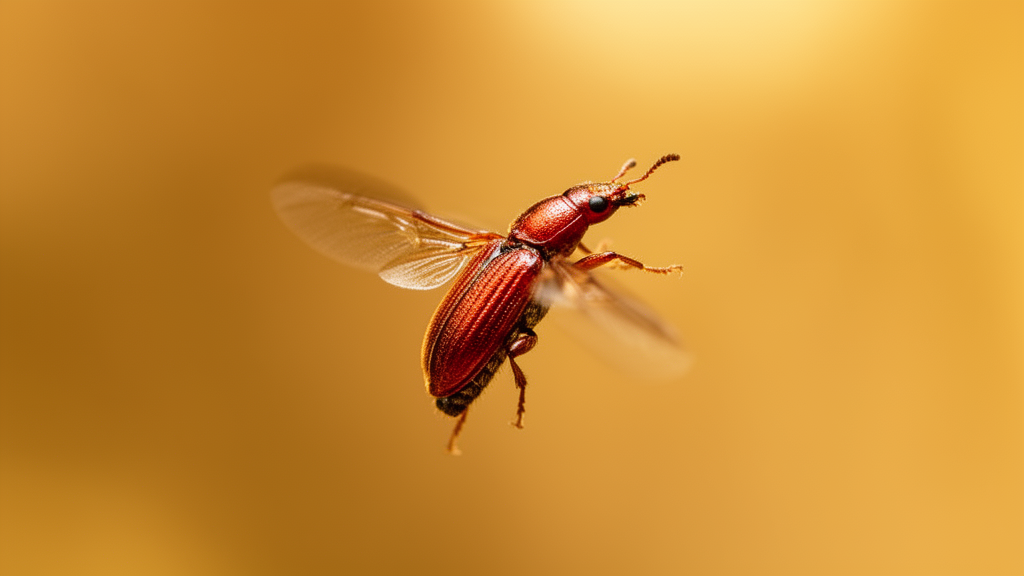
Researchers investigating the evolutionary maintenance and degeneration of insect movement have discovered that the red flour beetle, Tribolium castaneum, maintains widespread flight activity across long-reared laboratory populations and wild populations, yet exhibits sharp geographical divergence in its ability to execute upward flight. The experimental investigation, conducted by entomologists examining strains from across Japan, revealed that while more than eighty percent of beetles across every examined population initiated flight under warm test conditions, the capacity to fly upward and clear vertical obstacles was uniquely maintained in beetles collected from the subtropical island of Iriomote. Strains derived from temperate regions in mainland Japan and laboratory lines maintained under captive conditions for over four decades exhibited a persistent inability to achieve vertical elevation, demonstrating how selective pressure shaped by local temperature regimes and captive breeding histories influences specific flight mechanics rather than generalized flight behavior.
The study addressed fundamental questions regarding the evolutionary costs and ecological preservation of flight capability within insect species. While the acquisition of flight represents one of the pivotal evolutionary breakthroughs that permitted insects to prosper across the planet by facilitating genetic exchange across populations and enabling the rapid colonization of geographically separated habitats, maintaining flight-related physiological machinery imposes severe energetic burdens. Theoretical frameworks and empirical observations in evolutionary biology have established that the complex musculature and anatomical structures necessary to sustain flight are prone to evolutionary reduction or total degeneration when populations inhabit environments that remain stable across space and time. Because selective pressures on dispersal and locomotion fluctuate significantly across diverse climatic zones, geographical variation in flight performance frequently emerges among different populations of a single taxonomic species.
Beyond geographic selective pressures, the cumulative effects of long-term artificial propagation inside laboratory settings have historically demonstrated measurable impacts on insect dispersal biology. Previous entomological research across varied species, including extensive observations on the mass rearing of tephritid fruit flies such as the melon fly Bactrocera cucurbitae, showed that successive generations maintained in artificial indoor environments undergo notable reductions in dispersal capability compared to their wild counterparts. Despite these documented patterns, the red flour beetle had not previously been systematically evaluated for intra-specific variation or behavioural polymorphism in flight performance, despite serving as a premier experimental model and an economically destructive pest affecting stored grain facilities across the entire globe.
Although the red flour beetle is primarily recognized for traversing stored agricultural commodities by walking, earlier ecological field studies had revealed that individual adult beetles possess the physical capability to complete sustained flights exceeding one kilometer. While subsequent research efforts characterized how physiological state, age, mating status, and environmental variables like ambient heat modulate beetle activity, these investigations left open the question of whether different populations exhibit discrete behavioural differences or evolutionary divergences in flight performance. To resolve this empirical gap, the researchers designed a standardized comparative study evaluating six distinct strains of Tribolium castaneum, contrasting five field-collected strains against a benchmark laboratory strain maintained in continuous culture for more than forty-five years.
The historical laboratory strain utilized in the experimental trials had originally been collected from wild field populations residing in the Kanto region of Japan and maintained under uninterrupted captive culture across an estimated span of two hundred to three hundred generations without selective culling for dispersal. To contrast this long-term indoor strain against contemporary natural populations, the investigators sampled wild beetles from grain-processing machinery and rice bran storage sheds across diverse Japanese geographic environments. These field collections captured populations from temperate agricultural zones in western Japan, including Matsuyama and Iyo within Ehime Prefecture, alongside Tsudaka and Shimonakano within Okayama Prefecture, as well as an ecologically distinct subtropical population collected on Iriomote Island in the southernmost reach of the Japanese archipelago.
To eliminate parental environmental effects and standardize physiological condition, all field strains were reared in controlled laboratory incubators at twenty-eight degrees Celsius under an artificial photoperiod of sixteen hours of light and eight hours of darkness. The beetles were fed a consistent nutritional diet consisting of graham flour enriched with five percent yeast. The experimental trials strictly evaluated individuals belonging to the grandchildren generation onward relative to the initial wild founders, thereby standardizing the potential impacts of collection sex ratios. Experimental subjects were segregated by sex during the pupal phase into cohorts of seventy to eighty males and females to guarantee virgin status during testing, and all bioassays were administered within twenty-eight days of sex determination to avoid age-related locomotor decline.
To measure the distinct dimensions of flight behavior objectively and efficiently, the investigative team engineered a novel double-container testing apparatus composed of nested cylindrical plastic enclosures. The core assay chamber featured an inner plastic container measuring 48.5 millimeters in diameter and 80 millimeters in height, anchored by a central vertical wooden rod measuring 100 millimeters in height. For baseline flight activity evaluations, thirty adult beetles were placed within the small inner container, which was placed inside a larger transparent outer enclosure measuring 105 millimeters in diameter and 150 millimeters in height. Because physical barriers precluded crawling between chambers, beetles could only transfer into the larger outer container through airborne flight, allowing the researchers to quantify general flight activity by recording the proportion of individuals that vacated the inner vessel over a three-hour trial conducted at thirty degrees Celsius.
To evaluate specialized upward flight performance, the researchers modified the experimental apparatus by installing a circular plastic barrier measuring 70.6 millimeters in caliber atop the inner vessel. Positioned exactly ten millimeters above the apex of the central wooden rod, this structural obstruction mandated that beetles actively flap their wings with sufficient downward force to generate positive vertical elevation and surmount the obstacle in order to enter the outer enclosure. Because overcoming the barrier necessitated intensive wing flapping compared to horizontal gliding or downward trajectories, transfer past the barrier served as a definitive quantitative indicator of robust upward flight capability. Each experimental condition was replicated across eight independent trials comprising four male and four female groups per strain, with all bioassays conducted between 15:00 and 20:00.
Statistical evaluation using logistic regression demonstrated no significant difference in flight performance attributable to insect sex in either the baseline flight activity tests (chi-square = 1.17, degrees of freedom = 1, p > 0.05) or the upward flight barrier trials (chi-square = 1.47, degrees of freedom = 1, p > 0.05). Consequently, data from both sexes were combined for pairwise strain comparisons utilizing the Wilcoxon rank sum test with Bonferroni corrections. The baseline assays established that general flight activity exceeded eighty percent across all six populations, with no statistically significant differences emerging between the laboratory strain and any of the wild strains. This showed that the fundamental behavioral drive to initiate flight remained completely intact despite hundreds of generations of captive indoor propagation in the absence of dispersal requirements.
In contrast, the barrier trials evaluating upward flight performance uncovered stark behavioral divergences between the tested populations (p < 0.05). Adult beetles belonging to the subtropical Iriomote strain repeatedly achieved positive vertical lift, launching upward directly from the apex or upper shaft of the wooden dowel to clear the plastic barrier and land successfully within the perimeter of the outer vessel. In sharp contrast, individuals representing the four temperate field strains from Ehime and Okayama, as well as the long-domesticated Kanto laboratory strain, exhibited horizontal or downward launch trajectories. These beetles collided directly with the interior walls of the barrier ring and tumbled back down into the small inner container, failing to demonstrate the aerodynamic lift required to clear the obstacle.
The preservation of vertical lift exclusively in the Iriomote population reflects the unique selective pressures exerted by local thermal ecology and seasonal climatic constraints. Ecological literature indicates that while red flour beetles fly actively in thermal ranges between thirty and thirty-five degrees Celsius, their operational threshold for initiating flight outdoors sits at approximately fifteen degrees Celsius. On subtropical Iriomote Island, mean annual temperatures average approximately twenty-four degrees Celsius, and mean monthly minimum temperatures consistently exceed fifteen degrees Celsius throughout all twelve months of the year. This perpetual warmth ensures an uninterrupted year-round operational window for active airborne dispersal, while simultaneously fostering elevated population densities that incentivize individuals to disperse from crowded natal habitats to exploit scarce food reserves.
In contrast, temperate mainland regions across Ehime and Okayama maintain minimum monthly temperatures exceeding the fifteen-degree threshold for approximately nine months each year, reducing the viable dispersal window. Furthermore, temperate red flour beetles cope with adverse winter conditions by seeking physical shelter beneath tree bark rather than attempting seasonal flight migrations. Because neither the mainland wild beetles nor the captive laboratory strain experienced persistent evolutionary pressures favoring intensive upward flight, their capacity for vertical takeoff appears to have deteriorated or become suppressed. The research team emphasized that because the mainland field samples were limited to western Japan and Iriomote represents an isolated maritime ecosystem, future investigations must examine additional populations across eastern Japan, explore underlying morphological parameters including flight muscle mass and wing dimensions, and utilize genomic analyses to trace population structure.
Subject of Research: Geographic variation and laboratory rearing effects on flight behavior in red flour beetles
Article Title: Comparison of flight behaviors among laboratory and field strains in Tribolium castaneum (Coleoptera: Tenebrionidae) using a simple method to measure flight ability
Article References: Sone, S., & Miyatake, T. (2026). Comparison of flight behaviors among laboratory and field strains in Tribolium castaneum (Coleoptera: Tenebrionidae) using a simple method to measure flight ability. Applied Entomology and Zoology, 61(1), 45-50. https://doi.org/10.1007/s13355-025-00936-6
Image Credits: AI Generated
DOI: 10.1007/s13355-025-00936-6
Keywords: Tribolium castaneum, red flour beetle, flight behavior, flight activity, upward flight ability, dispersal polymorphism, laboratory rearing, field strains, Iriomote Island, Ehime, Okayama, stored grain pest, temperature threshold, overwintering strategy, selective pressure, insect dispersal, Coleoptera, Tenebrionidae
News Source: Drew Townsend. (November 24, 2026). Warmer Climates Preserve Upward Flight Ability in Red Flour Beetles. Scienmag.