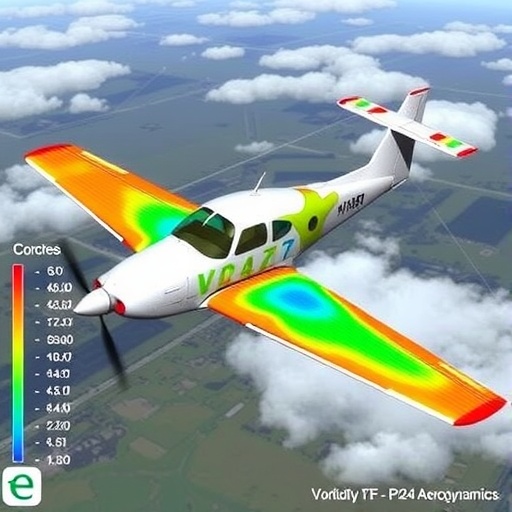
In the ever-evolving world of aviation, researchers continually seek innovative approaches to improve aircraft performance and safety. A recent study, spearheaded by a team of experts—Sanaboyina, Pradhan, and Srinivas—highlights a significant advancement in aerodynamic analysis. Their work primarily focuses on the Piper PA-24 aircraft, an iconic model revered for its versatility and reliability. The researchers employed an advanced computational method known as Flighstream, a vorticity-based panel solver, to evaluate the aerodynamic characteristics of this aircraft model.
The Piper PA-24 is known for its unique blend of performance, organization, and ease of use, making it a staple for both private pilots and flight schools alike. Its design embodies several aerodynamic principles that facilitate stability and maneuverability in various flight conditions. However, understanding the complete aerodynamic profile of such aircraft requires sophisticated computational tools, which is where Flighstream shines.
By using Flighstream, the researchers could simulate airflow around the aircraft with remarkable precision. This tool utilizes a vorticity-based approach to solve the complex equations governing fluid dynamics around the aircraft. This method allows for a more nuanced understanding of how air interacts with the aircraft at different speeds and angles of attack, key factors in determining the overall efficiency and safety during flight.
In the study, the team conducted a series of simulations, capturing a range of flight configurations and conditions. The results demonstrated how the design of the Piper PA-24 contributes to its aerodynamic performance. For instance, the aircraft’s wing design is pivotal in generating lift while minimizing drag, a balance crucial to maximizing flying efficiency and fuel consumption.
Moreover, the researchers discovered specific flow patterns that emerged around various components of the aircraft, including the wings and tail section. These patterns are instrumental in predicting how the plane would behave under different operational scenarios, such as takeoff, cruising, and landing. The use of Flighstream allowed the researchers to visualize these flow patterns in detail, providing insights into dynamic behaviors that conventional analysis methods might overlook.
One of the noteworthy aspects of this study is its emphasis on the importance of computational fluid dynamics (CFD) in modern aerodynamics. Traditional wind tunnel experiments, while still valuable, can be cost-prohibitive and time-consuming. In contrast, the Flighstream solver offers a more efficient and flexible alternative, enabling researchers to conduct multiple simulations in a fraction of the time. This accessibility can lead to rapid advancements in aircraft design and performance evaluation.
Furthermore, the research team applied their findings to suggest modifications and improvements in the PA-24’s design. By identifying areas where aerodynamic performance could be enhanced, such as wing shape alterations or adjustments to control surfaces, the researchers provided actionable insights that could lead to tangible benefits in real-world aviation.
The implications of this research extend beyond just the Piper PA-24. The methodologies applied could serve as a template for analyzing other aircraft models, potentially streamlining the aerodynamic evaluation process across the aviation industry. This adaptability of the Flighstream solver showcases its potential to become a vital tool in the aircraft design toolkit.
Another exciting facet of this study is its relevance in the context of aviation safety. A deeper understanding of the aerodynamic performance of aircraft can enhance their reliability and security. With insights garnered from such comprehensive analyses, engineers can better predict and mitigate potential issues that aircraft might face in adverse conditions, ultimately leading to safer skies for everyone.
As the aviation industry pushes towards more environmentally friendly solutions, the application of advanced aerodynamic techniques can also enhance fuel efficiency. Improved designs informed by detailed aerodynamic analysis can reduce fuel consumption and emissions, contributing to a greener future for air travel. This aligns with global initiatives aimed at reducing the environmental impact of aviation, making the findings of this study particularly timely.
Ultimately, the study embodied a blend of cutting-edge computational methods and practical aircraft design considerations, underscoring the significance of interdisciplinary collaboration in aviation research. By merging theoretical knowledge with practical applications, researchers are paving the way for the next generation of aircraft, equipped to meet modern demands.
In conclusion, the aerodynamic analysis conducted by Sanaboyina, Pradhan, and Srinivas not only sheds light on the Piper PA-24 but also exemplifies the transformative power of computational tools in aviation. The findings have far-reaching implications, suggesting new avenues for design, safety, and efficiency in the ever-important field of aeronautics. The continuous pursuit of innovation in aircraft performance analysis promises to enhance the operational capabilities of aviation, setting the stage for remarkable advancements in the years to come.
With such a powerful tool like Flighstream at their disposal, researchers are well-positioned to unlock new dimensions of understanding in aircraft aerodynamics. As this study illustrates, the future of aviation research is not only bright; it is also rife with potential for growth, improvement, and safety.
Subject of Research: Aerodynamic analysis of the Piper PA-24 aircraft
Article Title: Aerodynamic analysis of piper PA-24 aircraft using Flighstream—a vorticity-based panel solver.
Article References: Sanaboyina, H., Pradhan, S.K. & Srinivas, G. Aerodynamic analysis of piper PA-24 aircraft using flighstream—a vorticity-based panel solver. AS (2025). https://doi.org/10.1007/s42401-025-00428-z
Image Credits: AI Generated
DOI: 10.1007/s42401-025-00428-z
Keywords: Aerodynamics, Piper PA-24, Flighstream, Vorticity-based solver, Aircraft performance, Computational fluid dynamics, Aviation safety, Fuel efficiency.
Tags: advanced computational methods in aviationaerodynamics for private pilotsaircraft performance improvement techniquescomputational tools for aviation researchFlighstream aerodynamic analysisfluid dynamics in aerodynamicsinnovative approaches in aircraft designkey factors in flight safetyPiper PA-24 aerodynamicssimulation of airflow around aircraftunderstanding aircraft stability and maneuverabilityvorticity-based panel solver