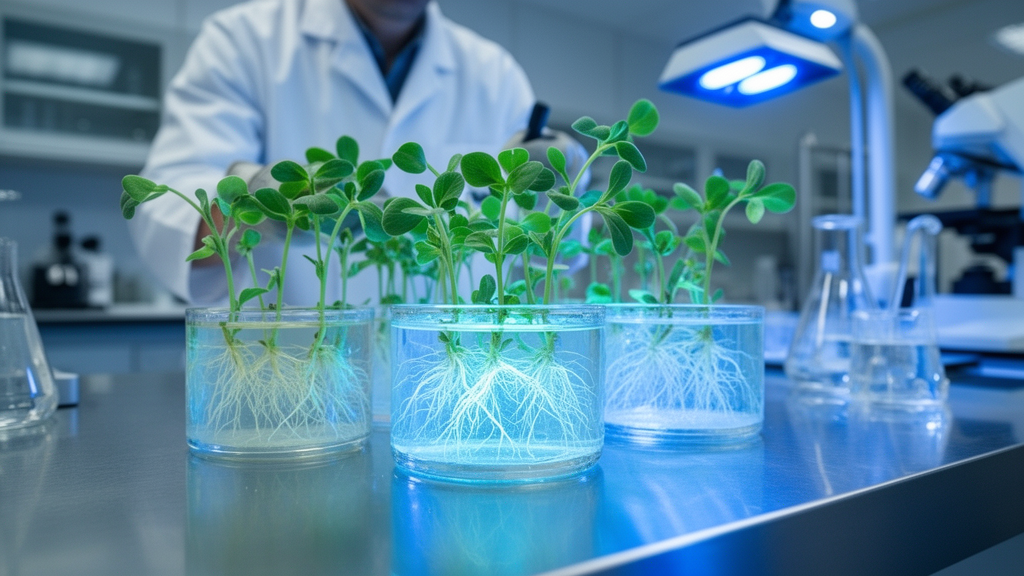
Researchers have developed a simple and efficient visualized identification system to identify and characterize alkaline response genes in soybean. By combining a synthetic reporter cassette with hairy root induction, the transient identification system enables visual selection of transformed tissues and direct observation of root growth phenotypes under alkaline stress. The method provides a rapid and accurate approach for evaluating candidate stress tolerance genes, addressing major methodological challenges in soybean functional genetics.
Alkaline stress represents one of the most widespread and devastating abiotic stresses, posing a major threat to soybean production. Multi-omics data of soybean have provided abundant genetic information that could be investigated for alkaline stress tolerance improvement, yet the identified alkaline response genes have remained limited.
Historically, gene functional characterization in soybean has been dependent on a tissue-culture-based strategy. That traditional strategy is characterized by low efficiency, technical complexity, and time-consuming procedures, which significantly constrain the pace of functional research.
To achieve rapid visual selection, the research team developed a system using a synthetic RUBY cassette to induce soybean hairy roots. The synthetic RUBY cassette encodes enzymes that convert tyrosine into clearly visible red betalain. The accumulation of red betalain enables direct visual selection of transformed tissues, allowing researchers to readily confirm transformation in soybean hairy roots based on visible coloration.
Using this transient identification system, the team evaluated a total of twenty differentially expressed genes gathered from previous data. The researchers monitored root growth phenotypes under alkaline stress to determine how each gene influenced plant performance. Based on these observed root growth phenotypes, the screen identified three alkaline-tolerant genes and two alkaline-sensitive genes, clarifying their respective functional roles during alkaline stress exposure.
On the basis of these single-gene findings, the researchers further established a multi-gene pyramiding system by expressing the three alkaline stress-tolerant genes in a single transcript unit. They then evaluated the pyramiding effect under alkaline stress conditions. The resulting pyramiding lines possessed enhanced alkaline stress tolerance compared with both the wild type and single-gene overexpression lines, confirming the benefit of multi-gene expression.
The authors concluded that the visualized identification system serves as a simple and efficient method enabling the screening of alkaline stress response genes rapidly and accurately. In addition to testing known candidates, this system can be applied for the preliminary evaluation of candidate genes before generating stable transgenic plants, thereby accelerating functional studies of stress-related genes in soybean.
Subject of Research: Visualized identification and characterization of alkaline response genes in soybean
Article Title: An efficient visualized identification system for characterizing alkaline response genes in soybean
Article References: Cao, Y., Li, H., Huang, S., Zhao, Y., Li, Y., & Meng, F. (2026). An efficient visualized identification system for characterizing alkaline response genes in soybean. Plant Methods. https://doi.org/10.1186/s13007-026-01613-7
Image Credits: AI Generated
DOI: 10.1186/s13007-026-01613-7
Keywords: soybean, alkaline stress, abiotic stress, RUBY cassette, betalain, tyrosine, hairy roots, visual selection, differentially expressed genes, gene pyramiding, alkaline tolerance, alkaline sensitivity, root growth phenotypes, functional gene characterization, transient identification system, stable transgenic plants
News Source: Juliet Wilcox. (November 12, 2026). Visualized Identification System Uncovers Alkaline Stress Response Genes in Soybean. Scienmag.