• HOME
  • NEWS
  • EXPLORE
    • CAREER
      • Companies
      • Jobs
    • EVENTS
    • iGEM
      • News
      • Team
    • PHOTOS
    • VIDEO
    • WIKI
  • BLOG
  • COMMUNITY
    • FACEBOOK
    • INSTAGRAM
    • TWITTER
Saturday, March 28, 2026
BIOENGINEER.ORG
No Result
View All Result
  • Login
  • HOME
  • NEWS
  • EXPLORE
    • CAREER
      • Companies
      • Jobs
        • Lecturer
        • PhD Studentship
        • Postdoc
        • Research Assistant
    • EVENTS
    • iGEM
      • News
      • Team
    • PHOTOS
    • VIDEO
    • WIKI
  • BLOG
  • COMMUNITY
    • FACEBOOK
    • INSTAGRAM
    • TWITTER
  • HOME
  • NEWS
  • EXPLORE
    • CAREER
      • Companies
      • Jobs
        • Lecturer
        • PhD Studentship
        • Postdoc
        • Research Assistant
    • EVENTS
    • iGEM
      • News
      • Team
    • PHOTOS
    • VIDEO
    • WIKI
  • BLOG
  • COMMUNITY
    • FACEBOOK
    • INSTAGRAM
    • TWITTER
No Result
View All Result
Bioengineer.org
No Result
View All Result
Home NEWS Science News

Virtual reality makes empathy easier

Bioengineer by Bioengineer
April 20, 2020
in Science News
Reading Time: 2 mins read
0
IMAGE
Share on FacebookShare on TwitterShare on LinkedinShare on RedditShare on Telegram

VR technology increases identification with others by activating key brain networks
IMAGE

Credit: de Borst et al., eNeuro 2020

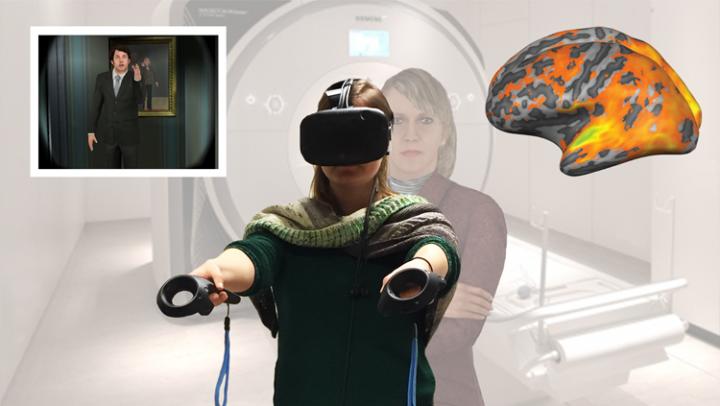
Virtual reality activates brain networks that increase your ability to identify with other people, according to new research published in eNeuro. The technology could become a tool in the treatment of violent offenders to empathize more with others.

Understanding someone’s point of view is crucial for successful relationships. When this doesn’t come naturally, virtual reality technology may be able to help the process. A first-person perspective virtual reality experience providing multi-sensory feedback can coax the brain into thinking a virtual body is its own body. This causes the brain to react to virtual events as if they are happening in the real world.

de Borst et al. used functional magnetic resonance imaging to monitor the brain activity of participants while they experienced a virtual reality animation of a man verbally abusing a woman, from the perspective of the woman. Before watching the scene, the participants went through virtual reality training embodied as the woman or as a bystander watching the woman. People experiencing the first-person embodiment identified the woman’s body as their own and demonstrated synchronized brain activity in the personal space and body ownership networks. They also showed strong synchronized activity in parts of the brain processing threat perception when the man got close.

###

Manuscript title: First Person Virtual Embodiment Modulates Cortical Network That Encodes the Bodily Self and Its Surrounding Space During the Experience of Domestic Violence

Please contact [email protected] for full-text PDF and to join SfN’s journals media list.

About eNeuro

eNeuro is an online, open-access journal published by the Society for Neuroscience. Established in 2014, eNeuro publishes a wide variety of content, including research articles, short reports, reviews, commentaries and opinions.

About The Society for Neuroscience

The Society for Neuroscience is the world’s largest organization of scientists and physicians devoted to understanding the brain and nervous system. The nonprofit organization, founded in 1969, now has nearly 37,000 members in more than 90 countries and over 130 chapters worldwide.

Media Contact
Calli McMurray
[email protected]

Related Journal Article

http://dx.doi.org/10.1523/ENEURO.0263-19.2019

Tags: Mental HealthneurobiologySocial/Behavioral ScienceTechnology/Engineering/Computer Science
Share12Tweet8Share2ShareShareShare2

Related Posts

In-Sensor Cryptography Links Physical Process to Digital Identity

In-Sensor Cryptography Links Physical Process to Digital Identity

March 25, 2026

Can Psychosocial Factors Influence Cancer Risk?

March 23, 2026

Depression Factors in Elderly: Pre vs. Post-COVID Analysis

March 23, 2026

Hidden Health Crises Among US and UK Volunteers in Ukraine Uncovered in New Study

March 23, 2026
Please login to join discussion

POPULAR NEWS

  • blank

    Revolutionary AI Model Enhances Precision in Detecting Food Contamination

    96 shares
    Share 38 Tweet 24
  • Imagine a Social Media Feed That Challenges Your Views Instead of Reinforcing Them

    1004 shares
    Share 397 Tweet 248
  • Uncovering Functions of Cavernous Malformation Proteins in Organoids

    54 shares
    Share 22 Tweet 14
  • Promising Outcomes from First Clinical Trials of Gene Regulation in Epilepsy

    51 shares
    Share 20 Tweet 13

About

We bring you the latest biotechnology news from best research centers and universities around the world. Check our website.

Follow us

Recent News

In-Sensor Cryptography Links Physical Process to Digital Identity

Can Psychosocial Factors Influence Cancer Risk?

Depression Factors in Elderly: Pre vs. Post-COVID Analysis

Subscribe to Blog via Email

Enter your email address to subscribe to this blog and receive notifications of new posts by email.

Join 78 other subscribers
  • Contact Us

Bioengineer.org © Copyright 2023 All Rights Reserved.

Welcome Back!

Login to your account below

Forgotten Password?

Retrieve your password

Please enter your username or email address to reset your password.

Log In
No Result
View All Result
  • Homepages
    • Home Page 1
    • Home Page 2
  • News
  • National
  • Business
  • Health
  • Lifestyle
  • Science

Bioengineer.org © Copyright 2023 All Rights Reserved.