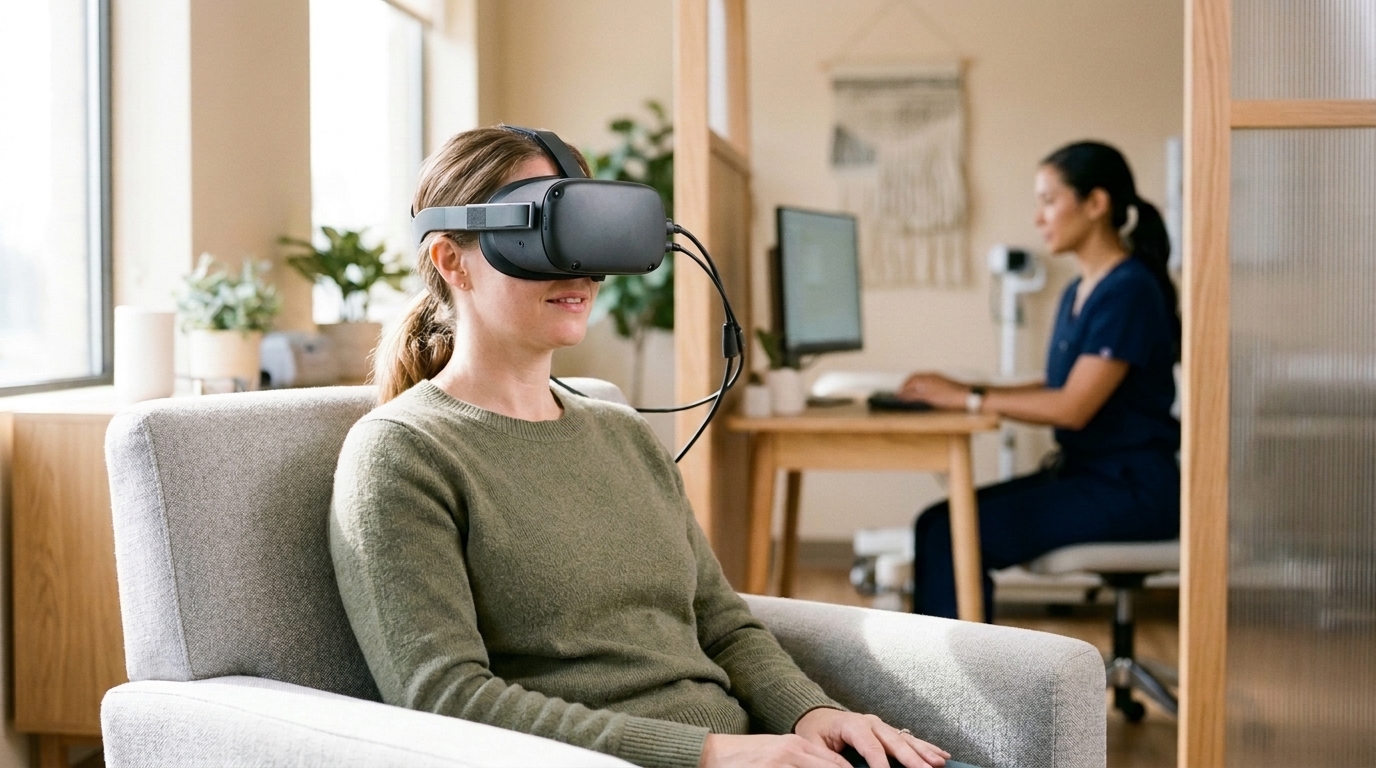
Adults living with persistent symptoms after concussion completed a six-week program of virtual reality-based eye movement rehabilitation with high adherence, no adverse events, and strong perceived benefit, according to a feasibility trial conducted at Toronto Rehabilitation Institute-University Health Network. The study, published in Frontiers in Neuroscience, was designed not to test whether the treatment works, but to determine whether a full randomized controlled trial is practical in this population, and all predefined benchmarks for moving forward were met.
Oculomotor deficits, which affect the coordinated movements of the eyes, are reported in up to 85 percent of adults after concussion and may contribute to prolonged symptoms and delayed return to daily activities. Clinically, these deficits show up as blurred vision, dizziness, light sensitivity, eye strain, and difficulty tolerating visually busy environments. Functional impairments in saccades, smooth pursuits, vergence, and pupillary light reflex occur far more frequently after concussion than structural injuries such as cranial nerve damage, making eye movement control a feasible and important target for rehabilitation. Without directed rehabilitation, symptoms can persist and delay return to work, school, sport, and social participation.
Rehabilitation approaches that retrain impaired eye movements have shown promise in younger patients, but the evidence base in adults has been thin. A recent systematic review by the study team found improvements in measures such as near point of convergence break, reading rate, and visual search and attention after oculomotor rehabilitation, though the certainty of that evidence was rated low due to methodological limitations, small samples, and variable protocols. More recent randomized trials focused on adolescents and young adults between roughly 11 and 30 years of age, leaving older populations largely unstudied. Virtual reality headsets offer a standardized and scalable way to deliver such training, and a scoping review of vestibular rehabilitation found VR-based interventions were well tolerated and perceived as more enjoyable than traditional approaches, but no published study had examined VR-based eye movement rehabilitation in adults with persisting post-concussion deficits.
The ORCA study enrolled 40 adults aged 18 to 42 who had been diagnosed with a concussion by a physician between 30 days and 12 months earlier and who endorsed visual symptoms including blurred vision, double vision, or light sensitivity. Participants also had to pass a series of vision checks: normal stereopsis on the Stereo Fly Test, equal visual acuity between eyes on the Snellen chart, intact extraocular movements and visual fields, reactive pupils, and healthy optic nerves, maculae, and retinal tissue on fundoscopy. Those with diagnosed eye disease, visual acuity worse than 20/80, severe neurocognitive deficits, or who lived more than 100 kilometers from the site were excluded. The age ceiling of 42 was chosen using the Hofstetter formula, which estimates the maximum age at which age-related ocular changes would not be expected to interfere with the intervention.
Participants were randomized in a 1:1 ratio, stratified by sex, to either six sessions of VR-based oculomotor rehabilitation with a mobile application for home exercises or usual care consisting of education only, delivered verbally and in writing, on symptom-limiting strategies such as pacing, taking breaks during visual work, and modifying visual stimuli. The intervention group trained with NeuroFlex software on FOVE VR goggles, completing 45-to-60-minute sessions covering saccades, smooth pursuits, head-free pursuit, optokinetic reflex, vergence, and anti-saccades. Sessions increased in difficulty, duration, and content each week based on tolerance, perceived exertion, and symptoms. Home-based exercises of 10 minutes or less were prescribed at least five of seven days weekly, with progression gated by a rated-exertion threshold. Because of the nature of the interventions, participants and study staff could not be blinded after assignment.
Retention was strong: 39 of 40 participants, or 95 percent, completed follow-up, with one withdrawal attributed to anxiety unrelated to the study. Every participant allocated to the intervention attended all six sessions, and 94.7 percent engaged in the prescribed home-based exercises, averaging 3.9 days per week against a target of five. Recruitment exceeded the a priori threshold of at least 32 participants within 12 months, with a randomization rate of 85.1 percent among those who passed initial phone screening. The trial was not powered for efficacy testing, so no inferential between-group comparisons were conducted; the results are descriptive and intended to inform the design of a definitive trial.
Perceived benefit, the study’s proof-of-concept measure rated on a 0-to-4 scale, averaged 3.4 in the intervention group compared with 2.3 in the education-only group, with confidence intervals that did not overlap. The authors emphasize these estimates are descriptive and were not intended to provide definitive evidence of between-group or sex differences. Overall study experience was rated 3.8 out of 4 across all participants. No adverse events or harms were reported; any symptoms provoked during VR use were transient, resolving within one minute of completing the task, and one participant required 10 minutes of rest after the first session. Symptom scores on the Simulator Sickness Questionnaire trended downward by weeks five and six even as training difficulty increased, and rated exertion also declined over time.
The VR platform functioned reliably, with only five occurrences of technical failure, about 2.5 percent of total study visits, requiring participant rescheduling. The eye-tracking system captured oculomotor metrics across six movement domains at a 100 Hz sampling frequency, with spatial accuracy of 1.15 degrees independently validated through bench testing. In a single case-level analysis, 18 of 21 direct eye-position metrics showed pre-to-post changes exceeding the device’s worst-case documented measurement error of one degree, suggesting the technology can capture within-participant change, though the authors caution this does not establish statistical, clinical, or VR-specific attribution. The study also generated variance estimates for powering a future trial: using the Brain Injury Visual Symptom Survey as a candidate primary outcome with a minimum clinically important difference of 10 points, roughly 70 participants would be needed, while the authors recommend near point of convergence break as the primary outcome for the definitive trial.
The recruited sample showed substantial symptom burden. Mean Rivermead Post-Concussion Symptom Questionnaire scores were 31.3, well above values reported in non-concussed populations, and baseline visual symptom scores on the Brain Injury Visual Symptom Survey averaged 49.7 out of 112. Females reported higher symptom burden on two measures at baseline, with effect sizes suggesting larger differences on the Rivermead questionnaire and the visual symptom survey, though the authors note these differences should be interpreted with caution and may not be meaningful when controlling for other variables. All participants identified as cisgender, which precluded gender-based analysis, and the sample size was insufficient to meaningfully explore sex or gender effects on feasibility outcomes.
Several limitations shape how these findings should be read. Feasibility was tested in a supervised clinical environment, and the authors warn against assuming similar tolerability in unsupervised or prolonged home use; people who knew they were susceptible to visually induced motion sickness may also have avoided participating. The exclusion of participants over 42 limits generalizability, injury mechanisms were heterogeneous, and reliance on self-reported homework adherence leaves room for recall or social desirability bias. Because the Rivermead questionnaire was collected only at baseline and final testing, distinguishing intervention effects from natural recovery was not possible in this design. The authors conclude that the intervention is feasible, acceptable, and well tolerated, and that a fully powered trial should evaluate clinical efficacy, use objective measures such as near point of convergence break as the primary outcome, add optometric evaluation at baseline and final testing, and consider sex and gender as interacting variables in samples with greater gender diversity.
Subject of Research: Feasibility of virtual reality-based oculomotor rehabilitation for adults with persistent symptoms after concussion
Article Title: Oculomotor rehabilitation after concussion in adults (ORCA): a feasibility study
Article References: Biscardi, M., Bayley, M. T., Thorpe, K., Quaid, P., Colantonio, A., & Mollayeva, T. (2026). Oculomotor rehabilitation after concussion in adults (ORCA): a feasibility study. Frontiers in Neuroscience, 20, Article 1898653. https://doi.org/10.3389/fnins.2026.1898653
Image Credits: AI Generated
DOI: 10.3389/fnins.2026.1898653
Keywords: concussion, virtual reality, oculomotor rehabilitation, feasibility study, randomized controlled trial, eye tracking, vision symptoms, neurorehabilitation, adults, persistent symptoms, Oculomotor, rehabilitation
News Source: Ophelia Keating. (November 5, 2026). Virtual reality eye-training trial clears feasibility hurdles in adults with lasting concussion symptoms. Scienmag.