Hands-on laboratory exercises and outdoor field sessions have long served as foundational cornerstones in preparing civil engineering and geomatics students for professional field practice. Within these disciplines, physical training is essential for cultivating spatial reasoning, rigorous measurement discipline, and the detailed procedural fluency required to execute accurate spatial surveys. Nevertheless, conventional field-based training faces compounding logistical hurdles, including restricted equipment availability, weather dependence, scheduling constraints, safety considerations, and substantial recurring expenditures for staffing and maintenance. Following disruptions highlighted during the pandemic, immersive virtual reality and virtual laboratories have gained considerable attention as scalable, flexible instructional complements capable of providing standardized exercises and repeatable practice without depleting physical resources or risking equipment damage.
To investigate how immersive simulations support procedure-intensive technical training, researchers developed and experimentally evaluated a dedicated virtual reality laboratory tailored to differential leveling. While much of the earlier literature surrounding virtual reality in engineering education focused on broad user engagement, conceptual awareness, or overall system usability, relatively few investigations have systematically tracked task-specific procedural execution or diagnostic behavioral data. Differential leveling represents a critical, multi-stage discipline within surveying curricula that demands precise tripod positioning, optical leveling, structured observation sequencing, rigorous error control, and numerical reduction. The study evaluated whether an interactive workflow could yield measurable learning gains across defined procedural competencies and whether granular interaction logs could identify meaningful behavioral distinctions between proficient and struggling learners.
The experimental platform was developed using the Unity engine version 2022.3 LTS alongside OpenXR to ensure device-level interoperability, deploying custom C# scripts for user interaction handlers and interface management. Three-dimensional environmental assets, instruments, and animations were modeled across Blender, Shapr3D, SketchUp, and SolidWorks before integration into Unity. The application was compiled on a Dell Pro Max 16 Plus mobile workstation equipped with an Intel Core Ultra 9 285HX processor, 128 gigabytes of CAMM2 DDR5 memory, and an NVIDIA RTX PRO 5000 Blackwell graphics processing unit featuring 24 gigabytes of GDDR7 memory. The virtual laboratory was delivered directly to students using the Meta Quest 3 headset, taking advantage of its six-degree-of-freedom tracking and handheld controllers to facilitate realistic manipulation of surveying gear.
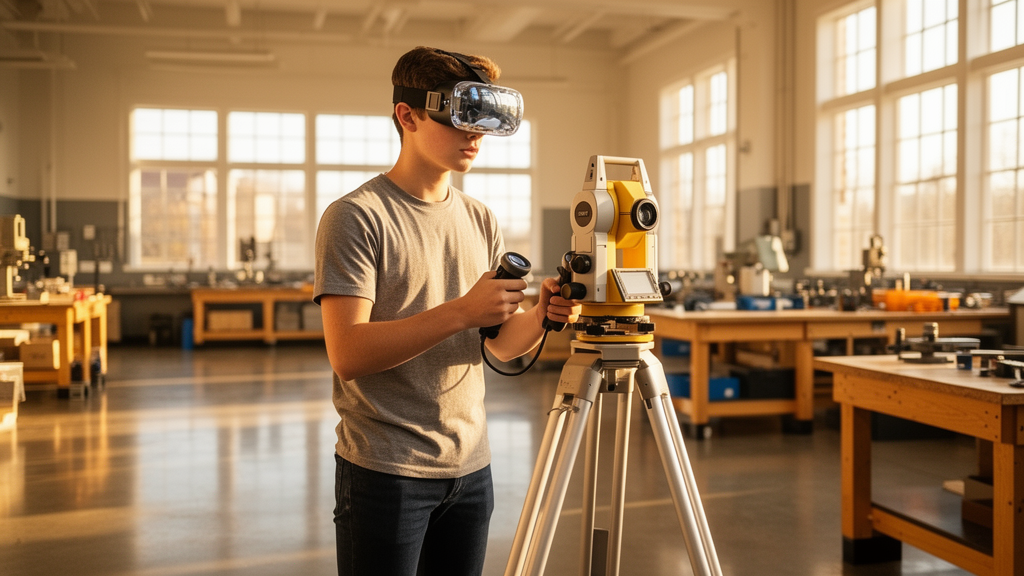
Instructional system design prioritized interaction fidelity over absolute visual photorealism, emphasizing how closely user mechanics mirrored physical field actions such as tripod placement, leveling screw calibration, and rod sighting. The virtual setting incorporated dynamic landscapes featuring open parkland, curved roadways, retaining walls, multi-building clusters, and urban corridors to simulate authentic sightline calibration challenges while keeping object densities controlled to limit extraneous cognitive load. To isolate core instrument skills and prevent working memory overload, a virtual assistant character was programmed to handle and transport the graduated metric leveling rod between designated benchmark stations. Students interacted with a simulated digital level mounted on a tripod, utilizing manual leveling screws alongside a dual-access viewing mechanism that mirrored scope views onto a handheld digital tablet equipped with magnified reticle crosshairs, on-screen adjustment sliders, and step-by-step guidance.
The study cohort comprised 42 civil engineering students recruited from an introductory geomatics engineering laboratory at Florida State University under Institutional Review Board protocol STUDY00007287. Demographically, 47.6 percent of participants were sophomores, 35.7 percent were juniors, 11.9 percent were freshmen, and 4.8 percent were graduate students, with 95.2 percent under the age of 22. While 31.0 percent reported having no previous virtual reality experience, familiarity with surveying hardware was relatively high, with 73.8 percent having previously operated a total station, 57.1 percent a leveling rod, and 42.9 percent a digital or automatic level, whereas 23.8 percent possessed no prior surveying equipment experience. Each individual completed an orientation, health screening, pre-test, a single seated 20- to 30-minute immersive virtual surveying session, and post-task evaluations.
Subjective experience and usability assessments indicated strong overall acceptance, high perceived engagement, and manageable cognitive demand across the cohort. On an adapted nine-item System Usability Scale, the virtual reality system achieved a mean composite score of 79.3 out of 100, exceeding the standard benchmark average of 68 and falling into the qualitative bracket between good and excellent. In terms of user perception, 97.6 percent of participants agreed that the virtual environment enhanced learning engagement, 88.1 percent felt genuinely immersed, and 97.6 percent affirmed they would recommend the platform for teaching differential leveling. NASA Task Load Index scores demonstrated low physical demand, low frustration, and modest temporal pressure, while emotional response inventories revealed marked increases in feelings of interest, excitement, and inspiration alongside notable decreases in nervousness and apprehension.
Objective pre- and post-task knowledge assessments revealed statistically evident learning gains across foundational surveying concepts, particularly in computational problem-solving where baseline proficiency was initially lower. The proportion of correct answers assessing elevation calculations rose from 61.9 percent prior to the exercise to 78.6 percent following completion, representing an absolute improvement of 16.7 percentage points. Height of instrument calculations improved from 83.3 percent to 92.9 percent, reflecting a 9.6 percentage point gain, while comprehension of backsight concepts increased from 64.3 percent to 73.8 percent, a 9.5 percentage point increase. Incremental improvements were documented in general leveling procedures, instrument setup, and rod reading relationships, whereas items addressing intermediate sights, rod positioning errors, and field note importance exhibited ceiling effects with baseline scores exceeding 95 percent.
Automated interaction logging captured detailed operational metrics that allowed researchers to classify learners and assess procedural efficiency across four core sequential stages: the initial backsight reading at station one, the height of instrument calculation, the foresight reading at station two, and the final elevation computation. Participants were categorized as accurate if all four fieldbook entries matched reference benchmarks and inaccurate if any entry deviated. Out of 42 participants, 19 met the strict accuracy threshold while 23 committed at least one error. Accurate participants finished the laboratory significantly faster than inaccurate peers, recording an average completion time of 217.71 seconds with a standard deviation of 46.34 seconds compared to an average of 264.52 seconds with a standard deviation of 67.02 seconds for inaccurate participants.
Statistical hypothesis testing verified key relationships between user interaction patterns, execution duration, and procedural accuracy during the leveling exercise. In accordance with the first hypothesis, independent-samples testing confirmed that accurate students completed tasks significantly faster and required significantly fewer click interactions than inaccurate learners. Under the second hypothesis, linear regression revealed a statistically significant moderate positive correlation between the total number of user interactions and overall completion time, yielding a correlation coefficient of 0.56, a coefficient of determination of 0.31, and a fitted model where time equaled 1.53 multiplied by click count plus 99.0 seconds. These findings established that interaction volume reliably reflects operational fluency and can serve as a diagnostic indicator of learner struggle.
Analysis of error distributions across discrete stages confirmed the third hypothesis, as a one-way analysis of variance demonstrated that error frequencies varied significantly across the workflow. Difficulties concentrated distinctly within later procedural stages rather than earlier setup routines: the second station foresight reading exhibited the highest error frequency at 35.7 percent, followed by the final elevation calculation at 26.2 percent, whereas height of instrument calculations showed a 16.7 percent error rate and initial backsights generated an error rate of only 7.1 percent. Error co-occurrence tracking showed that foresight misreadings frequently propagated directly into downstream elevation errors, an issue potentially exacerbated by the fact that 42.9 percent of participants lacked prior background with metric leveling staffs.
In contrast to operational pacing, testing of the fourth hypothesis showed no statistically significant association between total interaction clicks and aggregate task errors, producing a correlation coefficient of 0.20 with a 95 percent confidence interval spanning from negative 0.11 to positive 0.48. This outcome indicates that behavioral input volume alone does not directly account for whether a learner makes conceptual or interpretive calculation errors. While interactive inefficiency reliably mirrors slower execution and operational hesitation, specific mistakes during foresight readings and arithmetic reductions reflect distinct cognitive and domain-specific challenges that cannot be resolved solely through interface familiarity or faster input execution.
The authors highlighted several critical constraints, most notably the absence of an external control group receiving traditional field-based training under identical testing instruments, meaning observed knowledge improvements reflect individual progress relative to baseline rather than demonstrated superiority over outdoor fieldwork. Additionally, conducting the simulation in a seated posture and delegating rod transport to an autonomous virtual assistant removed physical transit and collaborative two-person crew coordination from the learning experience. Future investigations aim to incorporate comparative control trials, multi-session distributed curricula, expanded sample sizes, and adaptive instructional feedback to further clarify how immersive simulations can complement physical surveying laboratories in engineering education programs.
Subject of Research: Evaluation of an immersive virtual reality laboratory for teaching differential leveling in civil engineering education
Article Title: Integrating virtual reality into engineering education: Experimental study of differential leveling in surveying
Article References: Udekwe, D., Akin-Adamu, A., & Guo, Q. V. (2026). Integrating virtual reality into engineering education: Experimental study of differential leveling in surveying. Computers & Education: X Reality, 9, Article 100183. https://doi.org/10.1016/j.cexr.2026.100183
Image Credits: AI Generated
DOI: 10.1016/j.cexr.2026.100183
Keywords: Virtual Reality, Differential Leveling, Civil Engineering Education, Surveying Education, Spatial Reasoning, Procedural Learning, System Usability Scale, NASA-TLX, Unity Engine, Meta Quest 3, Learning Analytics, Height of Instrument, Foresight Reading, Backsight Reading, Interaction Fidelity, Cognitive Load, Engineering Pedagogy
News Source: Scienmag.