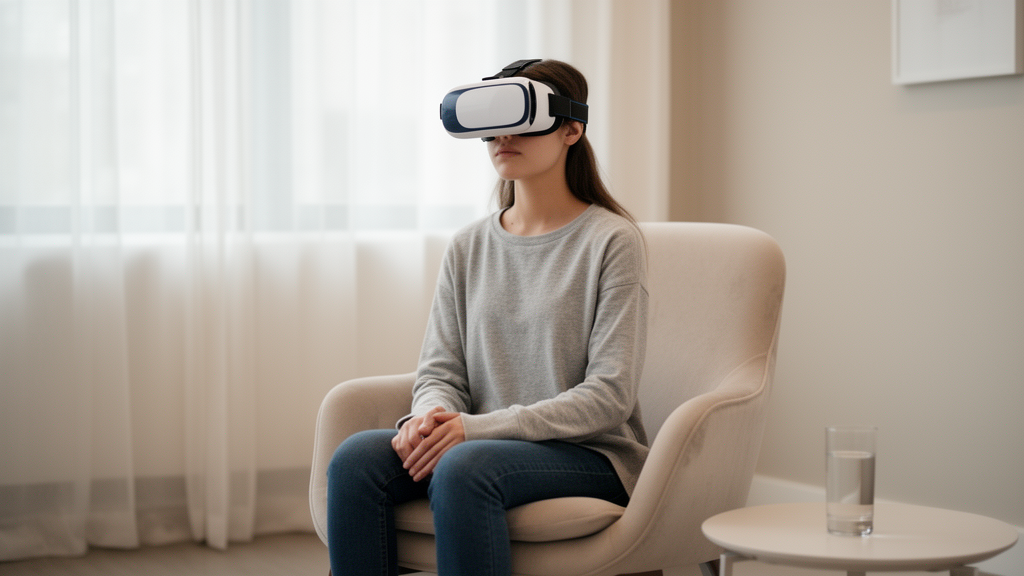
A single-case clinical investigation conducted at the University of Bologna has demonstrated the feasibility and therapeutic utility of an individual counseling intervention integrating cognitive-behavioral techniques, positive psychology strategies, and virtual reality software for a student with generalized anxiety disorder. Published in Frontiers in Health Services, the study examined the application of the H.O.M.E._Positivity software within an academic counseling setting across a six-week protocol. The intervention aimed to alleviate psychological distress while targeting positive psychological resources, character strengths, and emotional awareness. Applying an ABA repeated-assessment design and Reliable Change Index calculations, researchers documented significant reductions in maladaptive coping strategies and negative affect immediately post-treatment, alongside an increase in personal autonomy. While gains in coping strategies and autonomy persisted at a three-month follow-up, the reduction in negative affect attenuated over time, illustrating both the immediate clinical value and longitudinal maintenance considerations of brief technology-assisted counseling protocols.
The patient, designated as M., was a 23-year-old off-site female student attending the first year of a Master’s degree in Educational Studies at the University of Bologna. Raised in a mountainous region of Northern Italy within a family comprising her father, a 55-year-old clerk, her mother, a 53-year-old housewife, and a 19-year-old student brother, she resided in shared accommodation in Bologna. Concurrently, M. worked as a home educator for children from families experiencing acute distress and abuse. Upon seeking assistance, she presented with substantial psychological distress driven by chronic anxiety and elevated stress linked to academic, professional, and interpersonal responsibilities. Her background included a history of panic attacks for which she had undertaken a brief psychological intervention years earlier, discontinued due to university course scheduling conflicts. During initial assessment, panic attacks occurred only sporadically in the evening, with M. having developed personal strategies to cope with acute episodes.
Diagnostic assessment utilized the anxiety disorders module of the Structured Clinical Interview for DSM Disorders, confirming a diagnosis of Generalized Anxiety Disorder defined by difficult-to-control anxiety and worry across academic, occupational, and social settings. Standardized psychometric testing revealed marked distress, with M. scoring 44 on the Depression Anxiety Stress Scales. Stress constituted the most pronounced dimension at 36 out of 42, followed by anxiety and depressive symptoms each scoring 26 out of 42, although M. subjectively described herself as cheerful rather than persistently low in mood. Her baseline score on the Mental Health Continuum–Short Form was 33 out of 70, reflecting moderate mental health with emotional well-being at 12 out of 15, psychological well-being at 16 out of 30, and social well-being at 5 out of 25. On the Difficulties in Emotion Regulation Scale, her score of 33 out of 60 remained below the mild impairment cutoff, indicating preserved regulatory capacities.
Approved by the University of Bologna Ethical Board under protocol 0388152, the research enrolled M. voluntarily following digital screening, securing written informed consent alongside permission for case publication. The six-week intervention combined cognitive-behavioral therapy, positive psychology strategies, and the H.O.M.E._Positivity software delivered across weekly sessions. A cognitive-behavioral therapist administered the treatment under weekly expert supervision, with three randomly selected recorded sessions evaluated by an independent investigator to verify procedural adherence. The counseling structure comprised two distinct phases: the first established the therapeutic alliance, collected anamnestic data, enhanced emotional awareness, and examined personal life purpose; the second focused on cultivating character strengths, autonomy, self-awareness, and constructive interpersonal functioning. Clinical and psychometric outcomes were tracked using an ABA design at three specific time points: pre-intervention baseline, immediately following the completion of the sixth session, and at a three-month follow-up, providing a framework to monitor treatment-induced changes with heightened methodological confidence.
The H.O.M.E._Positivity software operated on a Meta Quest 3 standalone headset, delivering a display resolution of 2,064 by 2,208 pixels per eye with a 90-hertz refresh rate. The virtual environment comprised a 360-degree house featuring a kitchen, living room, bedroom, bathroom, study, and outdoor garden, populated with familiar items including a computer, credit card, bed, bedside lamp, garden vegetation, and a virtual cat. Using handheld controllers, the participant navigated rooms and operated an Emotional Labelling Tool, which permitted selecting objects, assigning emotional terms such as joy or anxiety, and scoring intensity on a zero-to-five scale. Specialized therapeutic mechanics included an interactive Virtual Bookshelf containing literary and philosophical quotations addressing life purpose, a gamified Resource Box and Virtual Backpack for storing psychological assets, a 3D Virtue and Strengths Tree displaying 24 VIA character strengths, a living-room avatar for practicing emotional expression, and a Hot Air Balloon scenario for synthesis.
During the first session, M. familiarized herself with the virtual home, exhibiting collaborative enthusiasm while reporting chronic stress and relaxation struggles. Interactions with virtual objects illuminated personal tensions: the garden and virtual cat evoked joy rated at five alongside nostalgia rated at five regarding distant family members. In session two, emotional exploration identified mixed reactions to domestic objects. The virtual computer was linked to joy rated at five, reflecting academic passion, while an adjacent credit card sparked gratitude toward her father alongside rigid cognitive demands regarding financial repayment and constant productivity. The bed triggered joy from sleep alongside guilt over perceived unproductiveness and boredom rated at three, whereas the bedside lamp elicited safety rated at five against panic episodes. The third session employed the Virtual Bookshelf to examine life purpose, revealing that deeply internalized obligations hindered M. from identifying personal pleasure independent of external achievements and parental expectations.
In session four, the Resource Box and Virtual Backpack allowed M. to explore character assets, identifying altruism and spirituality while selecting autonomy and mindful eating for homework exercises. By session five, M. reported that asserting boundaries reduced guilt when declining requests, while mindful eating minimized smartphone distractions. Session five integrated the Virtue and Strengths Tree, where M. recognized personal traits of humanity and empathy while addressing impulsive interpersonal reactions by committing to cultivate temperance, creativity, and self-regulation to curb social media use. In the final session, an avatar exercise in the living room enabled M. to express verbal gratitude toward her father, while the Hot Air Balloon scenario synthesized acquired competencies. M. demonstrated heightened mindfulness, reduced compulsive screen time, and rediscovered intrinsic leisure pursuits like drawing and listening to music, transitioning away from initial anhedonic attitudes toward self-directed appreciation of daily well-being independent of external praise.
Quantitative evaluation examined changes across the Psychological Well Being Scale, the Positive and Negative Affect Schedule, and the 28-item Brief COPE questionnaire using Reliable Change Index calculations. Across the pre-intervention to post-intervention comparison, index values for autonomy, negative affect, and maladaptive coping strategies exceeded the critical threshold of 1.96, establishing clinically significant improvements. Autonomy scores increased significantly post-intervention and remained stable at the three-month follow-up, confirming the durability of acquired gains. Similarly, maladaptive coping strategies demonstrated significant reductions that remained above the statistical threshold at follow-up, indicating sustained behavioral improvement. In contrast, while negative affect decreased significantly immediately post-treatment, the pre-intervention to three-month follow-up index failed to exceed the 1.96 threshold. This pattern revealed that the initial reduction in negative affect attenuated over time, suggesting that while the intervention effectively strengthened adaptive coping and autonomy, lasting emotional symptom reduction may require ongoing maintenance strategies or periodic booster sessions.
Qualitative feedback reflected strong patient engagement, with M. describing the intervention as motivating and constructive. She noted that the virtual reality environment served as an accessible catalyst for exploring emotions, personal values, and strengths that had previously been difficult to identify or articulate. Although extended exposure occasionally triggered mild discomfort and motion sickness, introducing structured conversational pauses mitigated these issues without disrupting completion. M. highlighted significant shifts in self-awareness, dismantling her former tendency to evaluate leisure negatively and learning to embrace intrinsically rewarding activities including drawing, listening to music, and self-care. In interpersonal relationships, she developed greater autonomy and assertiveness, expressing personal preferences and declining requests without excessive guilt or fear of disapproval. Furthermore, enhanced present-moment awareness supported improved emotional regulation, enabling M. to curb compulsive smartphone and social media usage while reinforcing supportive ties with family, friends, and her partner. These personal evaluations corroborated the therapist’s clinical observation of meaningful therapeutic progression.
Despite promising clinical observations, the investigators noted several methodological limitations inherent to a single-case investigation. Findings cannot be directly generalized to heterogeneous populations, and voluntary participation introduces potential self-selection bias. Because the protocol concurrently integrated cognitive-behavioral techniques, positive psychology exercises, clinician guidance, and virtual reality components, isolating the specific active therapeutic ingredient remains impossible. Nonspecific factors, including the therapeutic alliance, therapist empathy, participant expectancies, and technology novelty effects, may have contributed to outcomes. From an implementation standpoint, standalone headsets like the Meta Quest 3 reduce equipment expenses and 45-to-60-minute sessions align with university schedules, with brief breaks managing motion sickness. However, systemic integration into routine university counseling faces practical challenges, including hardware purchasing budgets, device sanitation protocols between sessions, institutional data privacy compliance, and variable digital literacy among clinicians, underscoring the necessity of larger randomized controlled trials evaluating booster sessions and long-term efficacy. Moreover, future component-dismantling studies remain essential to clarify active mechanisms.
Subject of Research: Virtual reality and positive psychology counseling intervention for generalized anxiety disorder
Article Title: The application of well-being and positive psychology strategies in a virtual reality protocol: a case report
Article References: Vescovelli, F., Castaldo, S., & Ruini, C. (2026). The application of well-being and positive psychology strategies in a virtual reality protocol: a case report. Frontiers in Health Services, 6, Article 1917191. https://doi.org/10.3389/frhs.2026.1917191
Image Credits: AI Generated
DOI: 10.3389/frhs.2026.1917191
Keywords: virtual reality, counseling psychology, positive psychology, generalized anxiety disorder, university mental health, psychotherapy technology, single-case study, digital health, application, well-being, positive, psychology
News Source: Glenn Wilkins. (November 7, 2026). Virtual Reality Counseling Protocol Shows Promise in University Student Case Study. Scienmag.