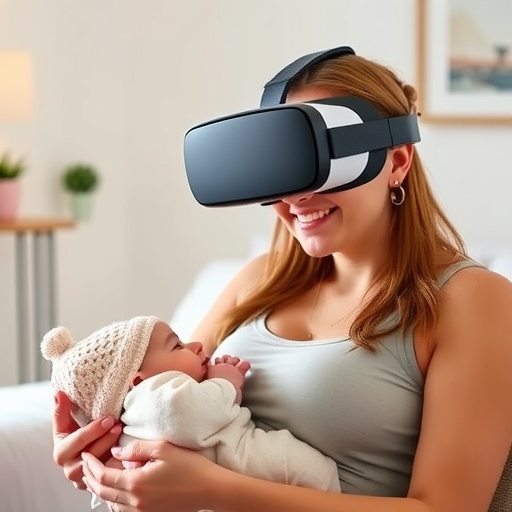
In a groundbreaking randomized controlled trial published in Journal of Perinatology in early 2026, researchers explored the transformative power of virtual reality (VR) as a tool to enhance breastfeeding outcomes among first-time pregnant women. This innovative study, helmed by Ertaş, Çevik, and Özerdoğan, investigated how immersive VR experiences tailored to breastfeeding education influence prenatal breastfeeding self-efficacy and postpartum motivation to breastfeed, promising a novel intervention that merges technology with maternal health education. With the advent of VR becoming more accessible, the potential for such digital health applications marks a significant advancement in prenatal care.
The study’s core premise rested on addressing a critical barrier to breastfeeding success: the lack of confidence and motivation among primiparous women, who often face anxiety and uncertainty regarding effective breastfeeding techniques. Prior interventions targeting breastfeeding education traditionally relied on verbal counseling or printed materials, which frequently fall short in creating lasting behavioral changes. Herein lies the significance of VR — by immersing learners in a simulated realistic breastfeeding experience, the researchers hypothesized that women could gain both psychological preparedness and hands-on simulated practice, ultimately fostering greater self-efficacy.
Technically, the virtual reality environment was meticulously designed to replicate the nuanced steps involved in breastfeeding, including infant positioning, latch techniques, and addressing common challenges such as nipple pain and milk supply management. Participants could navigate this environment interactively, allowing them to visualize actions and receive immediate simulated feedback. The immersive nature of VR engages multiple senses, providing a holistic learning experience that mere verbal instructions or videos cannot replicate. This multisensory feedback loop is fundamental in reinforcing neural pathways associated with skill acquisition and confidence.
Enrolling a cohort of primiparous pregnant women, the trial randomly assigned participants either to the VR breastfeeding experience intervention or to a control group receiving standard prenatal education. Pre-intervention assessments measured baseline breastfeeding self-efficacy, using validated psychometric scales, while postpartum follow-ups gauged changes in motivation and breastfeeding continuation rates. Importantly, the longitudinal design allowed the team to monitor whether gains in self-efficacy translated into tangible breastfeeding behaviors and persistence in the early postpartum period, a crucial window for establishing breastfeeding routines.
One of the salient outcomes revealed that participants exposed to the VR intervention demonstrated a statistically significant increase in breastfeeding self-efficacy scores prenatally compared to controls. This elevation in confidence was not merely theoretical but correlated with increased engagement and more positive attitudes toward breastfeeding after delivery. The VR group reported enhanced preparedness to manage common breastfeeding difficulties, which often derail new mothers from sustained breastfeeding efforts. Such findings underscore the role psychological empowerment plays in maternal health outcomes and infant nutrition.
Moreover, the study noted enhanced breastfeeding motivation among the VR participants postpartum. Motivation, a complex construct influenced by personal beliefs, social support, and anticipated challenges, is often a predictor of breastfeeding success. By providing an immersive, realistic preview of breastfeeding, the VR experience appears to mitigate fears and misconceptions, thereby fostering a more resilient commitment to breastfeeding. This insight heralds the potential of VR as a motivational tool, capable of reshaping behavioral intentions before they encounter real-life hurdles.
The innovative application of VR aligns with broader trends in healthcare technology integration, where experiential learning platforms are increasingly leveraged to augment patient education. Unlike traditional didactic methods, VR facilitates active learning — a critical factor in adult education theories that emphasize engagement for effective knowledge transfer. By enabling users to “practice” in a safe, consequence-free virtual environment, VR mimics real-world interactions and provides experiential rehearsal that is invaluable for skill mastery.
Technological refinement ensured the VR content was user-friendly and accessible even to pregnant women with minimal technological literacy. Such attention to usability stems from an understanding that digital divide issues could otherwise limit the intervention’s reach. The research team incorporated intuitive controls and clear instructional cues, guaranteeing that technology served as an enabler rather than a barrier. Accessibility enhances scalability, opening avenues for wide-scale implementation in diverse clinical settings globally.
Beyond individual benefits, the study’s implications ripple into public health domains. Breastfeeding is globally recognized for its profound short- and long-term health advantages for both infants and mothers, including reduced risks of infectious diseases, improved cognitive development, and decreased maternal cancer risks. Yet, breastfeeding rates in many countries remain suboptimal due to multifactorial obstacles. Interventions such as VR that boost self-efficacy and motivation could be integrated into prenatal care programs, thus supporting public health goals to increase breastfeeding initiation and duration.
The study also contributes methodologically by demonstrating how psychosocial variables like self-efficacy can be quantitatively assessed and positively influenced through digital interventions. This offers a blueprint for future research targeting other maternal behaviors and health outcomes. The ability to randomize and control for confounding variables alongside scalable technology platforms represents a paradigm shift toward evidence-based, technology-driven maternal support systems.
Furthermore, the researchers propose that future iterations of the VR breastfeeding program could incorporate artificial intelligence elements, tailoring feedback dynamically based on user responses and learning curves. Such adaptive VR systems could personalize education, responding to individual learning paces, cultural contexts, and specific concerns, thus maximizing efficacy and engagement. This intersection of VR with AI underscores an exciting frontier in personalized medicine and patient education.
While promising, the study acknowledges limitations, including sample size constraints and the need for validation in heterogeneous populations. Further research is warranted to evaluate long-term breastfeeding outcomes beyond initial postpartum months and to assess cost-effectiveness compared to conventional prenatal education methods. Despite these caveats, the current findings craft a compelling narrative about the role of immersive technologies in addressing enduring public health challenges.
The enthusiasm surrounding VR interventions is tempered by considerations regarding equitable access. Ensuring that economically disadvantaged populations benefit from such advancements mandates policy initiatives and resource allocation that prioritize inclusivity. Without such measures, disparities in breastfeeding outcomes could persist or widen. Thus, the intersection of technology, health education, and policy frameworks becomes a vital dialogue for stakeholders.
In summary, Ertaş and colleagues’ investigation unveils a pioneering use of virtual reality to foster prenatal breastfeeding self-efficacy and sustain postpartum motivation among first-time mothers. By simulating breastfeeding scenarios in an engaging, interactive format, VR serves not only as an educational apparatus but also as a psychological scaffold, empowering women to commence and continue breastfeeding with greater confidence and resilience. This approach promises to revolutionize prenatal education and highlights the vast potential of immersive experiences in enhancing maternal and infant health worldwide.
The study’s publication in Journal of Perinatology heralds a new era where technological innovation seamlessly integrates with clinical research to address nuanced behavioral challenges. As healthcare continues to digitalize, the paradigm showcased by this trial offers a template for future interventions exploiting VR to optimize outcomes across various domains of reproductive and child health. The convergence of technology and health education envisages a future where immersive learning transforms pregnancy and parenting experiences.
Ultimately, the application of virtual reality breastfeeding experiences represents a leap forward in marrying technology with empathetic healthcare delivery. By directly addressing psychological barriers through technologically mediated experiential learning, this intervention transcends the limitations of traditional educational efforts. As VR technology becomes increasingly accessible and affordable, it stands poised to become a standard component in prenatal care protocols, supporting mothers around the globe in achieving optimal breastfeeding outcomes.
Subject of Research:
The study investigates the impact of a virtual reality breastfeeding experience on prenatal breastfeeding self-efficacy and postpartum breastfeeding motivation among primiparous pregnant women.
Article Title:
The effect of breastfeeding experience presented with virtual reality on breastfeeding self-efficacy and breastfeeding motivation: a randomized controlled trial.
Article References:
Ertaş, E., Çevik, F. & Özerdoğan, N. The effect of breastfeeding experience presented with virtual reality on breastfeeding self-efficacy and breastfeeding motivation: a randomized controlled trial. J Perinatol (2026). https://doi.org/10.1038/s41372-025-02535-3
Image Credits: AI Generated
DOI: 10.1038/s41372-025-02535-3 (Published 05 January 2026)
Tags: barriers to breastfeeding successdigital health applications for mothersenhancing breastfeeding confidencefirst-time pregnant women supportimmersive VR experiences in healthcareinnovative maternal health interventionspostpartum breastfeeding motivationprenatal breastfeeding self-efficacysimulated breastfeeding techniquestechnology in prenatal carevirtual reality breastfeeding education