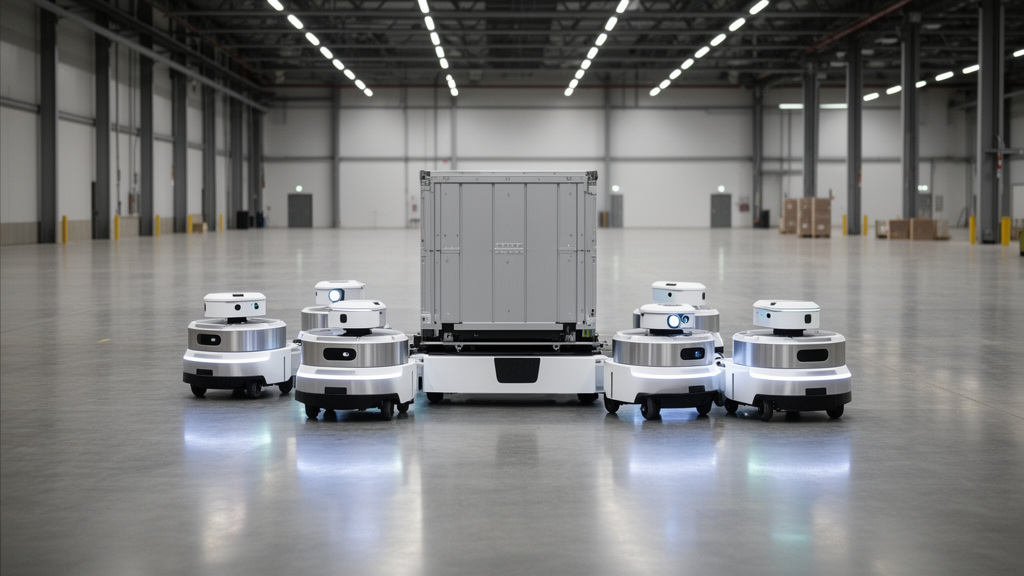
A multi-robot coordination method termed Shadowing reduces inter-robot communication message counts by over 93 percent compared to leader-follower systems and over 96 percent compared to centralized virtual structures during cooperative transport tasks. Developed by researchers Hoolark Jung, Donghyun Lee, and Hyunchul Tae, the virtual geometry approach allows autonomous mobile robot fleets to maintain load-supporting formations across dynamic environments without continuous wireless transmissions. Across extensive testing under two path planning algorithms, the framework eliminated formation collapses entirely while improving transport speeds and formation precision relative to standard baselines.
The research addresses an inherent weakness in existing multi-robot cooperative transport techniques, which rely on continuous communication to sustain payload configurations. Conventional leader-follower schemes demand constant communication between robots to coordinate movements, whereas centralized virtual structure architectures require uninterrupted position feedback sent to a central node. As robot fleets scale up in logistics automation and smart factory settings, continuous communication floods shared wireless channels with control-rate traffic. This heavy overhead generates computational bottlenecks and poses critical risks to the stable transport of fragile payloads.
To eliminate this communication dependency, the authors designed the Shadowing technique around independent trajectory tracking. The central innovation allows mobile robots to maintain formations and continue cooperative transport during communication outages by executing a pre-transmitted time-space trajectory of a virtual polygon framework. Each individual robot independently preserves its assigned spatial position according to pre-stored timestamps, operating reliably without needing ongoing data packets from peer robots or central controllers during nominal transit.
Under the Shadowing framework, active network communication consists of a single initial trajectory broadcast supplemented exclusively by event-triggered transmissions. Rather than broadcasting continuously at a fixed control frequency, robots transmit messages only when dynamic obstacles are detected or when individual positional error exceeds a maximum threshold designated as epsilon max. When positional drift crosses this allowable threshold, the affected unit triggers a realignment broadcast, ensuring the virtual polygon re-synchronizes without saturating the shared channel during uninterrupted motion.
The authors validated the method through a quantitative experimental campaign of 16,200 trials per path planner. The evaluation tested three distinct map types, four obstacle densities, three formation control methods, and three formation sizes consisting of two, four, and six robots across 150 trials per condition. In this testing regime, dynamic obstacles appeared at random times uniformly distributed between one and two seconds and remained static thereafter. To analyze continuously moving obstacles, the researchers conducted a separate physics-based evaluation within the Gazebo simulation environment.
Using Anytime D* as the path planning backbone, Shadowing achieved average communication message count reductions of 93.8 percent, 94.3 percent, and 95.5 percent relative to the leader-follower baseline for two, four, and six robots respectively. Compared to the centralized virtual structure approach, message reductions reached 97.8 percent, 97.0 percent, and 97.4 percent across the same fleet sizes, with complementary data-volume analyses confirming these gains. Shadowing also completed missions 25.0 percent, 21.2 percent, and 21.5 percent faster than the leader-follower scheme across the three fleet sizes, while incurring only 4.6 to 10.0 percent longer mission times than centralized structures in exchange for a 42 to 48 percent reduction in formation error.
Experiments under the classic A* path planner revealed comparable performance improvements. Relative to the leader-follower approach, Shadowing reduced message counts by 93.7 percent for two robots, 93.7 percent for four robots, and 94.8 percent for six robots. Compared against centralized virtual structures, message reductions were 97.8 percent, 96.8 percent, and 97.0 percent across the three formation sizes. Shadowing completed missions 19.4 to 23.9 percent faster than the leader-follower method while recording 45 to 51 percent lower formation error than the centralized virtual structure baseline.
The experimental results showed that the absolute message gap between Shadowing and baseline methods grew roughly linearly with the number of participating robots. Because Shadowing’s broadcast frequency is governed by discrete events—specifically initial trajectory transmission, dynamic obstacle replanning, and realignment—rather than by continuous control rates, the message reduction ratio remained above 93 percent relative to leader-follower and above 96 percent relative to centralized structures across all evaluated team sizes. Notably, the researchers recorded zero mission failures and zero formation collapses across all conditions and planners.
Subject of Research: Multi-robot formation control and cooperative payload transport using virtual geometry shadowing in dynamic environments
Article Title: A Novel Virtual Geometry Shadowing Approach For Multi-Robot Formation Control In Dynamic Environments
Article References: Jung, H., Lee, D., & Tae, H. (2026). A Novel Virtual Geometry Shadowing Approach For Multi-Robot Formation Control In Dynamic Environments. Journal of Intelligent & Robotic Systems. https://doi.org/10.1007/s10846-026-02488-5
Image Credits: AI Generated
DOI: 10.1007/s10846-026-02488-5
Keywords: multi-robot formation control, cooperative transport, virtual geometry shadowing, virtual polygon framework, leader-follower, centralized virtual structures, Anytime D* planner, A* path planning, dynamic obstacles, inter-robot communication, time-space trajectory, formation error, smart factory automation, Gazebo simulation, payload transport, event-triggered broadcast
News Source: Denise Maddox. (November 16, 2026). Virtual Geometry Shadowing Cuts Multi-Robot Transport Communication by Over Ninety-Three Percent. Scienmag.