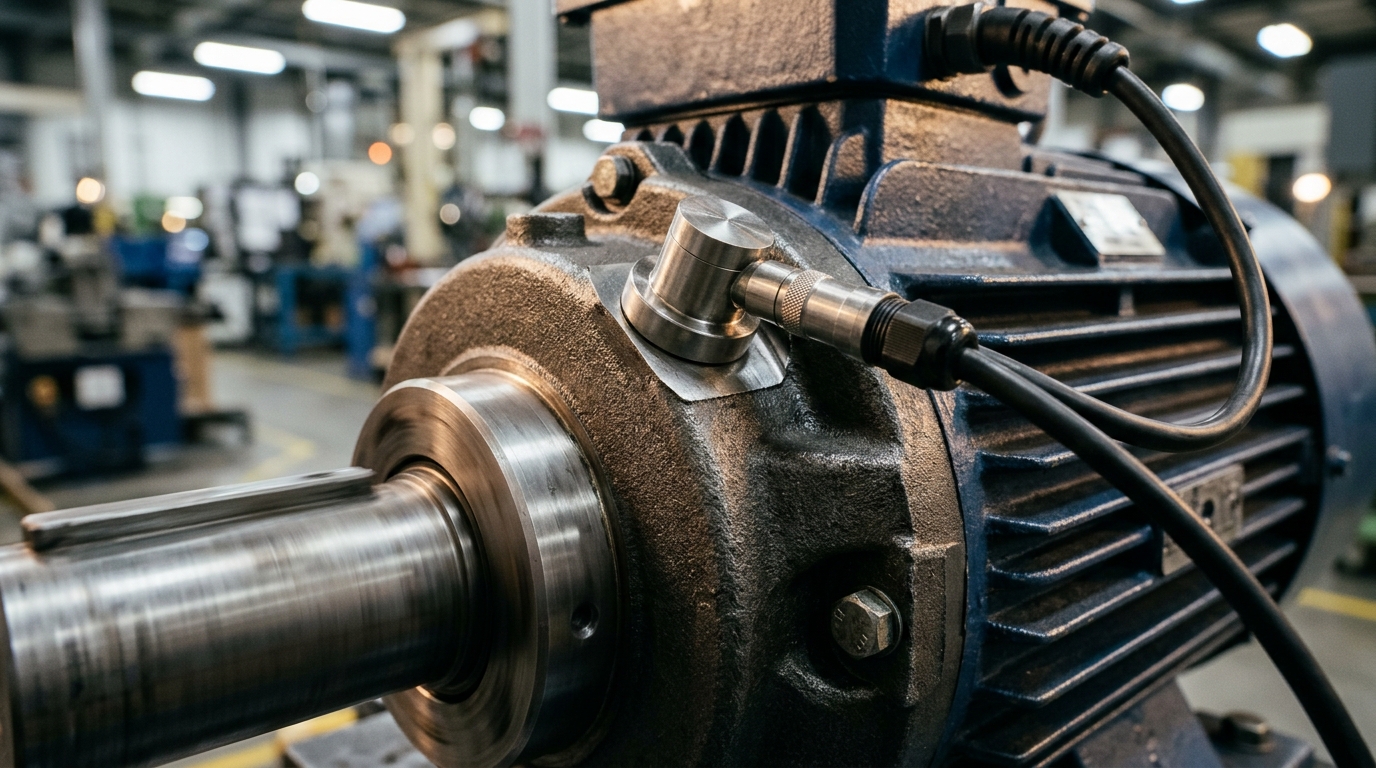
Researchers evaluating three-phase induction motors across varying operating loads and defect severities determined that integrating mechanical vibration velocity data with wrapper-based feature selection and lightweight machine learning classifiers maintained diagnostic stability under white noise contamination up to forty percent. While conventional motor current signature analysis frequently suffers from spectral leakage and resolution loss at low operating loads where rotational slip remains minimal, mechanical vibration analysis successfully detected structural degradation across the full operational range.
Three-phase induction motors represent the foundational workhorses of contemporary industrial manufacturing, accounting for as much as eighty percent of global industrial electricity consumption. When structural anomalies such as broken rotor bars emerge within these machines, they trigger secondary operational anomalies including stator voltage imbalances, destructive torque pulsations, reduced energetic efficiency, and intense local overheating. Although motor current signature analysis has long served as an established non-invasive diagnostic standard by tracking characteristic modulation sideband frequencies around the fundamental electrical supply frequency, its practical effectiveness diminishes severely during low-load operation, fluctuating operating states, or pronounced external noise interference. Under low shaft torque conditions, characteristic fault sidebands converge tightly against high-energy fundamental spectral components, preventing classical frequency-domain algorithms from isolating initial defect signatures before severe mechanical degradation transpires.
To overcome the operational limitations of single-modality monitoring, researchers conducted systematic experimental trials on a dedicated laboratory test bench composed of a one-horsepower, four-pole, sixty-hertz squirrel-cage induction motor operating at two hundred and twenty to three hundred and eighty volts and rated for a nominal torque of 4.1 Newton-meters at 1715 revolutions per minute. The induction machine was coupled via an inline rotating torque meter to a direct-current generator operating as an adjustable resistive dynamometer. Five distinct rotor conditions were evaluated, encompassing a pristine healthy rotor and four damaged rotors engineered with one, two, three, and four adjacent broken bars created by drilling six-millimeter-diameter holes at the longitudinal midpoint of the thirty-four-bar cage assembly. Operating loads were stepped from 0.5 Newton-meters to the nominal 4.0 Newton-meters in increments of 0.5 Newton-meters across ten independent repetitions per operational configuration, generating a structured repository of 1200 validated experimental samples.
Data collection simultaneously gathered mechanical and electrical phenomena across isolated sensor channels. Mechanical vibrations were captured using five uniaxial stainless-steel accelerometers positioned on the motor drive end, non-drive end, housing exterior, and rigid support desk. These vibration transducers operated across a frequency span from 5 to 2000 hertz with a continuous sensitivity of 10 millivolts per millimeter per second, feeding a six-channel analog conditioning platform equipped with second-order anti-aliasing filters set at a 2000-hertz cutoff and sampling at 7.6 kilohertz. Electrical current was recorded across all three stator phases through precision alternating current probes capable of handling fifty amperes root mean square with a conversion ratio of 10 millivolts per ampere, interfaced with an oscillograph digitizer sampling at 50 kilohertz. Both recording instruments synchronized acquisitions over twenty-second intervals, reserving the final sixteen seconds of continuous steady-state operation for statistical feature extraction and analytical validation.
Signal processing protocols were deployed across time and frequency domains to extract discriminating physical features from the raw digitized waveforms. For electrical phase currents, time-domain series were segmented into four-second non-overlapping windows, normalized to zero mean and unit variance, and transformed through Principal Component Analysis. While the first two principal components captured standard fundamental sinusoidal behaviors, the third principal component isolated orthogonal variance directly correlated with rotor cage damage. These distributions were modeled using non-parametric Kernel Density Estimators, allowing Kullback-Leibler Divergence, or relative entropy, to quantify statistical dissimilarity relative to healthy baseline operations. In the frequency domain, current signals underwent Hilbert transformation to evaluate the analytical signal modulus, circumventing spectral leakage limitations inherent to standard Fast Fourier Transforms and successfully isolating fault indicators below 1.5 Newton-meters where standard motor current signature analysis failed entirely.
Mechanical vibration velocity waveforms underwent an equivalent four-second windowing protocol in the time domain, yielding descriptive statistical metrics including root mean square velocity, peak amplitude, crest factor, and kurtosis. Because the vibration signal maintained an underlying sinusoidal profile, kurtosis values consistently centered near 1.5 across all motor health conditions, whereas root mean square amplitude served as a direct indicator of total vibrational energy and structural imbalance. In the frequency domain, Motor Vibration Signature Analysis paired with Hilbert transformations mapped spectral peaks over an 8.5-second time window with a fine spectral resolution of 0.1172 hertz. Transducer placement proved vital for mechanical analysis, as sensors mounted at the drive end and non-drive end bearings captured maximum vibrational energy via direct structural transmissibility, whereas current transducers exhibited balanced symmetry across all three stator phases, indicating that a single monitored phase provides sufficient electrical diagnostic data.
Extracted numerical features were subsequently filtered through two competing dimensionality reduction strategies to eliminate collinearity and optimize classification speed: Correlation-Based Feature Selection, functioning as a heuristic filter model, and a Wrapper method utilizing targeted pattern classifiers with a best-first search strategy halted after five consecutive non-improving subset expansions. The Wrapper selector consistently outperformed the filter approach across every experimental scenario by capturing complex multivariate interdependencies rather than evaluating variables in isolation. Normality assessments using Kolmogorov-Smirnov tests at a five percent significance level revealed that descriptors exhibiting Gaussian probability distributions appeared far more frequently within Wrapper-selected subsets. For current signals, relative entropy derived from Kullback-Leibler Divergence emerged as the most critical statistical feature, while root mean square vibration velocity proved to be the most universally relevant mechanical descriptor across all operational scenarios.
Classification efficiency was evaluated across four supervised machine learning architectures: Decision Trees implemented via the C4.5 algorithm with a confidence factor of 0.25 for tree pruning, Naïve Bayes classifiers assuming class-conditional feature independence, Multi-Layer Perceptron Artificial Neural Networks trained over 1000 epochs with a learning rate of 0.3 and momentum of 0.2, and linear-kernel Support Vector Machines. Performance was quantified through a six-vertex multicriteria radar analysis forming a geometric hexagon. The six standardized metrics comprised False Positive Rate, False Negative Rate, Complementary Accuracy, Learning Time based on Computational Complexity, Percentage of Features Selected, and the complement of the Area under the Receiver Operating Characteristics curve. Because a smaller enclosed hexagonal area denotes superior overall performance, the Wrapper-Decision Tree and Wrapper-Naïve Bayes configurations secured the highest rankings across all experimental scenarios, delivering superior generalization, rapid inference execution, and transparent decision logic.
To evaluate industrial robustness, the experimental signals were progressively degraded through the algorithmic insertion of synthetic Gaussian white noise ranging from zero to one hundred percent in ten percent increments. Across all tested architectures, feature selection stability broke down once noise levels exceeded forty to fifty percent, causing feature selectors to incorporate spurious descriptors that confused machine learning training routines. However, within the stable operating boundary up to forty percent added white noise, mechanical vibration velocity signals exhibited remarkable resilience, showing no statistically significant variation in multicriteria hexagon area at the five percent significance level. Integrating the hexagon area curves using Simpson’s one-third rule demonstrated that mechanical vibration signals yielded robustness area integrals approximately three to ten times smaller than those achieved using electrical current signals, proving that physical mechanical vibrations preserve clearer defect signatures under harsh electrical interference.
These experimental findings establish that although electrical current analysis remains a valuable baseline for continuous non-intrusive monitoring, mechanical vibration sensing combined with Wrapper feature selection and lightweight classification algorithms provides superior diagnostic reliability for industrial predictive maintenance. While the experimental investigation was conducted under controlled steady-state laboratory conditions using single-fault cage configurations, the demonstrated forty percent noise tolerance validates this data-driven framework for challenging production environments. Future extensions will examine data fusion methodologies integrating multiple transducer streams, the diagnostic tracking of compound mechanical and electrical anomalies, and the incorporation of deep neural architectures to enhance real-time autonomous health management across complex manufacturing ecosystems.
Subject of Research: Induction motor broken rotor bar fault diagnosis using machine learning, feature selection, and current versus vibration signals
Article Title: Comparative analysis of feature selection and classification techniques for robust broken rotor bar diagnosis in induction motors using current and vibration signals
Article References: Maciejewski, N. A. R., Freire, R. Z., Szejka, A. L., Bazzo, T. P. M., Frencl, V. B., & Treml, A. E. (2025). Comparative analysis of feature selection and classification techniques for robust broken rotor bar diagnosis in induction motors using current and vibration signals. Autonomous Intelligent Systems, 5(1), Article 26. https://doi.org/10.1007/s43684-025-00113-0
Image Credits: AI Generated
DOI: 10.1007/s43684-025-00113-0
Keywords: induction motors, broken rotor bars, vibration analysis, motor current signature analysis, feature selection, wrapper methods, decision trees, naive bayes, predictive maintenance, fault diagnosis, Comparative, analysis
News Source: Ophelia Keating. (November 9, 2026). Vibration Signals and Wrapper Algorithms Optimize Induction Motor Fault Diagnosis. Scienmag.