In a newly reported study, vertical directional solidification was employed to investigate capillary and thermocapillary mechanisms that enable spontaneous self-oriented seed formation and entirely detached crystal growth in antimony-based semiconductor systems. The experimental results establish that wall-free crystal growth under terrestrial gravity is a dynamically maintained state that can be sustained over extended crystal lengths rather than a temporary interfacial detachment.
Achieving meniscus-controlled contactless growth under normal gravitational conditions has long posed a significant technical hurdle in semiconductor crystal-growth technology. Within vertical directional solidification configurations, gravitational, thermal, and interfacial forces act simultaneously upon the system, strongly influencing melt interface stability and governing the mechanical interactions between the growing crystal and the surrounding ampoule wall.
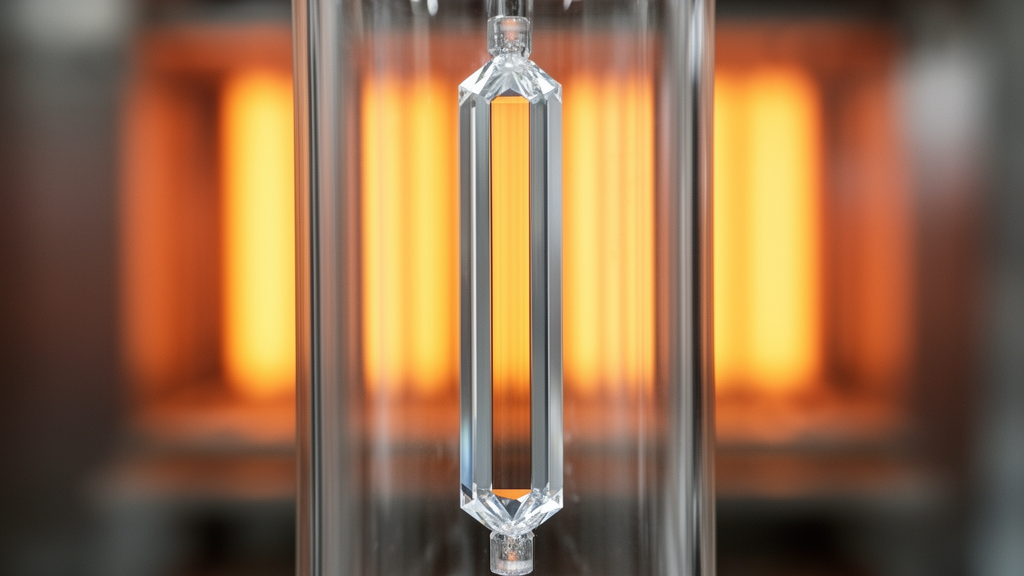
The reported experimental runs demonstrated that self-oriented seed formation takes place spontaneously at the conical apex of the growth ampoule. As solidification proceeded from this conical apex, a continuous annular gap developed along the perimeter of the crystal, isolating the solidifying material from contact with the ampoule container and preventing crystal-wall attachment during extended growth.
To evaluate the boundaries of this contactless regime, researchers evaluated three successive generations of vertical directional solidification experiments. Measurement of these experimental runs identified a dynamic annular-gap stability window, which initially extended from 69 to 145 micrometers in the first generation and subsequently broadened to span between 30 and 300 micrometers in the second and third generations.
The maintenance of a stable detached growth regime was correlated with specific quantitative thermal and hydrodynamic parameters. The experimental system operated under thermal gradients of 10 to 32 degrees Celsius per centimeter, alongside measured Bond numbers ranging between 7.7 × 10⁻⁶ and 7.7 × 10⁻⁴, a Capillary number of 4.72 × 10⁻⁹, and Marangoni numbers ranging from approximately 6.4 to 638.
These hydrodynamic conditions indicate that the detached-growth phenomenon is governed by coupled capillary confinement and thermocapillary stabilization, which act together to preserve a stable crystal-melt meniscus and suppress adherence to the container. Drawing from this observed processing window, the author proposed the Gadkari Dynamic Annular-Gap Stability Criterion, defined at a value of 8.3 × 10⁵, to classify detached-growth regimes and provide a quantitative framework connecting interfacial stability, annular-gap evolution, and long-length wall-free crystal growth under normal gravity.
By classifying these detached growth regimes through the GDAGSC criterion, this quantitative framework aids in understanding meniscus controlled crystal growth under terrestrial gravity. The findings specifically demonstrate how coupled capillary confinement and thermocapillary stabilization operate to suppress crystal wall attachment, resolving how interface stability is maintained when gravitational, thermal, and interfacial forces act simultaneously upon the solidifying melt.
Furthermore, establishing this processing window across three experimental generations confirms that wall free crystallization can be dynamically sustained over extended crystal lengths in vertical directional solidification. Linking annular gap evolution directly to interfacial stability demonstrates that maintaining a stable crystal melt meniscus enables continuous detached growth, verifying that contactless semiconductor crystal growth is achievable under normal gravitational conditions.
Subject of Research: Detached semiconductor crystal growth in vertical directional solidification
Article Title: Capillary–thermocapillary-enabled self-oriented seed formation and annular entirely detached crystal growth in vertical directional solidification under terrestrial gravity
Article References: Gadkari, D. (2026). Capillary–thermocapillary-enabled self-oriented seed formation and annular entirely detached crystal growth in vertical directional solidification under terrestrial gravity. Journal of Materials Science: Materials in Engineering. https://doi.org/10.1186/s40712-026-00626-3
Image Credits: AI Generated
DOI: 10.1186/s40712-026-00626-3
Keywords: vertical directional solidification, detached crystal growth, semiconductor crystals, antimony-based semiconductors, capillary confinement, thermocapillary stabilization, self-oriented seed formation, annular gap stability, crystal-melt meniscus, terrestrial gravity, conical ampoule apex, thermal gradients, Bond number, Capillary number, Marangoni number, Gadkari stability criterion, wall-free crystal growth, interfacial stability
News Source: Denise Maddox. (November 16, 2026). Vertical Directional Solidification Sustains Entirely Detached Semiconductor Crystal Growth Under Gravity. Scienmag.