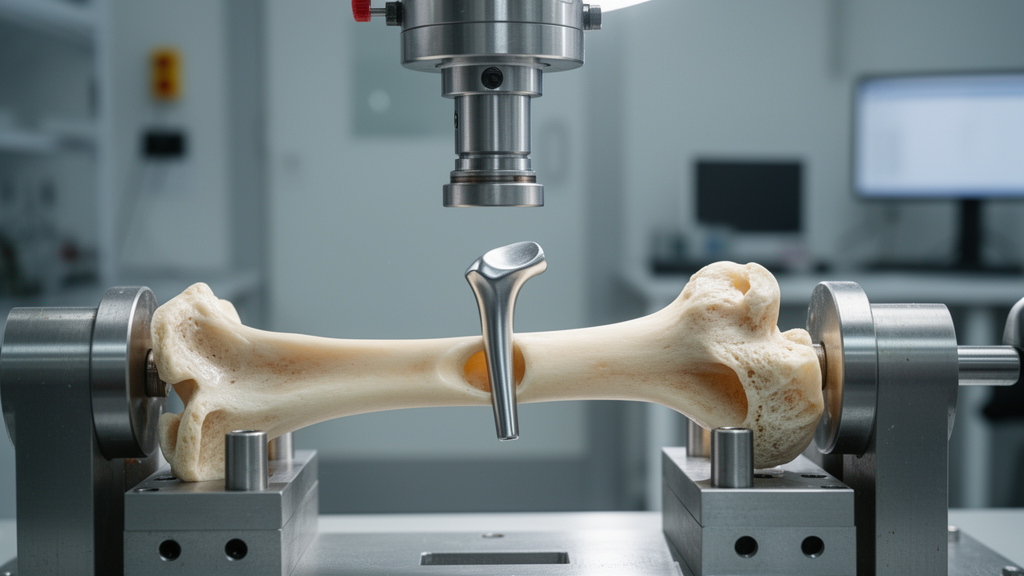
A biomechanical investigation evaluating femoral component orientation in cementless total hip arthroplasty has demonstrated that an intentional eight-degree varus malposition provides significantly greater resistance to dynamic stem subsidence than conventional neutral placement in human cadaveric bone. Reporting in Arthroplasty, an orthopedic research team analyzed paired human femora subjected to progressively increasing cyclic compression and discovered that although varus orientation reduced initial construct stiffness and necessitated smaller implant sizes, it allowed the constructs to withstand substantially higher peak loads and dynamic cycles prior to reaching defined thresholds of macro-instability and final catastrophic failure.
Minimally invasive surgical approaches have increasingly become standard clinical practice for cementless hip reconstructions because they spare soft tissue, diminish intraoperative blood loss, shorten operative times, reduce acute pain, and accelerate functional rehabilitation across the initial three postoperative months. Obscured visualization can cause lateralized acetabular component placement, conservative femoral neck resection, or insufficient soft-tissue release, each of which hinders adequate proximal femoral elevation during canal preparation and elevates the procedural likelihood of accidental varus stem malalignment regardless of the implant anchoring philosophy.
Deviating from neutral trajectory during femoral broaching creates a steep broaching angle that frequently forces the surgeon to seat an undersized femoral prosthesis, altering the cortical fill index within the proximal canal. Clinical literature has historically associated stem undersizing and varus deviation with early vertical instability, progressive subsidence or sintering, elevated interface micromotion, and an increased risk of intraoperative periprosthetic fractures. Despite widespread awareness of these surgical complications, definitive experimental evidence examining whether defined varus positioning and secondary implant undersizing compromise primary mechanical stability in modern metadiaphyseal anchoring designs has remained limited in orthopedic biomechanics.
To rigorously isolate the biomechanical effects of stem alignment, the researchers designed a controlled experimental model utilizing ten matched pairs of fresh-frozen human cadaveric femora obtained from Science Care with written anatomical donor consent and institutional review board approval. The donor cohort comprised three females and seven males with an average age of 69.6 years, spanning 42 to 84 years, and a mean body weight of 79.8 kg, spanning 44 to 109 kg, with all specimens free from bony lesions, malignancies, or metabolic bone diseases. Left and right femora from each donor were allocated pairwise into two balanced experimental cohorts of ten specimens each, satisfying an a priori statistical power calculation requiring at least nine specimens per group to detect significant differences at an alpha level of 0.05 and a statistical power of 0.8.
Specimen preparation involved thawing the tissues at room temperature for 24 hours, stripping external soft tissues, acquiring standardized anteroposterior radiographs, and conducting digital templating with mediCAD planning software to establish baseline anatomical dimensions and anticipated implant sizes. The investigators selected a calcium phosphate titanium plasma-coated diaphyseal anchoring press-fit prosthesis, specifically the ANA.NOVA alpha stem composed of Ti6Al4V titanium alloy featuring a double-conus geometry, a polished taper, and a 135-degree centrum-caput-collum-diaphyseal angle. Each specimen received a pristine implant seated under fluoroscopic guidance in strict adherence to manufacturer specifications, following a standardized ninety-degree femoral neck osteotomy referenced from the transition between the greater trochanter and femoral neck.
Specimens in the neutral cohort had stems aligned coaxially with the femoral shaft axis, whereas specimens in the varus cohort were implanted with an intended eight-degree varus malalignment relative to the anatomical shaft axis, facilitated by precision in-line predrilling. Because the angled trajectory within the femoral canal altered proximal fit, the varus cohort accommodated significantly smaller prostheses than the neutral cohort, producing an average size reduction of 1.7 implant sizes (p = 0.002). After completing osteotomies and component seating close to the piriformis fossa level, the femoral shafts were trimmed to uniform lengths and embedded within cylindrical polymethylmethacrylate bases to ensure standardized load application during mechanical evaluation.
An initial quasi-static testing phase applied three successive ramped compression cycles from 50 to 200 N at a rate of 15 N/s to eliminate specimen settling and quantify axial construct stiffness. Subsequently, a dynamic cyclic loading phase applied a physiological double-peaked compression profile at 2 Hz, maintaining a valley load of 200 N while progressively ramping peak force from 500 N upward by 0.1 N per cycle until catastrophic structural failure occurred, defined by an actuator displacement cutoff of 30 mm.
Optical motion tracking markers mounted directly to the femoral cortex and prosthetic neck recorded relative axial displacements at 128 Hz to assess primary stability across established clinical thresholds. Micro-instability was defined as the initiation of 0.15 mm stem subsidence, whereas macro-instability was established at 1.0 mm subsidence, alongside tracking the definitive rapid shift in the load-displacement profile that signaled catastrophic failure. Statistical evaluation using paired-samples t-tests confirmed normal data distributions and homogeneity of variance across the paired cohorts, revealing distinct mechanical profiles across the testing progression.
The experimental measurements indicated that neutral stems exhibited significantly higher initial axial stiffness than varus constructs during quasi-static evaluation (p = 0.023). However, resistance to micro-motion at the 0.15 mm subsidence cut-off showed no statistically significant differences between cohorts, with both groups reaching comparable load thresholds and cycle counts (p = 0.214). At the macro-instability threshold of 1.0 mm subsidence, the varus-aligned constructs demonstrated marked superiority, enduring significantly higher compressive loads and substantially more dynamic cycles than their neutrally aligned counterparts (p = 0.022), an advantage that persisted through catastrophic failure loads and total cycles to failure (p = 0.018).
Post-test structural analysis revealed equivalent failure modes across both groups, predominantly featuring medial femoral wall defects occasionally accompanied by lateral wall cortical blowout and secondary stem subsidence rather than isolated premature fracture. The authors concluded that while an eight-degree varus malalignment forces stem undersizing and reduces early elastic stiffness, progressive dynamic subsidence drives the angled stem into robust secondary cortical engagement that substantially reinforces load tolerance. Although these biomechanical findings demonstrate that inadvertent intraoperative varus alignment can be mechanically tolerated without necessitating risky corrective re-broaching, the authors emphasize that the results reflect ex vivo cadaveric loading without musculotendinous forces and should not be interpreted as a clinical endorsement for intentional varus positioning.
In contextualizing their observations, the researchers compared their experimental outcomes to prior biomechanical evaluations of femoral stem positioning, notably investigations by Konow and colleagues. Whereas earlier biomechanical models treated implant dimensions and canal alignment as separate, independent variables that evaluated fixed size disparities of only a single increment, the present protocol treated implant size and varus angulation as interdependent parameters. This design feature deliberately reproduced clinical operative circumstances, where altered canal trajectory naturally forces an average reduction of 1.7 implant sizes. Furthermore, while Konow et al. identified only non-significant stability enhancements alongside heightened micromotion in varus configurations, recording interface shifts of 0.017 mm in varus alignments compared to 0.008 mm in neutral orientations, the current evaluation established statistically validated load-bearing advantages at the one-millimeter subsidence threshold. The authors attributed the absence of significant differences at the earlier 0.15-millimeter micro-instability cutoff to modern design advancements in the investigated prosthesis, specifically its enlarged geometric profile and calcium phosphate titanium plasma coating, which preserved early construct fixation before secondary cortical engagement occurred.
The findings also contribute to ongoing orthopedic debates regarding periprosthetic fracture susceptibility. In this biomechanical model, varus-aligned femora exhibited failure modes identical to neutral controls under catastrophic loading, failing primarily through medial wall bone defects rather than premature structural collapse. Consequently, the authors highlighted that when an accidental varus alignment arises during surgery, attempting an immediate intraoperative revision by extracting the seated implant and recutting the canal to achieve a strictly neutral alignment carries a substantial hazard of causing iatrogenic femoral fractures. Leaving an unintended varus stem undisturbed avoids extraction trauma while preserving biomechanical stability, though clinicians must still monitor documented long-term trade-offs, such as altered hip offset reconstruction, reduced cortical fill, and potential stress shielding.
Despite these favorable mechanical observations, the authors underscored multiple methodological limitations inherent to ex vivo cadaveric models. The controlled laboratory setup relied on a limited series of donor femora and could not simulate physiological soft-tissue tension, active muscle forces, or complex multi-directional joint kinematics experienced during normal patient gait. Furthermore, manual specimen preparation and osteotomy positioning introduced slight mechanical variations despite computerized radiographic templating and calibrated predrilling. Because the protocol evaluated only immediate post-implantation mechanics, it could not assess biological osseointegration, ongoing bone remodeling, or long-term stress shielding patterns that evolve over months of in vivo implantation.
Subject of Research: Biomechanical comparison of varus versus neutral alignment in cementless metadiaphyseal hip stems
Article Title: Biomechanical effects of varus stem alignment on a cementless metadiaphyseal anchoring hip stem: a biomechanical investigation
Article References: Kastner, P., Luger, M., Kraus, M., Zderic, I., Gueorguiev, B., Gotterbarm, T., & Schopper, C. (2026). Biomechanical effects of varus stem alignment on a cementless metadiaphyseal anchoring hip stem: a biomechanical investigation. Arthroplasty, 8(1), Article 49. https://doi.org/10.1186/s42836-026-00413-7
Image Credits: AI Generated
DOI: 10.1186/s42836-026-00413-7
Keywords: cementless hip arthroplasty, varus malalignment, metadiaphyseal anchoring, biomechanical testing, paired cadaveric femora, stem subsidence, axial stiffness, dynamic cyclic loading, press-fit stem, micro-instability, macro-instability, catastrophic failure, implant undersizing, minimally invasive surgery, motion tracking, cortical engagement, ANA.NOVA alpha stem
News Source: Ophelia Keating. (November 13, 2026). Varus Malalignment Increases Subsidence Resistance in Cementless Hip Stem Cadaveric Testing. Scienmag.