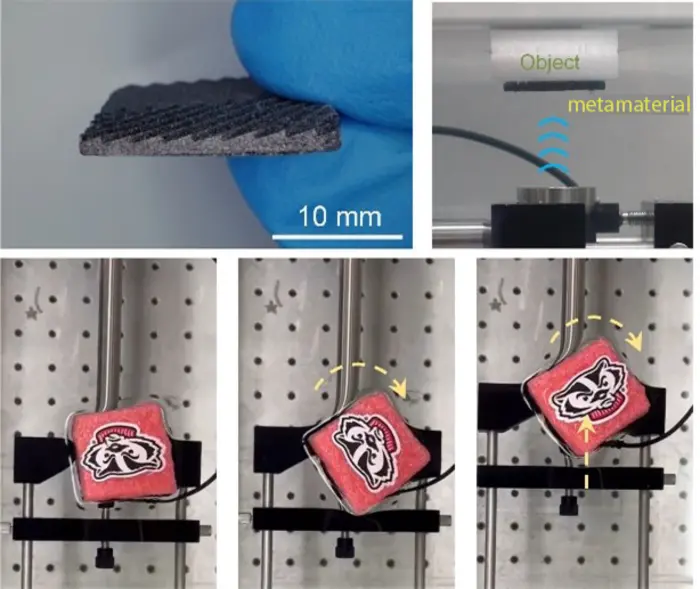
In a remarkable breakthrough at the intersection of acoustics and material science, Dajun Zhang, a doctoral student at the University of Wisconsin-Madison, has unveiled a groundbreaking metamaterial capable of manipulating objects underwater without physical contact. This pioneering development leverages the unique properties of acoustic waves paired with custom-designed materials, opening new horizons for underwater robotics, medical technology, and remote object manipulation.
The core of Zhang’s innovation lies in the engineering of a metamaterial—a composite fabricated with meticulously designed microstructures that endow it with acoustic behaviors not found in conventional materials. Unlike ordinary solids, this metamaterial possesses a finely patterned sawtooth surface structure that interacts with incident sound waves in special and controllable ways. By adjusting the acoustic fields emitted by surrounding speakers, the material can experience differing radiation forces, allowing it to push, pull, and even rotate objects in fluid environments with unprecedented precision.
Sound waves have long been exploited for underwater applications, including sonar mapping of the seafloor and non-invasive medical treatments like lithotripsy. However, harnessing these waves to achieve direct manipulation of objects remotely has remained a challenging endeavor. Zhang’s approach circumvents these difficulties by embedding the metamaterial on the target objects. When the tailored acoustic waves strike the metamaterial surface, they create localized differences in pressure and radiation force, effectively “grabbing” and moving the object without any mechanical attachment.
One of the unique challenges addressed by Zhang stems from fabricating underwater metamaterials that combine the right structural intricacies with the necessary acoustic impedance contrasts. Conventional manufacturing techniques either fall short in resolution or demand prohibitively high costs. To overcome these obstacles, Zhang developed an innovative low-cost fabrication method that achieves remarkable precision while producing material surfaces with a large acoustic impedance difference relative to water. This disparity is crucial for generating strong acoustic forces and precise control.
The functionality of Zhang’s metamaterial was extensively tested on a variety of objects immersed in water, including items made of wood, wax, and plastic foam. By affixing the material patch onto these objects, he demonstrated the ability to manipulate them three-dimensionally—pushing, pulling, and rotating them solely through carefully modulated acoustic fields. This non-contact manipulation method hints at applications ranging from delicate underwater assembly tasks to the control of small underwater robotic vehicles.
Beyond underwater robotics, the implications for medical science are profound. Human tissue is predominantly composed of water, and this similarity suggests that Zhang’s acoustic metamaterial technology could pave the way for novel forms of remote surgery or targeted drug delivery. By fine-tuning sound waves, medical devices or therapeutic agents could be manipulated precisely inside the body without invasive procedures, reducing risk and increasing efficacy.
Zhang emphasized the broad potential of this technology, stating that his metamaterial method provides a reliable means to apply different acoustic radiation forces on various objects in liquid media. This could transform the way engineers and medical professionals conceive underwater tools and in-body devices, enabling levitation, actuation, and complex manipulations previously thought impossible outside robotic grippers or direct mechanical operations.
Looking forward, Zhang is working to refine his metamaterial designs into smaller, more flexible patches. Such developments could vastly enhance maneuverability and integration into diverse environments, from compact medical instruments navigating within the body to compact underwater systems managing fragile tasks in tight spaces. The modular and tunable nature of the metamaterial approach points toward customizable solutions serving a wide array of future technological needs.
This research heralds a transformative shift in acoustic manipulation paradigms, moving from theoretical concepts to practical applications. Remote manipulation without physical contact is no longer the stuff of science fiction. Instead, it is rapidly becoming a practical tool backed by fundamental physics, advanced materials engineering, and sophisticated acoustic control systems.
By enabling precise, remote force generation in liquid media, Zhang’s acoustic metamaterials set the stage for multidisciplinary innovations. Underwater exploration, environmental monitoring, industrial processing, and minimally invasive medical procedures stand to benefit significantly. The ability to perform complex object movements and orientations remotely could reduce human risk, increase operational efficiency, and unlock new experimental possibilities.
In sum, Dajun Zhang’s work exemplifies the power of integrating acoustic science with metamaterial engineering to surmount longstanding challenges in underwater manipulation. As this technology matures, it promises to revolutionize how humanity interacts with submerged objects and biological environments, ushering in a new era of contactless, sound-driven control.
Subject of Research: Underwater acoustic metamaterials for remote manipulation of objects
Article Title: Remotely Moving Objects Underwater Using Acoustic Metamaterials
News Publication Date: May 20, 2025
Web References:
https://acoustics.org/asa-press-room/
https://acoustics.org/lay-language-papers/
https://acousticalsociety.org/
Image Credits: Dajun Zhang
Keywords
Acoustics, Physics, Applied acoustics, Underwater acoustics
Tags: acoustic fields and radiation forcesacoustic metamaterialsacoustic wave applicationsDajun Zhang researchmetamaterials engineeringnon-invasive medical technologyprecision underwater object controlremote object manipulation techniquessound wave interaction with materialsunderwater object manipulation breakthroughsunderwater robotics advancementsUniversity of Wisconsin-Madison innovations