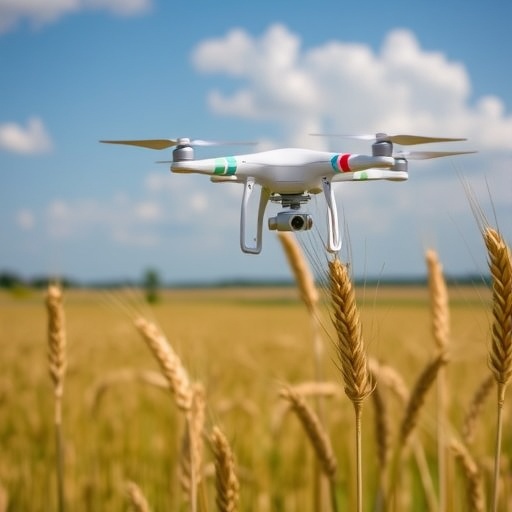
In the face of accelerating climate change and its disruptive impact on global agriculture, enhancing the resilience of staple crops like wheat has become a paramount scientific and societal goal. A pioneering study led by researchers at the University of Barcelona and the Agrotecnio research centre is now breaking new ground by integrating cutting-edge technologies such as artificial intelligence and drone-based multi-sensor phenotyping to revolutionize how wheat varieties are selected and cultivated for future climates. This innovative approach emphasizes a paradigm shift—prioritizing not only yield potential but also yield stability under fluctuating Mediterranean environmental conditions.
The research focuses on durum wheat, a critical cereal crop widely grown across Mediterranean regions, where unpredictable rainfall patterns and rising temperatures challenge consistent crop production. The team meticulously analyzed 64 diverse genotypes cultivated under two contrasting field regimes: irrigated and rain-fed systems. By capturing comprehensive data throughout the growing season, their goal was to elucidate which wheat varieties blend high productivity with robust performance stability, a balance crucial for safeguarding food security amid climate volatility.
One of the hallmark innovations of the study lies in its use of advanced remote sensing technologies. Employing drones outfitted with a suite of cameras—including RGB, multispectral, and thermal sensors—the researchers conducted non-invasive, high-throughput monitoring of crop development. These aerial platforms enabled repeated, precise measurement of physiological traits such as canopy temperature, leaf greenness, and early vigor without destructive sampling. This shifts traditional breeding assessments from laborious manual harvests to rapid, scalable phenotyping, dramatically reducing costs and accelerating data acquisition cycles.
The deployment of ground-based sensors complemented the drone observations, collectively generating a rich phenotypic dataset capturing dynamic plant responses to environmental stressors. These multi-modal datasets formed the foundation for sophisticated machine learning models, leveraging artificial intelligence to predict both yield and yield stability across variable environmental scenarios. This modeling framework represents a transformative step in predictive breeding, allowing breeders to select genotypes not merely for maximum yield but for resilience and consistent performance.
Contrary to conventional expectations that “stay-green” traits—where plants maintain leaf greenness late into the season—correlate with superior yield, the study uncovered a counterintuitive insight. The most desirable wheat varieties exhibited vigorous early growth and reached maturity earlier, rather than prolonging green leaf retention. This strategy optimizes resource allocation and improves drought and heat tolerance during critical grain-filling stages. Meanwhile, varieties showing delayed senescence and prolonged greenness often exhibited lower initial vigor and poorer yield outcomes, challenging former breeding dogmas.
Extensive trait analysis distinguished two key growth strategies among the genotypes tested. Yield-maximizing genotypes demonstrated high initial vigor with sustained greenness during rapid developmental phases but faced trade-offs in terms of stability. In contrast, genotypes with greater yield stability showed moderate early growth and shorter growth cycles, harnessing available environmental resources more efficiently under stress conditions. Balancing these compensatory traits, the researchers proposed a novel selection methodology integrating competitive yield performance with enhanced stability metrics.
This research carries far-reaching implications for plant breeding programs globally, especially those targeting crops vulnerable to climate-induced stresses. By harnessing multi-sensor phenotyping combined with AI-driven predictive modeling, breeders can now more rapidly and accurately identify wheat varieties best suited to evolving climatic patterns. This method accelerates the development of cultivars equipped to sustain food production in arid and semi-arid environments subjected to increasing temperature extremes and water scarcity.
The study’s findings illuminate the crucial role of early vigor as a determinant trait for durum wheat adaptation under Mediterranean conditions. Fast initial canopy development not only secures better use of early-season water and nutrients but also enhances resilience against terminal drought—a perennial challenge in rain-fed agriculture. Early maturation further contributes by shortening the crop’s exposure to late-season heat stress, reducing grain filling disruption and yielding more consistent harvests.
Moreover, the integration of drone technology and ground sensors illustrates a leap forward in phenomic research capabilities. These technologies enable real-time monitoring of plant physiological states during the entire growing season, far surpassing traditional snapshot-based analyses. The continuous data stream enables dynamic adjustment of AI models to account for environmental variability, substantially improving yield and stability predictions for diverse genotypes.
This fusion of artificial intelligence and precision agriculture exemplifies the next frontier in crop improvement. By translating complex phenotypic signals into actionable breeding insights, the approach mitigates the uncertainties that climate change imposes on agricultural productivity. Ultimately, it offers a scalable, cost-effective strategy for securing global food supplies by promoting genotypes that combine vigor, resilience, and stable performance under increasingly erratic environmental conditions.
In conclusion, the integration of multi-sensor drone phenotyping with AI predictive analytics represents a groundbreaking advancement for wheat breeding under climate stress. This technology-driven strategy redefines selection paradigms, emphasizing the dual imperatives of yield maximization and stability. As climate change continues to challenge food systems worldwide, such innovations constitute vital tools in developing crop varieties capable of thriving in diverse, unpredictable environments and maintaining the resilience of one of the world’s most essential food crops.
Article Title: Multi-sensor phenotyping of yield and yield stability for genotype selection in durum wheat
News Publication Date: 5-Feb-2026
Web References: https://doi.org/10.1016/j.plaphe.2026.100178
References: Plant Phenomics, University of Barcelona, Agrotecnio research centre, ITACyL, INIA-CSIC
Image Credits: Jara Jauregui-Besó (University of Barcelona – AGROTECNIO)
Keywords
Durum wheat, climate resilience, yield stability, artificial intelligence, drone phenotyping, Mediterranean agriculture, multi-sensor imaging, crop breeding, early vigor, predictive modeling, sustainable agriculture
Tags: AI-driven plant breedingartificial intelligence in agricultureclimate-adaptive wheat varietiesdrone-based crop monitoringdrought-tolerant wheat genotypesdurum wheat yield stabilityMediterranean agriculture challengesmulti-sensor phenotyping in cropsprecision agriculture for food securityremote sensing for crop selectionsustainable wheat cultivation technologieswheat resilience to climate change