


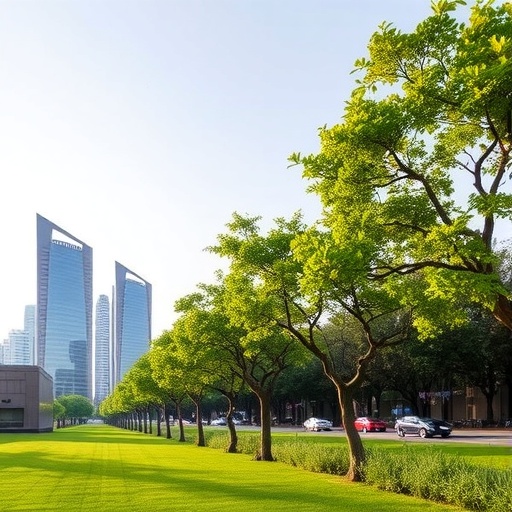
As global temperatures climb and heatwaves become a rampant phenomenon in urban landscapes, the urgent need to mitigate the adverse effects on human health and comfort intensifies. Urban heat islands amplify these challenges, pushing city dwellers into increasingly uncomfortable and dangerous environments. Vegetation, particularly through the mechanism of evapotranspiration, emerges as a promising natural solution capable of cooling urban microclimates. However, the distinct roles and behaviors of different types of urban vegetation during heatwaves have remained elusive until now. A landmark study spanning ten years of observations in a subtropical city brings unprecedented clarity to this topic, unmasking the complex dynamics through which urban lawns and trees respond to heat stress and water scarcity.
Heatwaves impose a critical stress on the balance between water availability and thermal regulation in cities. While plants naturally dissipate heat through evapotranspiration—a process where water absorbed by roots is transferred through leaves and evaporated into the atmosphere—how different urban plant species modulate this vital function under extreme temperature spikes has been poorly understood. This study leverages an extensive dataset covering 54 discrete heatwave events to dissect the contrasting water-use strategies and stomatal behaviors underpinning the cooling capacities of urban lawns versus urban trees.
One of the key revelations from this pioneering research is the rapid and pronounced increase in evapotranspiration exhibited by urban lawns during heatwaves. Lawns, characterized by relatively high canopy stomatal conductance, were documented to elevate their transpiration rates by approximately 37.65%, translating into a remarkable cooling effect exceeding 7 degrees Celsius per square meter per day. This immediate and potent response affords cities with an effective short-term mitigation against extreme surface temperatures, underscoring the vital role of turfgrass in urban heat management.
Yet, this aggressive water-use comes at a steep price. The very same lawns that rapidly amplify their evapotranspirative output also experience swift depletion of surface soil moisture. This depletion threatens their sustained cooling potential, especially during prolonged or successive heatwave episodes when irrigation resources might be limited. The study reveals that this vulnerability necessitates a careful balance between maximizing cooling benefits and ensuring ecological sustainability, highlighting the importance of strategic water management in maintaining urban lawn vitality during climate extremes.
In stark contrast, urban trees pursue a more conservative but stable approach to water utilization during heatwaves. Whereas lawns amplify transpiration rapidly, trees respond by closing their canopy stomata significantly—about a 35% reduction—thereby tempering water loss. This stomatal regulation enables trees to maintain steady transpiration rates, dropping only slightly from 1.77 to 1.66 millimeters per day despite the severe heat. Such physiological adaptation showcases a sophisticated drought-tolerant strategy that allows trees to conserve vital water resources while still contributing meaningfully to urban cooling.
Trees’ remarkable ability to access deeper soil moisture layers further bolsters their resilience under heat stress conditions. By tapping into subsoil water reserves, urban trees can sustain evaporative cooling longer than shallow-rooted lawns, which rely predominantly on topsoil moisture. This characteristic positions urban trees as crucial long-term allies in enhancing the thermal comfort of cities during heatwaves, offering a more sustainable water-use pathway that complements the rapid but transient cooling provided by lawns.
The dual function of urban lawns and trees—immediate effusiveness versus enduring stability—in cooling urban heat stress presents a compelling case for integrated urban vegetation design. This research radically reframes existing paradigms by dissecting the interwoven physiological and ecological mechanisms that govern evapotranspiration under thermal extremes. Understanding these distinct roles enables city planners and environmental managers to harness the synergistic potential of both vegetation types to optimize urban microclimates effectively.
Moreover, the results bear profound implications for water resource management in cities facing multifaceted challenges of climate variability and drought. For regions where water scarcity constrains irrigation, relying exclusively on lawns for cooling may threaten urban greenery sustainability, necessitating supplemental strategies such as drought-tolerant turf species selection, or supplementary irrigation during critical heat periods. Conversely, investing in robust urban trees capable of deep moisture extraction can provide a more consistent thermal buffer against escalating heatwaves, highlighting the importance of species-specific and depth-specific root system understanding in urban forestry.
This nuanced comprehension of evapotranspirative behavior also intersects with urban socio-economic dimensions, as different neighborhoods possess varying greening strategies and water access. Equitable allocation of green infrastructure that maximizes both immediate and sustained cooling effects can enhance urban resilience holistically. Incorporating trees and lawns thoughtfully into urban designs can mitigate health disparities exacerbated by disproportionate heat exposure in vulnerable communities.
The methodology underlying this extensive study exemplifies the integration of long-term observational datasets and advanced remote sensing technologies. The researchers utilized biophysical measurements to monitor stomatal conductance and soil moisture dynamics, alongside heatwave tracking, enabling a granular understanding of physiological responses over an unprecedented duration. This robust approach lays the groundwork for predictive models that can simulate plant water-use responses under future climate scenarios, offering critical insights for anticipatory urban planning.
This study also challenges simplistic narratives that categorize all urban greenery as equal contributors to heat mitigation. By unraveling complex plant-environment interactions, it underscores the necessity of species-specific assessment and management. Urban environments can no longer rely solely on general greening efforts but must adopt precision landscaping incorporating ecological and physiological knowledge to maximize cooling benefits while preserving water sustainability.
In confronting escalating urban heat challenges, these findings pivotally inform adaptive green infrastructure frameworks. Urban planners and policymakers can use this knowledge to prioritize planting regimes and maintenance schedules that optimize cooling outcomes while safeguarding against water resource depletion. This strategic leveraging of evapotranspiration dynamics fosters resilient cities capable of buffering climate extremes and protecting public health.
Furthermore, enhancing public awareness about the distinct cooling contributions of trees and lawns could empower communities to engage more actively in urban greening initiatives. Educating residents about the value of deep-rooted trees for long-term climate resilience, alongside enjoying the immediate shade and cooling of lawns, bridges scientific insight with actionable public behavior.
Overall, this ten-year, multi-event investigation elevates our understanding of urban vegetation’s hydrological and thermal functions under extreme heat. By delineating the divergent water-use strategies employed by lawns and trees, it offers a foundational blueprint for crafting urban ecosystems that balance rapid cooling with sustainable water consumption. As cities worldwide grapple with the intensifying frequency and severity of heatwaves, such fine-tuned ecological intelligence becomes indispensable for crafting nuanced, adaptive, and equitable urban cooling solutions.
The marriage of detailed physiological measurements with long-term climatic observations not only advances urban ecology but also resonates with broader climate adaptation goals. This research situates urban green spaces at the frontline of climate mitigation efforts, spotlighting plant physiological mechanisms as critical tools in the urban climate resilience arsenal. Far beyond aesthetic or recreational roles, urban vegetation emerges as an active and dynamic participant in the fight against rising urban temperatures exacerbated by climate change.
In conclusion, the interplay between urban lawns and trees during heatwaves reveals a sophisticated balance between rapid cooling imperatives and sustainable water management. Lawns act as rapid responders, offering substantial immediate relief from searing surface heat but consuming valuable surface moisture swiftly. Trees serve as steadfast guardians, employing stomatal control and deep soil water extraction for resilient temperature regulation over extended durations. This complementary dynamic provides a robust framework for future urban landscaping strategies aimed at maximizing human comfort and ecological sustainability in a warming world.
The insights garnered through this extensive study pave the way for next-generation urban heat mitigation planning, wherein vegetative cooling is optimized holistically across spatial and temporal scales. As metropolitan centers worldwide march toward increasingly uncertain climatic futures, integrating the distinct ecological strengths of both urban lawns and trees represents a critical frontier in safeguarding livable and healthy cities for generations to come.
Subject of Research: Evaporative cooling and water-use strategies of urban lawns and trees during heatwaves
Article Title: Observed evaporative cooling of urban trees and lawns during heatwaves
Article References:
Fang, T., Hu, W., Yan, C. et al. Observed evaporative cooling of urban trees and lawns during heatwaves. Nat Cities (2025). https://doi.org/10.1038/s44284-025-00353-4
Image Credits: AI Generated
DOI: https://doi.org/10.1038/s44284-025-00353-4
Tags: cooling effects of urban treesevapotranspiration in citiesimpact of heatwaves on city healthlawn versus tree cooling strategiesstrategies for mitigating urban heatsustainable urban landscapingthermal regulation in urban landscapesurban heat islandsurban microclimate managementurban vegetation heat stressvegetation responses to climate changewater availability in urban environments



