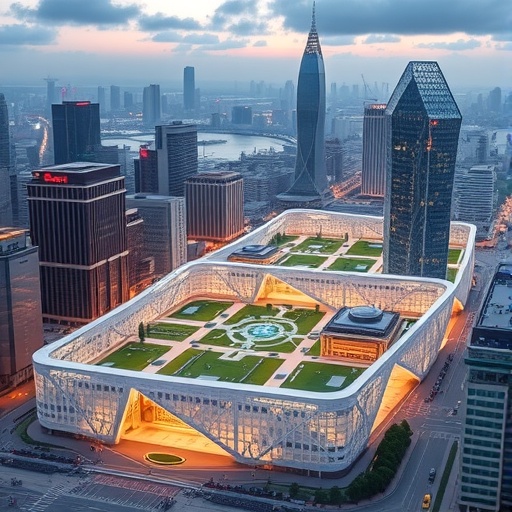
In the quest for sustainable urban environments, the transition to net-zero carbon emissions is emerging as a paramount challenge and opportunity for cities worldwide. Recently, a groundbreaking study led by researchers Chen, Wang, Wen, and colleagues has unveiled a sophisticated building-scale modeling framework designed specifically for urban net-zero transitions, with the historic city of Nanjing serving as a pioneering case study. This innovative approach offers transformative potential not only for Nanjing but also for urban landscapes across the globe aiming to harmonize development with stringent climate goals.
Cities are responsible for a substantial majority of global greenhouse gas emissions, primarily due to energy consumption in buildings and infrastructure. Achieving net-zero emissions at the urban scale requires intricate coordination among various energy systems, building types, and socio-economic factors. The framework presented by the team leverages advanced computational tools and extensive empirical data to represent these complexities with unprecedented granularity, allowing for tailored strategies that optimally balance environmental impact, economic feasibility, and occupant comfort.
At the heart of this new model is a detailed analysis of energy flows at the building level, integrating renewable energy supply, energy efficiency improvements, and demand-side management. The model dissects energy use patterns characteristically unique to residential, commercial, and industrial sectors in an urban matrix, accounting for temporal variations such as occupant behavior and weather fluctuations. By doing so, it generates precise simulations that clarify how individual buildings interact with localized energy infrastructures and broader city systems.
One of the remarkable aspects of the framework is its capacity to simulate retrofit scenarios and new construction strategies within the existing urban fabric. This feature enables policymakers and planners to weigh the benefits of upgrading historical structures against the implications of introducing novel architectural designs embedded with smart technologies. Furthermore, the model incorporates economic mechanisms, evaluating investments in energy technologies against savings from reduced carbon footprints, thereby guiding cost-effective pathways toward net-zero targets.
The case of Nanjing is particularly illuminating due to the city’s blend of dense urban cores and suburban expansions, industrial zones, and cultural heritage sites. Applying the framework to this spatially heterogeneous environment necessitated the integration of high-resolution spatial data, building inventories, and energy consumption records alongside socio-economic variables such as household income distribution and commercial activity profiles. The outcome is a multifaceted portrait of energy dynamics that informs customized interventions for different city sectors.
Moreover, this modeling approach does not stop at energy systems alone. It captures interdependencies with urban infrastructure—transport networks, waste management, and water systems—that collectively contribute to urban carbon emissions. By modeling feedback loops and cross-sectoral interactions, it underscores the systemic nature of urban decarbonization, emphasizing that incrementally isolated improvements fall short without harmonized strategies.
The predictive power of this model is augmented by sophisticated machine learning algorithms that refine parameter estimations and enhance scenario analyses. These algorithms process large datasets encompassing meteorological trends, electric grid conditions, and behavioral change patterns, thus enabling dynamic updates and adaptive planning. This feature equips urban managers with the ability to respond proactively to emerging challenges and shifting policy landscapes.
Application of the framework in Nanjing has revealed key leverage points—specific building types and districts where interventions yield disproportionately large carbon reductions. For instance, upgrading heating and cooling systems in mid-rise residential areas combined with rooftop solar installations significantly lowers energy demand and grid dependency. Conversely, enhancing energy efficiency in commercial office towers coupled with demand response programs enables peak load balancing and cost savings.
The study also underscores the critical role of stakeholder engagement, highlighting how the success of transitions depends on collaborative governance involving residents, businesses, utility providers, and government agencies. The modeling framework is designed with accessibility in mind, enabling interactive visualization tools that facilitate understanding and buy-in from diverse groups, fostering shared ownership of net-zero objectives.
Crucially, the framework’s capacity for scalability and transferability marks its greatest promise. Although tailored to Nanjing, its modular structure allows adaptation to other urban contexts worldwide, accommodating varying geographic, climatic, and socio-economic characteristics. This adaptability positions it as a vital instrument in accelerating global urban sustainability efforts.
Beyond its immediate technical advancements, this research embodies a paradigm shift in how cities conceive and implement decarbonization pathways. It moves beyond simplistic, top-down mandates toward evidence-based, integrated planning that reconciles environmental urgency with practical, localized solutions. This shift is indispensable in confronting the escalating climate crisis.
Furthermore, the integration of domain expertise from urban planning, environmental engineering, data science, and economics within this framework illustrates the power of interdisciplinary collaboration. The authors demonstrate that breakthroughs in sustainable urban development demand such cross-pollination of knowledge, breaking silos to address complexity holistically.
The implications for policy formulation are profound. This modeling framework equips decision-makers with actionable insights backed by robust scenarios that can justify investments, legislative changes, and incentive programs. It empowers them to set realistic, measurable goals aligned with international climate agreements while tailoring approaches to city-specific contexts.
Moreover, this work contributes to advancing digital twin technologies in urban sustainability. By mirroring real-world dynamics in virtual environments, cities can experiment with innovative solutions without costly physical trials, accelerating learning cycles and deploying resources more judiciously.
In conclusion, the research by Chen and colleagues on a building-scale modeling framework opens a transformative chapter in urban net-zero transitions. As cities grapple with the complexities of climate mitigation amid growth pressures, this pioneering tool offers a beacon of clarity and direction. Through harnessing data, technology, and collaborative insight, it charts a feasible, scalable path toward sustainable urban futures, exemplified by the vibrant city of Nanjing but poised for global impact.
Subject of Research: Urban net-zero transition strategies at the building scale in Nanjing.
Article Title: A building-scale modeling framework for urban net-zero transitions in Nanjing.
Article References:
Chen, Y., Wang, Z., Wen, Q. et al. A building-scale modeling framework for urban net-zero transitions in Nanjing. Nat Commun 16, 8954 (2025). https://doi.org/10.1038/s41467-025-64016-7
Image Credits: AI Generated
Tags: advanced computational tools for energy modelingbuilding-scale modeling frameworkdemand-side energy management in citiesenergy efficiency improvements in buildingsgreenhouse gas emissions in citieshistorical case studies in urban sustainabilityNanjing sustainable urban developmentrenewable energy integration in urban planningsocio-economic factors in urban sustainabilitytailored strategies for net-zero transitionstransformative potential of urban net-zero frameworksurban net-zero emissions strategies