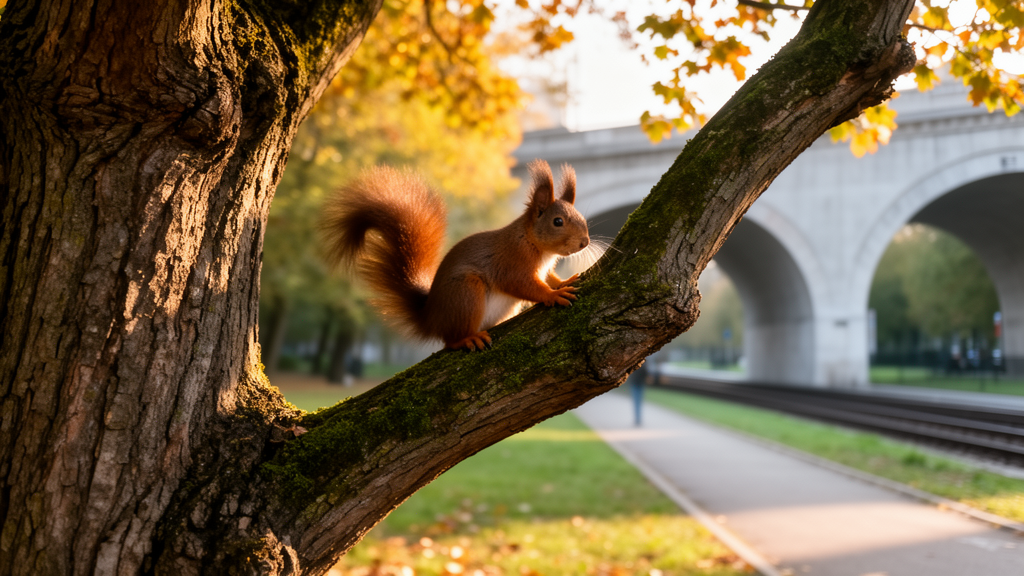
Human-made infrastructure such as roads and buildings can restrict the natural movements of wildlife in metropolitan areas, leading to reduced encounters between individuals from separated zones and potentially limiting overall genetic diversity. To investigate whether these urban landscape pressures leave measurable signatures on local fauna, researchers from the Leibniz Institute for Zoo and Wildlife Research and the Technische Universität Berlin analyzed populations of Eurasian red squirrels (Sciurus vulgaris) living across Berlin. The investigation revealed that while the overall genetic differentiation across the study sites remains generally modest, subtle genetic variations have already emerged among different municipal areas, indicating that the distribution and exchange of alleles throughout the city is constrained by surrounding developments.
Eurasian red squirrels are known for their ecological flexibility, routinely adapting their diurnal behavior patterns to navigate human traffic, domestic pets, and coexisting city wildlife. In urban settings, the animals actively steer clear of common predators like domestic cats, dogs, and martens while utilizing human-provided food resources to thrive within public gardens and municipal parklands. Despite frequent public sightings that suggest widespread abundance, urban squirrel territories remain inherently fragmented into relatively isolated patches. The research team specifically designed their study to evaluate whether this patchwork quilt of urban environments is already recorded within the genomes of local red squirrels and whether such habitat boundaries alter their probability of survival.
The scientists conducted their field investigations between autumn 2021 and spring 2025 across three designated locations within Berlin that represent varying degrees of development, infrastructure density, and human disturbance. These study sites comprised an inner-city cemetery, a sprawling municipal park, and a woodland sector situated on the city outskirts. Each location was selected to provide suitable squirrel habitat while offering distinctly different levels of structural integration into the wider urban matrix, ranging from an extensive contiguous forest tract on the suburban fringe to a heavily built-up city park surrounded on all sides by dense municipal infrastructure.
Over the multi-year study period, the researchers captured and individually marked 141 squirrels across the three study zones. From these animals, the team successfully generated 135 individual genetic profiles to examine the internal diversity of each group and determine the precise degree of divergence between separate locations. In a continuous and fully connected natural landscape, animal populations typically intermix freely, creating relatively uniform genetic profiles with minimal divergence between nearby geographic points.
Genetic analysis demonstrated that overall genetic diversity remained high at all three sampled locations, but the spatial distribution of genetic groups defied simple geographic distance models. Lead author Sinah Drenske of the Leibniz-IZW noted that based purely on geographic distance, the inner-city cemetery and the city park—separated by only a few kilometers—would have been expected to share strong genetic similarities, while the distant woodland population was expected to stand apart. Instead, the genetic data demonstrated that squirrels inhabiting the cemetery and the outer woodland clustered predominantly into a single genetic group, whereas the population in the centrally located city park diverged markedly from the other two groups.
These genetic findings indicate that physical proximity alone does not govern gene flow in developed environments, as heavy infrastructure can create significant movement barriers. Although the researchers emphasized that Berlin does not currently harbor severely isolated or heavily inbred squirrel groups, the subtle genetic distinctions detected show that squirrels cannot move entirely without hindrance across the urban matrix. The structural barriers surrounding the heavily urbanized park appear to restrict animal movements more effectively than the longer geographical distance separating the cemetery from the outer forest.
In addition to molecular genetic evaluations, the team analyzed multi-year capture-recapture records to determine whether genetic differentiation and urban exposure translated into measurable demographic differences among the animals. The researchers estimated the squirrels’ probability of survival over standardized six-month intervals across the three comparative environments. While the estimated survival probability appeared slightly lower among individuals residing in the heavily built-up city park, the associated statistical uncertainty prevented the authors from asserting a definitive negative impact of urbanization on squirrel survival rates.
The study highlights that while Berlin’s red squirrels currently maintain substantial genetic diversity without evidence of acute inbreeding, ongoing habitat fragmentation poses potential long-term risks if connectivity diminishes further. Co-author Stephanie Kramer-Schadt of the Leibniz-IZW and Technische Universität Berlin pointed out that future declines in environmental connectivity could further restrict genetic exchange among urban wildlife. The authors emphasized that maintaining interconnected green spaces, parks, and continuous tree canopies is critical for arboreal species, providing valuable guidance for wildlife-friendly urban planning designed to sustain genetic health across expanding cities.
Subject of Research: Urban habitat fragmentation and genetic diversity in Berlin red squirrels
Article Title: Survival in a patchwork landscape: City life leaves subtle genetic traces in Berlin squirrels
Article References: Survival in a patchwork landscape: City life leaves subtle genetic traces in Berlin squirrels. Original publication (Bibliographic details unavailable.)
Image Credits: AI Generated
DOI: Not provided
Keywords: Eurasian red squirrel, Sciurus vulgaris, urban wildlife, Berlin, habitat fragmentation, genetic diversity, alleles, Leibniz-IZW, Technische Universität Berlin, Ecology and Evolution, urban ecology, capture-recapture, survival probability, wildlife corridors, urban planning, genetic differentiation
News Source: Juliet Wilcox. (November 12, 2026). Urban Infrastructure Shapes Subtle Genetic Differences in Berlin Red Squirrel Populations. Scienmag.