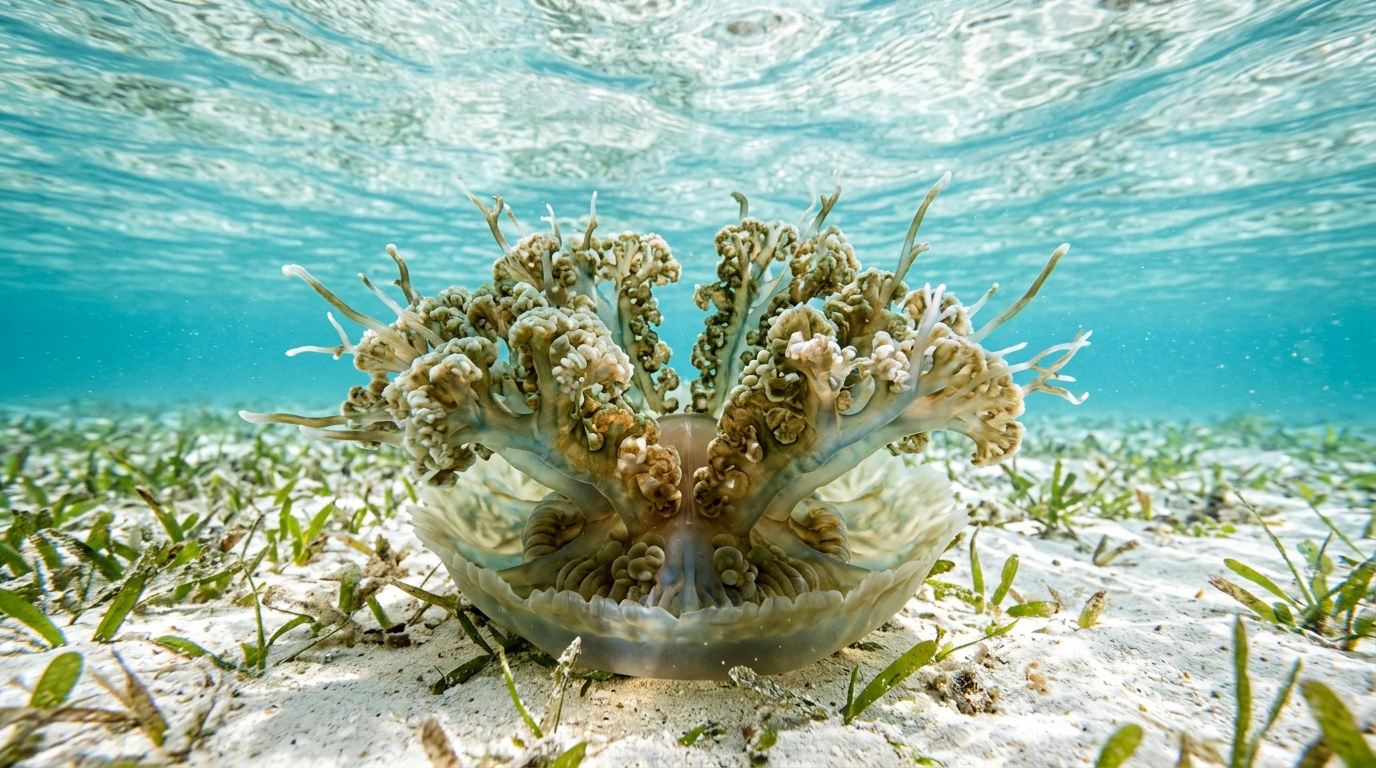
A comprehensive developmental investigation of the upside-down jellyfish Cassiopea xamachana has resolved key stages of its life cycle, demonstrating that early embryonic cleavage, gastrulation, and planula metamorphosis follow patterns largely conserved across scyphozoan cnidarians while revealing unexpected asymmetry during polyp establishment. Conducted by researchers Bailey M. Steinworth and Mark Q. Martindale at the Whitney Laboratory for Marine Bioscience, the study tracks the structural and molecular progression from fertilized zygotes through swimming planulae, settling polyps, and asexually generated planuloid buds. While earlier investigations of Cassiopea xamachana concentrated predominantly on strobilation and the formation of swimming asexual buds, the new findings document the full sequence of embryonic division, cell-layer formation, and metamorphosis under standardized laboratory conditions. By combining confocal microscopy, cell proliferation assays, and gene expression analyses, the investigation confirms that basic embryonic architecture aligns with the moon jelly Aurelia, yet identifies critical divergences in cellular proliferation and axial symmetry.
To obtain staging material across the reproductive cycle, adult medusae of Cassiopea xamachana were collected from Key Largo, Florida, during sampling excursions in January and May 2022 and September 2023. Animals were housed in flow-through seawater aquaria heated to twenty-five degrees Celsius on a controlled twelve-hour light and twelve-hour dark photoperiod at the Whitney Laboratory in St. Augustine, Florida, and sustained on freshly hatched Artemia four days each week. Females were identified by the presence of a specialized brooding structure located at the center of the oral disc. Four hours after illumination began each morning, females deposited fertilized zygotes onto their oral discs, allowing researchers to collect synchronized cohorts of embryos at fertilization or during early cleavage. Embryos were transferred into filtered seawater treated with penicillin at 0.06 milligrams per milliliter and streptomycin at 0.05 milligrams per milliliter to suppress bacterial proliferation during extended culture. Complementary populations of budding polyps were harvested from the surfaces of housing tanks, with free-swimming asexual buds collected within twenty-four hours of detaching from the calyx of parental polyps to provide direct comparisons with sexually derived planulae.
Embryonic development begins with unipolar cleavage initiating at the animal pole between one and a half and two and a half hours following zygote release, with consecutive cleavages taking place at intervals of approximately two hours. Like most cnidarian embryos, early cleavage patterns in Cassiopea xamachana display significant natural variability, with no two individual embryos adhering to an identical blastomere arrangement. By eight hours after the initial cleavage division, embryos reached the sixteen to thirty-two cell stage, arranging their blastomeres around a distinct central lumen. Continued mitotic divisions produced a hollow blastula in which cellular nuclei were initially positioned along the apical periphery. By twenty-four hours, several nuclei migrated toward the basal regions of the cells, forming a pseudostratified epithelial layer. Surface cilia emerged across the blastula between twenty-four and forty-eight hours, during which a subset of nuclei remained situated basally while the overall cellular envelope maintained an organized epithelial structure surrounding the interior cavity.
Confocal microscopy confirmed that gastrulation in Cassiopea xamachana proceeds by invagination, providing additional evidence that this mode represents the primary mechanism of primary germ-layer formation within the Scyphozoa. Epithelial infolding along the blastula wall became visibly apparent at forty-three hours post-cleavage, leading to a prominent external blastopore by forty-eight to fifty-one hours. Infolding continued until presumptive endoderm contacted the outer ectodermal layer at fifty-six hours, generating a bilayered spherical embryo. Although the blastopore remained detectable through seventy-two hours while the ciliated embryo exhibited active rotational spinning, complete blastopore closure occurred by ninety-six hours. Concurrent with closure, the spinning motion transitioned into directional swimming along the oral-aboral axis. By five days post-cleavage, the resulting planulae achieved settlement competence. Cross-sectional imaging demonstrated that the planula ectoderm consists of a ciliated pseudostratified epithelium packed with dense nuclei, while interior endodermal cells feature surface cilia and distinct apical-basal polarity. The presence of polarized, ciliated interior cells confirms the formation of a true epithelial endoderm without the nutritive, non-epithelial cell aggregates or epithelial-to-mesenchymal ingression observed in certain other cnidarian taxa.
The aboral end showed no apical tuft or specialized sensory cilia at any point in development. However, immunohistochemical staining using anti-acetylated tubulin antibodies identified distinctive branching structures located within the apical regions of aboral ectodermal cells beginning five days post-cleavage, situated above basally oriented nuclei. When maintained in filtered seawater with antibiotics in the absence of external chemical induction, planula morphology remained stable past six days. Metamorphosis was experimentally triggered by exposing competent larvae to the synthetic settlement peptide GPGGPA at concentrations between twenty-five and fifty micrograms per milliliter. Exposure prompted attachment and transformation into juvenile polyps within forty-eight hours, though a minor proportion failed to progress past initial attachment and subsequently died.
Metamorphosis induced by the synthetic peptide revealed unusual spatial orientations during primary substrate attachment. Rather than securing themselves exclusively to solid surfaces, the majority of settling planulae attached to the surface tension of the water, developing into suspension polyps that hung vertically downward from a floating contact point. These juvenile polyps could be readily detached by a single water droplet while leaving their surface attachment layer intact. Morphologically, transformation began with the flattening of the aboral ectoderm at the contact boundary, followed by the appearance of a shallow concavity at the oral pole that reshaped the organism into an open cup. An oral aperture subsequently perforated the tissue, directly linking the gastrovascular cavity with the surrounding aquatic environment. Circular mouth musculature differentiated as the aboral calyx constricted toward a defined stalk. Four primary tentacle buds emerged outward from the oral muscular ring, elongating as secondary tentacles intercalated between them. As structural maturation proceeded, four longitudinal retractor muscle fibers extended from the tentacle base along the stalk to the aboral attachment zone, completing the transition into a fully functional twelve-tentacle scyphistoma.
Cellular proliferation assays using 5-ethynyl-2′-deoxyuridine revealed notable operational differences between Cassiopea xamachana and other investigated scyphozoans. Incubation of seventy-two-hour gastrulae in 150 micromolar EdU for thirty minutes resulted in extensive incorporation into S-phase nuclei across both the ectodermal and endodermal layers in all eleven assessed specimens. In swimming planulae subjected to thirty-minute pulses, overall numbers of cycling nuclei declined, but all thirteen examined individuals maintained multiple labeled S-phase nuclei within the endoderm and at least one labeled nucleus within the ectoderm. This distributed proliferative capacity contrasts sharply with observations in the moon jelly Aurelia, where planula EdU labeling is restricted entirely to ectodermal nuclei. In asexual planuloid buds incubated in EdU for two and a half hours, DNA synthesis was similarly detected across both epithelial sheets, although cycling nuclei were conspicuously absent from the aboral extremity of the bud body wall.
Spatial gene expression profiling using colorimetric whole-mount in situ hybridization demonstrated that conserved developmental regulators establish early embryonic polarity. Orthologs of two transcription factors broadly shared across cnidarians, CxBrachyury and CxWnt2, were identified through reciprocal BLAST comparisons with Nematostella vectensis sequences and confirmed using maximum-likelihood phylogenetic reconstructions. Expression of CxBrachyury initiated at the oral margin of the invaginating gastrula at forty-eight hours and remained localized around the oral pole through the mature planula stage. Transcripts of CxWnt2 appeared uniformly in the blastula at twenty-four hours before concentrating at the blastopore of the forty-eight-hour gastrula. Following blastopore closure at ninety-six hours, CxWnt2 expression shifted outward from the immediate pole, forming an equatorial ring surrounding the presumptive oral territory that persisted across five-day and six-day planulae.
The study demonstrated that homeobox transcription factors deployed during embryonic embryogenesis are reactivated during asexual budding from the polyp calyx. In Cassiopea xamachana, asexual reproduction occurs through outpocketings of parental epidermis and gastrodermis that form motile planuloid buds whose distal extremity represents the aboral pole, reversing the oral-distal budding axis typical of hydrozoan polyps such as Hydra. Whole-mount hybridization revealed that the homeobox gene CxHox9-14C, which marks the aboral ectoderm of the sexually derived planula, initiates transcription at the central apex of the budding outpocketing and maintains aboral ectodermal expression through bud elongation and post-detachment swimming. Conversely, CxHox9-14B, which is broadly expressed across embryonic ectoderm before condensing into a ring adjacent to the aboral pole in immature planulae and disappearing at larval maturity, displayed an identical spatial profile in developing buds. Because CxHox9-14B is absent from mature polyps, its reappearance confirms that budding involves the specific reactivation of intermediate larval developmental modules rather than direct polyp replication.
The most unexpected molecular finding occurred during the analysis of the unclassified homeobox gene designated g9676 in newly metamorphosed polyps. While g9676 transcripts were localized to the oral endoderm of developing planulae and planuloid buds, its distribution shifted dramatically once the planula completed settlement and initiated tentacle morphogenesis. In newly established four-tentacle polyps, endodermal expression of g9676 became strictly restricted to the base of a single tentacle, breaking both radial and biradial symmetry across the oral disc. This unilateral asymmetric domain persisted as tentacle numbers expanded through eight, twelve, and sixteen tentacles, establishing an unambiguous secondary axis perpendicular to the oral-aboral plane that qualifies as bilateral symmetry. The phenomenon represents an unprecedented molecular symmetry break in a scyphozoan polyp, a group traditionally regarded as exemplifying strict radial symmetry outside of budding site selection.
Phylogenetic analysis indicates that g9676 does not group within known anthozoan directive-axis homeobox gene families such as Anthox1a, Anthox8, Anthox6a, or Gbx, which are altogether absent from investigated medusozoan genomes. Consequently, the authors find no evidence that this unilateral marker is homologous to the directive axis of anthozoan corals and sea anemones. Instead, the expression pattern appears to represent an independent symmetry-breaking mechanism within Scyphozoa. Because planuloid budding in Cassiopea xamachana polyps occurs primarily at a single discrete locus near the base of the calyx, the authors hypothesize that the localized expression of g9676 in juvenile polyps could prefigure the lateral site of future bud emergence. However, because tissue opacity and non-specific endodermal background prevented hybridization detection in large mature polyps, testing this morphological association will require the creation of transgenic reporter lines and targeted CRISPR/Cas9 loss-of-function mutagenesis to track gene activity in living animals and evaluate its functional necessity during asexual development.
Subject of Research: Embryonic development, planula metamorphosis, and homeobox gene expression in Cassiopea xamachana
Article Title: Embryonic and planula development in the upside-down jellyfish Cassiopea xamachana
Article References: Steinworth, B. M., & Martindale, M. Q. (2025). Embryonic and planula development in the upside-down jellyfish Cassiopea xamachana. EvoDevo, 16(1), Article 14. https://doi.org/10.1186/s13227-025-00250-w
Image Credits: AI Generated
DOI: 10.1186/s13227-025-00250-w
Keywords: Cassiopea xamachana, scyphozoan development, embryogenesis, planula metamorphosis, homeobox genes, radial symmetry, planuloid budding, marine biology, Embryonic, planula, development, upside-down
News Source: Drew Townsend. (November 8, 2026). Upside-Down Jellyfish Study Uncovers Conserved Development and Surprising Radial Symmetry Breaking. Scienmag.