When the body encounters bacteria, viruses or harmful substances, its innate immune cells, neutrophils, assemble at the site to combat the invader.
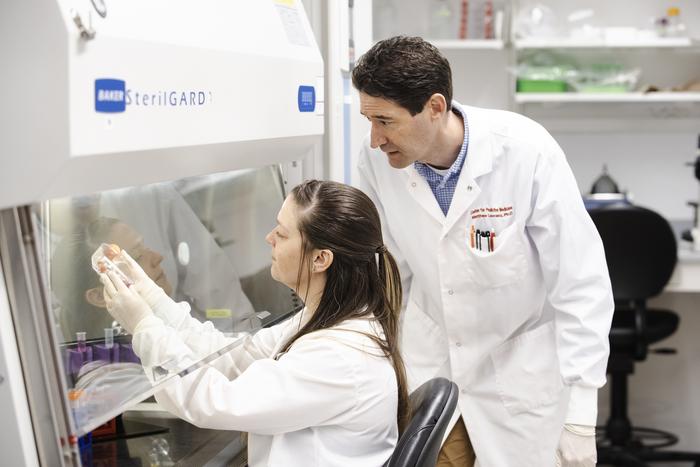
Credit: UofL photo.
When the body encounters bacteria, viruses or harmful substances, its innate immune cells, neutrophils, assemble at the site to combat the invader.
Bacteria and viruses have ways to avoid these defenses, however. Yersinia pestis, the bacteria that causes bubonic and pneumonic plague, for example, can hide from the immune system, allowing it to replicate in the body unhindered until it can overwhelm the host. This ability allowed Y. pestis to spread bubonic plague across Europe in the 14th Century, killing a third of the European population.
While plague may not be a serious threat to human health in modern times, researchers at the University of Louisville are studying Y. pestis to better understand its ability to evade the immune system and apply that understanding to control other pathogens.
“If you look at human plague, people don’t show symptoms right away even though they have an active infection because the bacteria is hiding from the immune system. Then all of a sudden there is a lot of bacteria, the immune system is overwhelmed and in the case of pneumonic plague, the individual dies from pneumonia,” said Matthew Lawrenz, professor in the UofL Department of Microbiology and Immunology.
Neutrophils are the immune system’s first responders, sending out protein molecules to summon other neutrophils to attack and destroy the invader. Among the first molecules sent out by neutrophils to signal an infection are Leukotriene B4 (LTB4) lipid molecules. Y. pestis interferes with the immune response by suppressing the LTB4 signals. Lawrenz has received a new $2.9 million, four-year grant from the National Institutes of Health to investigate how Y. pestis blocks LTB4. Ultimately, he expects this understanding will lead to ways to prevent Y. pestis from blocking the signals and hopefully, apply that understanding to other types of infections.
“This historic pathogen is really good at manipulating the immune system, so we use it as a tool to better understand how white blood cells like neutrophils and macrophages respond to bacterial infection,” Lawrenz said. “In this project, we are using Yersinia to better understand why LTB4 is so important to controlling plague. This understanding would apply to almost any infection of the lungs or other areas, and it probably could apply to viruses also.”
A member of the UofL Center for Predictive Medicine for Biodefense and Emerging Infectious Diseases, Lawrenz has been studying plague bacteria for nearly two decades. His previous work includes discoveries of how Y. pestis acquires iron and zinc to overcome a host’s defense mechanism known as nutritional immunity and has increased understanding of how Y. pestis inhabits spaces within host macrophages to hide from the immune system.
Katelyn Sheneman, a doctoral student in Lawrenz’s lab, also has received a prestigious $100,000 research award for trainees from the NIH. This grant will fund her research to understand how Y. pestis changes the contents of extracellular vesicles, cellular containers produced by immune cells that contain proteins, lipids such as LTB4 and other components. These vesicles are released into the bloodstream to communicate to other cells what is happening in their part of the body, such as an infection.
“My project is looking at how Y. pestis alters the number of vesicles being produced, what is being packaged in them and how other cells are responding to them,” Sheneman said. “We have some good evidence that pestis is able to manipulate the production of these vesicles, so we are going to look at the role the vesicles play in pulmonary infection and how that influence contributes to overall systemic infection.”
Since there is no effective vaccine against infection by Y. pestis and it has the potential to be used as a bioweapon, Lawrenz and Sheneman study Y. pestis in UofL’s Biosafety Level 3 facilities at the Regional Biocontainment Laboratory, part of a network of 12 regional and 2 national biocontainment laboratories for studying infectious agents. Biosafety Level 3 facilities are built to exacting federal safety and security standards in order to protect researchers and the public from exposure to the pathogens being investigated.