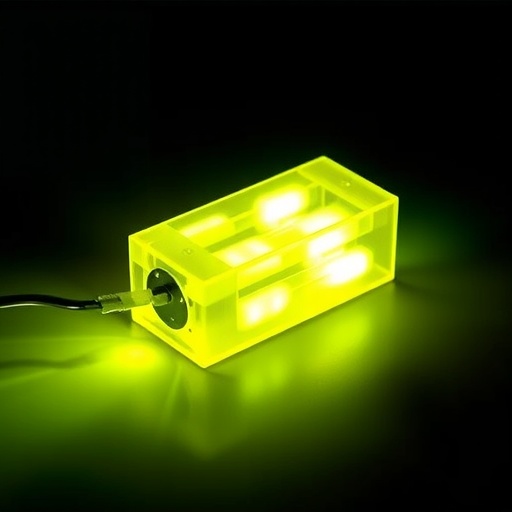
In a groundbreaking advance that could redefine how we engineer next-generation light-emitting devices, researchers at Osaka Metropolitan University have harnessed the power of quantum magnetic resonance to decode the elusive behavior of electron-hole pairs within light-emitting electrochemical cells (LECs). These fleeting intermediates play a pivotal role in determining the efficiency and brightness of devices that promise cost-effective and flexible lighting solutions, yet have long evaded direct observation due to their instability and the complex internal environments they inhabit.
Light-emitting electrochemical cells stand out from conventional organic LEDs by featuring an elegantly simple composition: a single active layer composed of an organic semiconductor intermixed with mobile ions, bordered by two electrodes. This minimalistic architecture not only lowers manufacturing costs but also opens new avenues for flexible and lightweight optoelectronics. Despite this structural simplicity, the processes governing their light emission are profoundly intricate, dictated by subtle interplays between charged particles and shifting internal fields.
Applying an external voltage initiates a cascade of events inside an LEC. Mobile ions facilitate the injection of electrons (negatively charged) and holes (positive charge carriers created by electron vacancies) from opposite electrodes into the active layer. Once inside, electrons and holes may form transient electron-hole pairs—excitons—whose subsequent recombination is the fundamental mechanism behind light emission. Yet, the efficiency of this recombination, and thus the brightness of the device, is intimately tied to how these pairs behave under the influence of internal electric fields and ionic motion, factors that have remained largely speculative due to observational constraints.
Conventional optical techniques, while adept at tracking individual charge carriers, struggle to detect the short-lived electron-hole pairs forming right before photon emission. Adding to this challenge is the presence of mobile ions, which continuously migrate within the active layer, dynamically altering the internal electric field landscape. These ions partially shield and redistribute charges, giving rise to a fluctuating, spatially complex environment that further complicates direct measurements of recombination dynamics.
To break this investigative impasse, the Osaka Metropolitan University team employed electroluminescence-detected magnetic resonance (ELDMR), an innovative quantum-sensing approach that sensitively links magnetic resonance signatures to changes in emitted light intensity. By probing the spin states of the electron-hole pairs—whose magnetic resonance is exquisitely sensitive to local electric fields—this operando technique provides selective, real-time insights into these ephemeral intermediates during actual device operation, thus offering a valuable window into microscopic recombination phenomena.
The researchers achieved a seminal milestone by obtaining highly sensitive ELDMR signals from a polymer-based LEC under working conditions, a feat never accomplished before in such devices. Spectroscopic analysis confirmed that the detected signals emanated from electron spin resonance associated with electron-hole pairs, substantiating that this quantum measurement method could directly capture the key actors in light emission dynamics.
When subjected to a voltage sweep—progressively increasing and then decreasing the applied voltage—the ELDMR response exhibited pronounced hysteresis, meaning that the magnetic resonance signals depended strongly on the direction of the voltage change. This observation revealed that the internal electric field distribution within the device is not static but evolves dynamically as the mobile ions rearrange themselves in response to the applied bias.
Delving deeper into this phenomenon, the team discovered that during the reverse voltage sweep—when the applied voltage is lowered after peaking—the internal electric field diminishes. Under these reduced field conditions, electron-hole pairs are less prone to dissociation and more likely to undergo recombination, thereby enhancing the electroluminescence efficiency. This behavior also amplifies the magneto-electroluminescence effect, highlighting a direct correlation between electric field modulation and light emission intensity.
This key finding overturns the simplistic notion that stronger electric fields invariably increase recombination; rather, an optimally stable and lowered internal electric field enhances the probability of electron-hole recombination, leading to brighter and more efficient light emission. These insights carry profound implications for the design and engineering of organic optoelectronics, suggesting that effective management of internal electric fields—particularly considering the ionic environment—is critical to optimizing device performance.
Though this study focused specifically on LECs, the fundamental mechanism of electron-hole pair recombination under modulated electric fields is shared across a broad spectrum of organic electroluminescent devices, including organic LEDs. Hence, the advances realized here open pathways for transformative improvements in device architectures beyond LECs, potentially impacting display technologies, lighting, and photonic applications worldwide.
Beyond unveiling novel physical insights, this research solidifies ELDMR as a powerful and sensitive methodology to probe the quantum spin dynamics of charge carriers inside operating devices. Extracting detailed information directly from the spin states linked to emitted light, ELDMR enables researchers to visualize the microscopic processes governing device efficiency—information that was previously inaccessible with conventional characterization tools.
Osaka Metropolitan University’s pioneering application of ELDMR not only advances fundamental understanding but also exemplifies the burgeoning role of quantum measurement techniques in practical device physics. As we edge closer to commercializing highly efficient, flexible, and low-cost organic optoelectronic devices, such quantum-sensing tools will be indispensable in guiding material selection and device engineering to overcome long-standing efficiency bottlenecks.
Looking forward, the research team envisions that their findings will inspire a new wave of investigations into electric field effects and charge recombination in organic materials, leveraging ELDMR and related quantum protocols. This synergy between quantum science and materials engineering heralds a future in which light-emitting technologies become more efficient, durable, and versatile—benefiting applications from wearable displays to sustainable lighting solutions.
This transformative study was published in Advanced Optical Materials on December 16, 2025, and marks a milestone in the quest to illuminate the microscopic physics underlying some of the most promising organic light-emitting devices.
Subject of Research: Not applicable
Article Title: Unveiling How Electric Fields Influence Electroluminescent Properties in Light-Emitting Electrochemical Cells via Operando Optically Detected Magnetic Resonance
News Publication Date: 16-Dec-2025
Web References: http://dx.doi.org/10.1002/adom.202502592
Image Credits: Osaka Metropolitan University
Keywords
Light-emitting electrochemical cells, electron-hole pairs, electroluminescence, quantum magnetic resonance, electroluminescence-detected magnetic resonance (ELDMR), organic optoelectronics, electron spin resonance, internal electric field, charge recombination, organic LEDs, quantum sensing, device efficiency
Tags: cost-effective flexible lighting technologyelectrode charge injection mechanismselectron-hole pairs in electrochemical cellselectron-hole recombination dynamicsflexible organic semiconductor lightinginternal electric fields in LECslight-emitting electrochemical cells efficiencymobile ions in optoelectronicsnext-generation light-emitting device engineeringorganic semiconductor active layersquantum magnetic resonance in light-emitting devicestransient excitons in LECs